
A crypto flash loan enables borrowers to access substantial capital without any upfront collateral, challenging traditional lending conventions. Flash loans are a type of uncollateralised loan in the decentralised finance (DeFi) ecosystem, in which assets are borrowed and returned within the same block chain transaction. This innovation, popularised by Aave around 2020, transformed DeFi lending; individual flash loan transactions have reached hundreds of millions of dollars. Whilst crypto flash loans create unique opportunities for arbitrage, liquidations, and collateral swaps, they also introduce vulnerabilities, particularly through attack vectors. Understanding how to get a crypto flash loan, its technical mechanics, and associated risks is essential for anyone navigating the DeFi landscape.
What Flash Loans Are and Why They Matter in DeFi
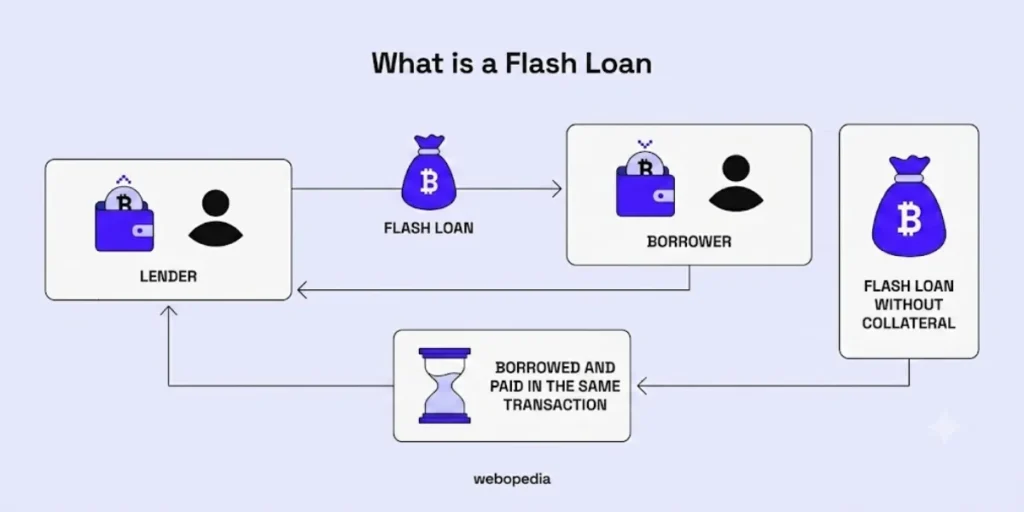
Defining Uncollateralized Borrowing in Blockchain
Flash loans are a sort of uncollateralized loan with zero default risk that is unique to blockchain ecosystems. Since their inception in 2018, the technology has facilitated over $3.06 trillion in lending activity in 2024 on Ethereum-Virtual-Machine-compatible blockchains. These loans allow users to borrow large amounts of capital instantly without posting collateral, provided the borrowed funds are returned within the same blockchain transaction. The atomic structure ensures that lenders face virtually no default risk because either the full repayment occurs instantly or the transaction never settles.
Single-Transaction Loan Mechanism
The lifecycle of a flash loan occurs within a single blockchain transaction. A borrower initiates a transaction by calling a flash loan function on a DeFi protocol, which temporarily transfers funds from its liquidity pool to the borrower’s contract. The borrower executes arbitrary on-chain logic using those funds. Before the transaction ends, the borrower must return the original principal plus a protocol fee; for example, Aave historically used approximately 0.09% in some deployments.
If repayment conditions are not satisfied, the blockchain reverts the entire transaction state, meaning balances return to their original values as though the loan never occurred. Transaction atomicity ensures that if the loan is not repaid within the transaction, the full transaction reverts and has no impact on the state of the blockchain. A transaction block might only last around 12 seconds on the Ethereum blockchain.
Smart Contract-Based Lending Without Credit Checks
Smart contracts automatically act as both the guarantor and the executor of the agreement. The protocol is completely indifferent to who the borrower is or what their reputation is, as the algorithm simply will not let the transaction finish until the debt is settled. The main advantage is the lack of collateral requirements, credit checks, or KYC. If the transaction reverts, the typical direct loss is gas fees.
Flash Loans vs Traditional Collateralised Loans
Traditional loans involve identity checks, underwriting, collateral requirements, and repayment schedules designed for long-term financing. By comparison, flash loans concentrate capital within a single computational event rather than distributing it across time. Key differences include:
- Collateral: Traditional loans require deposits to show repayment means; flash loans require none
- Timeline: Traditional loans span months or years; flash loans execute within seconds
- Risk: Traditional lenders face counterparty risk; flash loan lenders face virtually zero default risk due to atomic execution
- Purpose: Traditional loans fund consumption; flash loans execute complex onchain operations within single transactions
How Flash Loans Work: Technical Mechanics

Borrowing from On-Chain Liquidity Pools
Flash loan transactions begin when a user or smart contract calls a flash loan function on a DeFi protocol. The protocol temporarily transfers funds from its liquidity pool to the borrower’s contract, allowing the borrower to execute arbitrary on-chain logic using those funds. Platforms like Aave, dYdX, and Venus maintain liquidity pools that serve as the capital source for these loans. The borrower contract communicates directly with the pool contract and requests a certain quantity of reserve assets. Following this initial call, the pool performs sanity checks before transferring the requested amounts.
Atomic Transaction Execution and Automatic Reversal
The execution proceeds in a predetermined order: the protocol transfers the requested cash to the borrower’s contract, the borrower performs a series of onchain activities such as trades, swaps, or liquidations, and then returns the original amount plus fees to the lending pool. All operations occur within a single block confirmation cycle, eliminating settlement risk over time. If repayment conditions are not satisfied at any step, the blockchain reverts the entire transaction state, returning balances to their original values. This atomic execution model relies on virtual machines like the EVM, which allow operations to be executed atomically—either all actions are performed at once, or nothing happens at all.
Fee Structure and Repayment Requirements
Aave’s flash loan fee is initialised at deployment to 0.05% and can be updated via governance vote. Venus Protocol employs a similar structure where fees can be distributed between liquidity providers and the protocol treasury. Borrowers must approve the pool for the flash-loaned amount plus the fee, ensuring the protocol can pull those funds to complete repayment.
Smart Contract Development for Flash Loan Access
Accessing crypto flash loans requires technical expertise. Users must create or deploy a smart contract that automatically executes the entire operation. Most EVM-compatible protocols follow the EIP-3156 standard for flash loan functionality. The receiver contract must conform to specific interfaces by implementing the executeOperation() function, which contains the custom logic executed during the loan period.
Practical Applications of Crypto Flash Loans
Arbitrage Trading Across Decentralised Exchanges
Arbitrage represents the most common application of flash loans. Traders borrow substantial capital to exploit price discrepancies between markets without personal capital requirements. For instance, if DAI/USDC trades at 1:1 on Uniswap but 1 USDC costs 0.99 DAI on Curve Finance, a trader borrowing 10,000 DAI can trade for 10,101 USDC on Curve, swap back to DAI on Uniswap, repay the loan, and retain 101 DAI profit. Automated bots execute these opportunities in milliseconds, contributing to market efficiency across decentralized exchanges.
Liquidation of Undercollateralized Positions
Flash loans enable liquidation bots to operate without maintaining large capital reserves. Bots borrow assets, liquidate undercollateralized positions, seize collateral, sell it to repay the loan, and collect liquidation bonuses. This democratises liquidation participation and increases competition among liquidators.
Collateral Swapping Without Closing Loans
Borrowers can automatically change collateral types without closing existing debt positions. A user with ETH collateral can flash borrow USDC to repay their debt, withdraw ETH, sell it for USDC, deposit USDC as new collateral, and repay the flash loan in one transaction.
Self-Liquidation to Avoid Penalty Fees
DeFi liquidation penalties range between 3% and 15% depending on the platform. Users facing liquidation can flash borrow to repay debt, withdraw collateral, repay the flash loan with some collateral, and avoid external liquidation penalties whilst paying flash loan fees under 1%.
Transferring Debt Between DeFi Protocols
Flash loans facilitate debt refinancing across protocols with better terms. Users borrow funds, repay existing debt in one protocol, move assets to another with lower rates, and repay the flash loan atomically.
Understanding Crypto Flash Loan Attack Vectors and Risk Mitigation

Price Oracle Manipulation Exploits
Attackers exploit price oracles by feeding false data to smart contracts, triggering malicious actions like over-collateralised loans or forced liquidations. The attack typically targets protocols relying on single, low-liquidity decentralised exchanges or vulnerable time-weighted average price oracles. Using flash loans, attackers perform massive buy orders to inflate token prices on specific exchanges artificially. The victim’s smart contract queries the oracle, receives the inflated price, and the attacker obtains substantial loans against overvalued collateral before repaying the flash loan. Over 31% of early 2025 DeFi losses originated from oracle-based attacks, with flash loan oracle exploits totalling over AUD 616.18 million historically.
Decentralised Oracle Solutions for Attack Prevention
Decentralised Oracle networks query information from multiple sources to avoid single points of failure. Chainlink’s decentralised oracle network validates data using hundreds of exchanges, data providers, and nodes. Time-weighted average price mechanism query asset prices at two different points, calculating spot prices based on averages. Choosing longer time periods protects protocols against manipulation since large orders executed recently cannot impact asset prices.
Smart Contract Auditing Best Practises
Reentrancy guards prevent unexpected contract calls. Access control mechanisms like OpenZeppelin’s Ownable limit critical functions. Third-party auditing firms conduct comprehensive testing to identify vulnerabilities. Formal verification tests smart contracts using mathematical methods to ensure correctness. Circuit breakers pause contracts under unusual conditions to limit damage.
Market Liquidity Risks and Slippage Concerns
Small liquidity pools face sharp price slippage when large loans cause significant price movements, rendering operations unprofitable. Transaction reversal occurs upon failure, but gas fees remain unrefunded. Protocols should monitor pools for unusual activity and maintain reserve thresholds to protect against complete depletion.
Conclusion – Crypto Flash Loan
Flash loans represent a groundbreaking innovation in decentralised finance, enabling instant, uncollateralized borrowing through atomic transaction execution. These loans democratise access to substantial capital for arbitrage, liquidations, and collateral management without credit checks or upfront deposits. However, the same mechanism that creates opportunity also introduces vulnerabilities, specifically through Oracle manipulation attacks. As a result, robust security measures—including decentralised oracles, comprehensive auditing, and circuit breakers—remain essential for protecting protocols whilst advancing DeFi’s evolution.
What exactly is a flash loan in DeFi?
A flash loan is an uncollateralised loan in decentralised finance where you borrow assets and return them within the same blockchain transaction. The entire process happens within seconds, and if you cannot repay the loan plus fees before the transaction ends, the blockchain automatically reverses everything as though the loan never occurred.
Can you actually lose money with flash loans?
Whilst the crypto flash loan itself carries no default risk due to automatic reversal if unpaid, you will lose the gas fees for the transaction whether it succeeds or fails. These fees can be substantial depending on network congestion and the complexity of your smart contract operations, so failed attempts still cost money.
Do flash loans require collateral or credit checks?
No, flash loans require absolutely no collateral, credit checks, or KYC verification. The smart contract algorithm ensures repayment through atomic execution—either the entire transaction succeeds with full repayment, or it fails and reverses completely, eliminating the need for traditional lending requirements.
Are flash loans still profitable to use?
Flash loans can be profitable for those with technical expertise in smart contract development and arbitrage strategies. However, competition is fierce, with sophisticated bots executing opportunities in milliseconds. Most profitable opportunities are captured by institutional-level participants with advanced software, making it challenging for casual users to succeed.
What are the main risks associated with flash loans?
The primary risks include Oracle manipulation attacks, where malicious actors exploit price feed vulnerabilities to drain protocol funds. Additionally, smart contract bugs can be exploited, and market liquidity issues may cause slippage that renders operations unprofitable. Robust security measures like decentralised oracles and comprehensive auditing are essential for protocol protection.