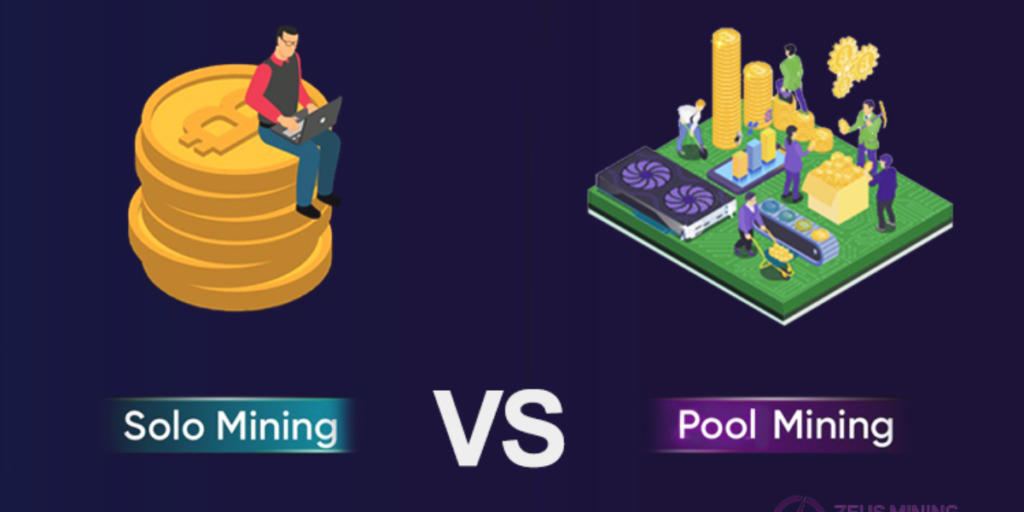
When miners consider pool vs solo mining, profitability is undoubtedly the deciding factor. Solo mining offers full block rewards but comes with high risk and extremely low odds of success. On the contrary, pool mining provides consistent, smaller payouts and is generally a safer option. Without massive hashrate, finding a block through solo mining can take months or years, whilst pool mining delivers regular and predictable rewards. This guide examines the profitability factors, costs and revenue potential of solo mining vs pool mining to help miners determine which method maximises profit in 2026.
Understanding Solo Mining Vs Pool Mining
What Is Pool Mining?

Pool mining combines the computational power of multiple miners who work together to solve cryptographic puzzles and validate blockchain transactions. A central server coordinates the work of miners and communicates with the Bitcoin network, providing each participant with block templates containing transaction information needed to create candidate blocks.
Specifically, the pool operator assigns shares to each participant. A share represents a hash of the candidate block that satisfies a higher difficulty target than Bitcoin’s actual difficulty target. The pool adjusts share difficulty according to each miner’s hashrate, ensuring all miners submit shares at regular intervals regardless of their computational power. This mechanism allows the pool to measure each miner’s contribution accurately.
When any participant in the pool finds a valid block, the pool broadcasts it to the network and receives the block reward plus transaction fees. The pool then distributes these rewards among participants based on the amount of work each contributed. As of Q1 2026, the total hashrate of the Bitcoin network sits around 600 EH/s, with major pools like Foundry USA controlling 29% and AntPool holding 25% of mined blocks.
Pool mining provides several distinct characteristics. Miners receive small, predictable daily payouts proportional to their hashrate contribution. This approach dramatically reduces variance, allowing miners to smooth their earnings and maintain steady income streams against regular operational expenses. Even miners with less powerful hardware can participate and earn rewards. However, pools typically charge fees ranging from 1-3% of earnings.
What Is Solo Mining?
Solo mining refers to the process where one miner works independently to solve blocks without joining forces with others. The miner connects their hardware directly to a full node of the blockchain network, such as Bitcoin Core. This requires downloading and maintaining the entire blockchain, with the node validating all transactions and blocks independently.
In solo mining, the miner’s hardware iterates through every possible value for the block header nonce, generating corresponding hashes. If the miner’s hardware finds a hash below the target threshold, the complete block gets broadcast to the network for addition to the blockchain. At a network hashrate of approximately 800 EH/s in Q1 2026, a single Antminer S21 XP (270 TH/s) has a solo block probability of roughly 1 in 2,963,000 per block, statistically translating to finding a block once every 17,000 years.
Solo miners maintain full control over their mining activities, including decisions about which cryptocurrency to mine, when to operate, and how much computing power to allocate. No fees get deducted from earnings, as there is no pool operator to compensate. In fact, solo mining supports network decentralisation by running full nodes, enhancing the security features of the cryptocurrency network.
How Mining Rewards Work in Both Methods
The fundamental difference between pool vs solo mining lies in reward distribution. Solo miners receive the entire block reward of 3.125 BTC plus all transaction fees when they successfully find a block. No splits occur, and no deductions apply. However, solo mining delivers zero income most of the time, then a massive windfall if a block gets found.
Pool mining distributes rewards through several payout models:
- Pay-Per-Share (PPS): Miners receive a fixed amount for each valid share submitted, regardless of whether the pool finds a block. This model provides steady, predictable income but typically carries higher fees of 2-4%.
- Full Pay-Per-Share (FPPS): Similar to PPS but includes transaction fees on top of the block subsidy. FPPS became the most common model in 2026.
- Pay-Per-Last-N-Shares (PPLNS): Rewards get calculated based on shares submitted before a block gets found. This method rewards consistent miners but offers less predictable short-term payouts.
As a result, pool mining provides frequent, smaller payouts whilst solo mining offers rare, substantial rewards.
Profitability Factors: Pool vs Solo Mining in 2026

Multiple interconnected variables determine whether pool vs solo mining delivers superior returns in 2026. Network conditions have evolved substantially since the 2024 halving, creating a profitability landscape where efficiency and cost management outweigh raw computational power.
Mining Difficulty and Network Hash Rate
Bitcoin’s mining difficulty reached approximately 127.17 trillion in mid-2026 following a 5% downward adjustment in July. This adjustment occurred after network hashrate stabilised near 940 EH/s, though estimates vary with some sources reporting ranges between 800-1,000 EH/s. The difficulty recalibration happens every 2,016 blocks to maintain the 10-minute average block time. Consequently, as more miners deploy hardware or existing operators upgrade equipment, difficulty rises proportionally, shrinking each individual miner’s expected reward share.
For solo mining vs pool mining comparisons, this dynamic creates vastly different practical outcomes. A solo miner with 140 TH/s on a network of 1,050 EH/s controls just 0.0000133% of total hashrate, translating to an expected block discovery time of roughly 143 years. Pool mining, on the other hand, aggregates hashrate across thousands of participants, allowing even modest contributors to receive proportional daily payouts regardless of network difficulty fluctuations.
Related Article: Bitcoin Mining in 2025: The Surprising Shift Nobody Sees Coming
Block Rewards and Transaction Fees
The current block subsidy stands at 3.125 BTC following the April 2024 halving. Transaction fees have grown in significance, now accounting for approximately 15% of total miner revenue in 2026. During network congestion peaks, fees occasionally represent 20-40% of block value, with some blocks during high-activity periods containing fees exceeding 0.8 BTC above the base subsidy. This shift matters considerably for pool selection. Full Pay-Per-Share (FPPS) models distribute both block subsidy and estimated transaction fees to miners, whilst basic Pay-Per-Share (PPS) may exclude fee revenue. Solo miners capture 100% of both components when successful, but the probability remains extraordinarily low.
Hardware Efficiency Requirements
Current-generation air-cooled ASICs achieve 15-18 J/TH efficiency, whilst hydro-cooled flagship models reach 11-14 J/TH. Hardware below 20 J/TH maintains competitiveness, but older models above 30 J/TH only remain viable at exceptionally low electricity rates. The efficiency threshold determines breakeven electricity costs, which shifted dramatically after the halving reduced the block reward from 6.25 BTC to 3.125 BTC. Efficient operations that previously achieved 12-18 month payback periods saw those timelines extend significantly unless offset by rising Bitcoin prices or falling energy costs.
Electricity Costs and Location
Electricity constitutes 60-80% of total mining expenses. A miner operating an Antminer S21 Pro at £0.08/kWh generates approximately £172.78 monthly profit, whilst the same setup at £0.23/kWh produces a £214.06 monthly loss. European residential rates averaging €0.20-0.28/kWh create thin margins, whilst Canadian provinces like Quebec offer industrial rates as low as 2.9-4.0 cents USD, providing substantial competitive advantages. Geographic arbitrage has become essential for profitability in both pool vs solo mining scenarios.
Pool Fees vs No Fees
Mining pools typically charge 1-3% fees. FPPS structures commonly assess 2.5% fees, whilst PPLNS models range from 0-2%. Solo miners avoid these deductions entirely, retaining 100% of block rewards and transaction fees. Notwithstanding this advantage, the fee elimination provides no practical benefit when block discovery occurs once every several decades for small-scale operations. The 1-2% pool fee effectively purchases income stability and cash flow predictability.
Payout Frequency and Consistency
Pool mining delivers daily or near-daily payouts with low minimum thresholds, often as little as 0.001 BTC. This regular income stream allows miners to manage electricity bills, plan reinvestment, and adjust operations based on market conditions. Solo mining produces zero income for extended periods followed by substantial windfalls. At any rate, the variance becomes unmanageable for operations requiring consistent cash flow to cover fixed monthly expenses.
Cost Analysis: Initial Investment and Operating Expenses
Hardware investment requirements differ substantially between solo mining vs pool mining, though the equipment itself remains identical. The choice of mining method influences scale and infrastructure needs rather than hardware specifications.
Hardware Costs for Solo Mining
Solo miners pursuing meaningful block discovery probability require significant hashrate concentration. The Bitmain Antminer S23 Hyd 3U delivers 1.16 PH/s at 11,020W with pricing starting around AUD 11,773.22, whilst the Bitdeer SealMiner A4 Ultra Hydro produces 886 TH/s at 8,372W. Mid-range air-cooled models like the Antminer S21 XP series range from 270-473 TH/s, with prices spanning AUD 12,231.92 to AUD 22,934.85. These industrial-grade units generate 75-90 dB noise levels and require dedicated ventilation infrastructure.
Hobbyist solo miners occasionally deploy mini miners like the Bitaxe Gamma 601 (£199.99) or NerdQaxe++ Rev5 (£485.62 including import duty). However, ancillary components including power supplies, cooling systems, and heatsinks add £282.47 to total setup costs. One documented home setup invested £1,157.41 in hardware before upgrades.
Hardware Costs for Pool Mining
Pool mining accepts any hashrate contribution, making entry accessible at multiple price points. A single Bitmain Antminer S19 95T costs approximately AUD 9,930.79, delivering 95 TH/s at 3,250W. Smaller operations frequently deploy mid-tier machines like the Canaan Avalon Q (90 TH/s, 3,010W) for European home mining. The hardware remains functionally identical to solo mining equipment, but pool participants avoid the pressure to deploy multiple units simultaneously.
Monthly Electricity Bills Comparison
A documented UK home mining operation running 123W total draw (including Bitaxe, NerdQaxe, and supporting infrastructure) incurs £18.90 monthly at 21.04p/kWh. In contrast, a 3,500W industrial miner costs roughly €2,100 annually at €0.25/kWh, translating to €175 monthly. Australian residential rates averaging AUD 0.25/kWh result in AUD 433 monthly for a 3,010W Avalon Q unit.
Maintenance and Downtime Costs
Mining equipment maintenance represents 30-50% of overall operating costs in industrial contexts. Unscheduled downtime creates hidden expenses through lost revenue during offline periods. Home operations face thermal management challenges, with enthusiasts spending £280 on cooling improvements for £200 devices. Equipment operates continuously under high thermal loads, with typical operational lifetimes of three to five years before failure rates increase substantially.
Which Mining Method Makes More Profit?

The choice between pool vs solo mining hinges on operational scale, financial capacity, and strategic objectives rather than hardware specifications alone.
When Solo Mining Is More Profitable
Solo mining only makes economic sense at 9.5 EH/s or more of dedicated hashrate, equal to approximately 35,000 Antminer S21 XP-class miners. Below this threshold, operators face negative expectancy despite zero pool fees. A few profiles justify solo mining: industrial operators with multi-exahash deployments, ideological miners prioritising sovereignty as the primary return, and hybrid miners allocating 5-10% of fleet hashrate for jackpot exposure.
When Pool Mining Is More Profitable
Pool mining delivers superior returns for 99.9% of operators. Any hashrate level functions profitably in pools, from single hosted ASICs to 100 MW fleets. Miners requiring predictable cash flow to cover monthly electricity bills find pool mining non-negotiable. Operations below industrial scale never achieve meaningful solo block probability, making the 1-3% pool fee a worthwhile expense for income stability.
Hybrid Approach: Combining Both Methods
Miners with sufficient fleet size split hashrate between methods. A common configuration directs 90% to reliable pools whilst dedicating 10% to solo mining. This structure provides regular income covering operational costs plus lottery-ticket exposure to full block rewards. The hybrid approach works best for operators where 5-10% of hashrate still represents meaningful capital.
Conclusion – Pool vs Solo Mining
Pool mining delivers superior profitability for virtually all operators in 2026. Solo mining only makes financial sense at 9.5 EH/s or greater, a threshold beyond reach for most miners. Consequently, the 1-3% pool fee becomes a worthwhile investment for consistent daily payouts and manageable cash flow.
Electricity costs below £0.10/kWh and efficient hardware remain essential regardless of method choice. Operators with substantial fleet capacity might consider a hybrid approach, allocating 90% to pools whilst dedicating 10% to solo mining for potential windfalls. For the vast majority of miners, pool mining represents the only viable path to profitability. Solo mining remains a lottery ticket rather than a business strategy.
You May Also Be Interested In: Bitcoin Halving Explained: What It Is and Why It Matters
Is pool mining more profitable than solo mining?
Pool mining is more profitable for virtually all miners in 2026. It provides consistent daily payouts and predictable income, whereas solo mining only makes financial sense for operations with 9.5 EH/s or greater hashrate. For the vast majority of miners, the 1-3% pool fee is worthwhile for stable cash flow and regular returns.
Can you still make a profit from Bitcoin mining in 2026?
Yes, Bitcoin mining remains profitable in 2026, but only under specific conditions. Miners need efficient hardware (below 20 J/TH), electricity costs under £0.10/kWh, and must join mining pools for consistent returns. Operations with expensive electricity above £0.25/kWh typically operate at a loss, whilst those with cheap power and modern equipment can achieve 12-18 month ROI periods.
What are the chances of successfully solo mining a Bitcoin block?
The probability of solo mining a block is extremely low for individual miners. A 270 TH/s miner has roughly 1 in 23,471 odds of finding a block on any given day, which translates to approximately once every 17,000 years at current network difficulty. This makes solo mining impractical for anyone without massive industrial-scale hashrate.
Should I use a hybrid approach combining pool vs solo mining?
A hybrid approach works well for operators with substantial fleet capacity. The typical configuration allocates 90% of hashrate to reliable pools for consistent income whilst dedicating 10% to solo mining for potential full block rewards. This strategy only makes sense when your 10% allocation still represents meaningful capital and hashrate.