
Rebalancing vs Buy and Hold remains one of the most debated topics amongst investors seeking optimal portfolio performance. Surprisingly, research shows that high-frequency rebalancing is worth less than 0.01% per annum versus buy-and-hold over a four-year horizon. Understanding what is buy and hold strategy and how it compares to active rebalancing can save investors both time and money. Whilst portfolio rebalancing vs buy and hold each offers distinct advantages, the choice depends on individual circumstances, market conditions and cost considerations. This guide examines both strategies in depth, helping investors determine which approach suits their financial goals.
What is Buy and Hold Strategy?

Buy and hold strategy represents a passive investment strategy where investors purchase securities and maintain ownership for extended periods, often spanning years or decades, regardless of short-term market fluctuations. This approach stands in direct contrast to active trading, focusing on the principle that time in the market matters more than timing the market.
Core Principles of Buy and Hold Strategy
The foundation of this strategy rests on several key tenets. Investors base their initial purchase decisions on fundamental analysis, evaluating a company’s financial health, competitive advantages and long-term growth prospects rather than short-term price movements. Once invested, they maintain discipline through market cycles, resisting the temptation to panic-sell during downturns or chase performance during speculative bubbles.
Reinvestment of returns forms another critical element. Dividends and interest payments flow back into the portfolio, allowing compound growth to accelerate wealth accumulation over time. More than 30% of the S&P 500’s total gains have come from dividends and their reinvestment. This compounding effect proves particularly powerful when given sufficient time to operate.
The strategy minimises transaction frequency, reducing frictional costs such as brokerage fees and buy-sell spreads. Investors who adopt buy and hold typically favour diversified holdings through low-cost index funds or ETFs, which track broad market benchmarks. Management costs for a low-cost, broadly diversified world ETF amount to less than 0.20% annually, whilst actively managed funds can charge up to 1.8% per year.
How Buy and Hold Works in Practise
Investors select assets based on intrinsic value rather than market timing. Whether purchasing individual stocks, bonds or index-tracking funds, the focus remains on long-term fundamentals. Warren Buffett famously stated that his favourite holding period is forever, whilst Benjamin Graham counselled against attempting to predict future performance or beat the market through stock selection.
The strategy proves accessible to various investor types. Retirement savers regularly contribute to diversified portfolios throughout their careers, ignoring short-term news and relying on long-term average returns. Value investors identify quality companies at fair prices, buying significant stakes with the intention of acting as long-term business owners rather than short-term traders.
Expected Returns Over Time
Historical data supports the buy and hold approach. The S&P 500 has posted positive annual returns in nearly eight of every 10 years over the past 35 years. The index’s inflation-adjusted annual average return sits at approximately 7%. At this pace, £100,000 invested in 1995 grew to £326,900 after 10 years and exceeded £2.6 million after 30 years ending in December 2025.
Tax efficiency enhances these returns further. Long-term capital gains receive preferential tax treatment in many jurisdictions, with Australian investors receiving a 50% CGT discount on assets held beyond 12 months. Deferring asset sales postpones tax liability, allowing investments to compound tax-free for extended periods.
Related Article: Investing Guide 2026: How Markets Are Shaping the Year Ahead
Understanding Portfolio Rebalancing
Portfolio rebalancing returns an investment portfolio to its target allocation after market movements cause positions to drift from their original weightings. A 60% stock and 40% bond allocation can transform into a 70/30 split during strong equity rallies, fundamentally altering the portfolio’s risk profile. Without intervention, unattended portfolios gradually concentrate in best-performing assets, with some drifting to 75/25 or even 80/20 allocations over multiple years.
What Triggers a Rebalancing Action
Market performance drives asset allocation changes without any investor action. When stocks outperform bonds significantly, equity exposure increases automatically, raising sensitivity to market downturns beyond intended levels. Rebalancing triggers when any asset class drifts beyond predetermined tolerance bands.
The 5/25 rule represents the professional standard: rebalance when any asset class moves more than 5 absolute percentage points from its target, or more than 25% of its target weight, whichever band proves tighter. For a 60% stock target, this triggers outside the 55% to 65% range. Threshold sizes matter considerably. A 5 percentage point band maintains aggressive risk control but increases trading frequency. A 10 percentage point band balances control with efficiency. A 20 percentage point band minimises turnover but permits significant risk drift.
Annual vs Quarterly vs Threshold-Based Rebalancing
Calendar rebalancing operates on fixed schedules regardless of actual drift. Experts advise assessing portfolios quarterly or yearly, with weekly rebalancing proving overly expensive in taxable gains and transaction costs, whilst waiting beyond a year allows excessive portfolio drift. Monthly rebalancing on a £1.17 million portfolio costs roughly £585 to £765 annually in trading fees plus capital gains taxes.
Threshold rebalancing responds only when assets breach tolerance bands, requiring ongoing monitoring but avoiding unnecessary trades when portfolios remain close to targets. This approach proves more turnover-efficient than calendar methods.
Hybrid strategies combine both approaches. Quarterly calendar reviews paired with threshold triggers create the industry standard. This method provides discipline whilst reducing unnecessary trades, preventing large drift without constant portfolio surveillance.
Rebalancing Methods: Selling Winners vs Adding Cash
Three distinct execution approaches exist. Trade-based rebalancing sells overweight assets and purchases underweight positions, directly restoring target allocations. Cash-flow rebalancing directs new contributions to underweight assets, closing gaps without triggering taxable sales. This works best for accounts receiving regular contributions. Tax-aware rebalancing prioritises account types to minimise tax consequences, with most investors using combinations of all three methods.
Buy and Hold vs Rebalancing: Performance Analysis
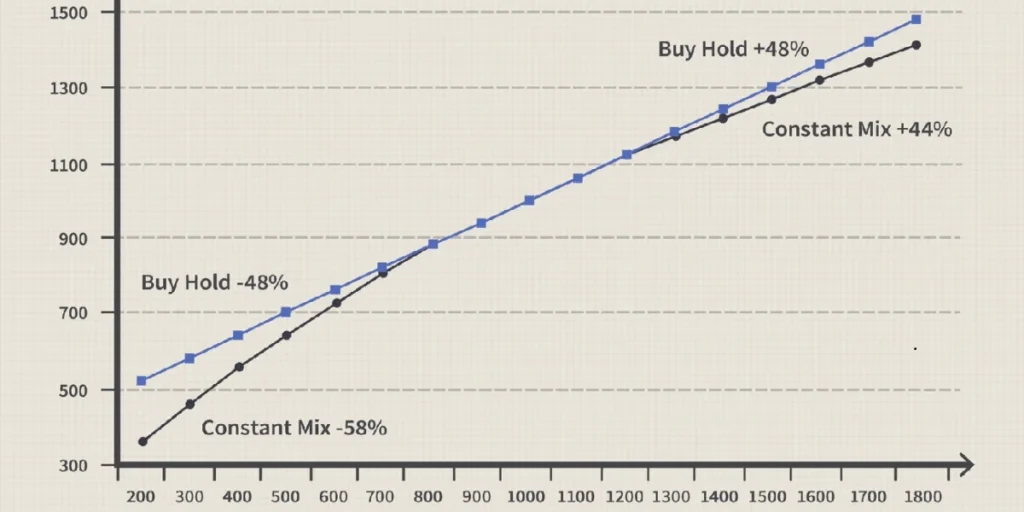
Debate over rebalancing vs buy and hold centres on actual performance outcomes rather than theoretical benefits. Analysis reveals nuanced results that challenge conventional assumptions about which strategy delivers superior returns.
Risk-Adjusted Returns: 1-Year vs 10-Year Horizons
German household portfolios following buy-and-hold earned an annual mean of 6.3%, whilst monthly rebalancing reduced returns by 0.05% and annual rebalancing by 0.15%. These differences, though statistically significant, proved economically negligible for most investors. The mean Sharpe ratio for buy-and-hold reached 0.697, with monthly rebalancing improving this marginally to 0.703. However, all rebalancing strategies undercut buy-and-hold on adjusted Sharpe ratios by 0.009 to 0.019, indicating less favourable return distribution characteristics.
Over trailing 10-year periods through May 2020, buy-and-hold posted the strongest annualised returns due to persistent equity trends. Investors who avoided rebalancing maintained roughly 70% equity exposure during this bull market period. In contrast, over 20-year periods including the 2000 tech correction, buy-and-hold posted the weakest returns after entering that downturn with 79% equity weighting.
Impact of Market Volatility on Both Strategies
During heightened volatility, annual rebalancing proved more efficient than quarterly or monthly approaches due to rising transaction costs. Monthly rebalancing forced investors to buy dips repeatedly during sustained losses, amplifying drawdowns. The financial crisis exposed this weakness: a 60/40 portfolio rebalanced monthly experienced maximum drawdowns 1.2 times worse (5 percentage points) than buy-and-hold.
Annual rebalancing achieved the lowest downside capture ratio of 54.12% and maintained standard deviation 15% lower than buy-and-hold. During oscillating markets, constant-mix rebalancing outperforms buy-and-hold by buying dips and selling rallies, whilst trending markets favour buy-and-hold’s ability to ride momentum.
Historical Performance Data (2016-2026)
Following the COVID-19 correction in February-March 2020, buy-and-hold portfolios suffered 27.8% losses after drifting to 80% equity exposure. Rebalanced portfolios limited losses to 20.67-21.34%, with quarterly and annual strategies performing best.
Which Strategy Performed Better in Bear Markets
Seven bear markets since 1961 revealed minimal recovery time differences. For the December 1961 bear market, non-rebalanced and 50/50 rebalanced portfolios both recovered by January 1963, whilst aggressive 60/40 rebalancing recovered one month earlier. Only severe downturns exceeding 40% showed meaningful improvements from rebalancing, though many investors resist aggressive buying during such conditions.
Practical Costs and Benefits Comparison
Costs separate theoretical strategy benefits from real-world implementation outcomes. Rebalancing incurs expenses that buy and hold strategy largely avoids, creating a financial hurdle that must be justified by improved risk management or returns.
Transaction Costs: Fees and Spreads
Bid-ask spreads persist even when brokers eliminate commission fees. Less liquid assets such as small-cap stocks, international bonds and municipal bonds carry wider spreads. Large trades can trigger market impact costs when orders move prices unfavourably. Frequent rebalancing amplifies these expenses, particularly during market turmoil when spreads widen sharply. Monthly rebalancing of multiple positions accumulates substantial dealing charges, platform trading fees and fund bid-offer spreads. Buy and hold eliminates most transaction costs after initial purchase, giving it a structural cost advantage.
Tax Implications of Selling Winners
Capital gains taxes represent the largest friction in taxable accounts. UK investors face CGT rates of 18% at basic rate or 24% at higher and additional rates on gains exceeding £3,000 annually. Annual rebalancing between 2000 and 2020 generated a £109,590.37 tax bill for certain portfolios, whilst style-neutral strategies reduced this to £35,906.81. Selling appreciated positions crystallises gains immediately, whilst buy and hold defers tax liability indefinitely, allowing tax-free compounding. Tax-loss harvesting can offset gains when rebalancing, purposefully realising losses to minimise immediate tax impact. Prioritising rebalancing within tax-advantaged accounts such as ISAs or SIPPs avoids triggering capital gains entirely.
Time Investment Required for Each Strategy
Buy and hold demands minimal ongoing attention once positions are established. Quarterly or annual portfolio reviews suffice for most investors. Rebalancing requires continuous monitoring to identify threshold breaches, calculate required trades and execute transactions across multiple accounts. Threshold-based approaches particularly demand regular surveillance to catch allocation drifts promptly.
Risk Control and Portfolio Drift Management
Rebalancing prevents unintended risk accumulation. A portfolio designed at 60% equity can drift to 75% or 80% during extended rallies, materially increasing exposure beyond the investor’s risk tolerance. Tax-motivated trades should never supersede core investment strategy or risk profile. The primary objective centres on safeguarding investors from excessive concentration in any single asset class.
Portfolio Rebalancing vs Buy and Hold Strategy: When to Use Each

Choosing between portfolio rebalancing vs buy and hold depends on market conditions, investor circumstances and specific financial objectives. Neither strategy wins universally, making contextual application essential.
Best Scenarios for Buy and Hold Strategy
Buy and hold excels during sustained upward trends when equities climb steadily over extended periods. The 2010s bull market demonstrated this advantage, with buy and hold maintaining higher equity exposure that captured full gains. Investors with decades until retirement benefit most, as extended time horizons smooth volatility and maximise compound growth. This approach suits those preferring minimal portfolio maintenance, spending less time managing positions whilst reducing brokerage fees that erode returns. Tax-conscious investors in taxable accounts also favour buy and hold, as deferring sales postpones capital gains tax indefinitely.
When Rebalancing Adds Real Value
Rebalancing proves superior during choppy, oscillating markets. The Great Depression, 1970s inflation period and 2000-2010 decade all saw buy and hold produce minimal gains, whilst annual rebalancing captured value from volatility. Investment professionals recommend rebalancing every six to 12 months to maintain desired risk levels. Threshold-based approaches work well for investors comfortable monitoring portfolios, triggering action only when allocations breach predetermined bands.
Hybrid Approach: Combining Both Strategies
Combining calendar and threshold methods creates optimal balance. Quarterly reviews paired with 5 percentage point tolerance bands provide discipline without excessive trading. This hybrid strategy delivers rebalancing benefits whilst minimising transaction costs and tax consequences.
Age and Risk Tolerance Considerations
Asset allocation should shift as investors age. A portfolio holding 80% stocks and 20% bonds in one’s twenties might transition to 60/40 approaching retirement, then 30-50% stocks during retirement. Life events triggering capital preservation priorities may require transitioning from buy and hold to active management.
Conclusion – Rebalancing vs Buy and Hold
The rebalancing vs buy and hold debate yields no absolute winner. Surprisingly, performance differences prove economically negligible in most scenarios, with high-frequency rebalancing underperforming buy and hold by less than 0.15% annually. The optimal choice hinges on personal circumstances rather than universal superiority.
Investors seeking minimal maintenance and maximum tax efficiency should favour buy and hold strategy, particularly during sustained bull markets. Conversely, those prioritising strict risk control during volatile periods benefit from annual or threshold-based rebalancing. A hybrid approach combining both strategies often delivers the best balance, maintaining discipline whilst controlling costs. Ultimately, consistency matters more than strategy selection.
Is buy-and-hold still an effective investment strategy?
Yes, buy-and-hold remains effective, particularly during sustained bull markets and for long-term investors. Historical data shows the S&P 500 has posted positive returns in nearly eight of every 10 years over the past 35 years, with an inflation-adjusted annual average return of approximately 7%. The strategy excels for investors with decades until retirement, as extended time horizons smooth volatility and maximise compound growth whilst minimising transaction costs and deferring capital gains tax.
Does rebalancing actually improve portfolio performance?
Rebalancing typically doesn’t significantly improve raw returns compared to buy-and-hold. Research shows high-frequency rebalancing underperforms buy-and-hold by less than 0.15% annually. However, rebalancing excels at risk control, particularly during volatile or oscillating markets. It prevents portfolios from drifting beyond intended risk levels—a 60% equity allocation can drift to 75-80% during rallies—and performs better during choppy market conditions like the 2000-2010 decade.
How often should I rebalance my investment portfolio?
Investment professionals recommend rebalancing every six to 12 months, or when any asset class moves more than 5 percentage points from its target allocation. The industry-standard 5/25 rule suggests rebalancing when positions drift more than 5 absolute percentage points or 25% of their target weight, whichever is tighter. A hybrid approach combining quarterly calendar reviews with threshold triggers provides discipline whilst minimising unnecessary trades and transaction costs.
What are the main costs associated with portfolio rebalancing?
Rebalancing incurs several costs that buy-and-hold largely avoids. Transaction costs include bid-ask spreads, platform trading fees and market impact costs, with monthly rebalancing potentially costing £585-£765 annually on a £1.17 million portfolio. Capital gains tax represents the largest friction in taxable accounts, with UK investors facing CGT rates of 18% at basic rate or 24% at higher rates. Annual rebalancing can generate substantial tax bills, whilst buy-and-hold defers tax liability indefinitely.
Which strategy works better during market downturns?
Rebalancing typically performs better during severe market downturns by limiting losses through controlled equity exposure. During the COVID-19 correction in February-March 2020, buy-and-hold portfolios suffered 27.8% losses after drifting to 80% equity exposure, whilst rebalanced portfolios limited losses to 20.67-21.34%. Annual rebalancing achieved the lowest downside capture ratio of 54.12% and maintained standard deviation 15% lower than buy-and-hold during volatile periods.