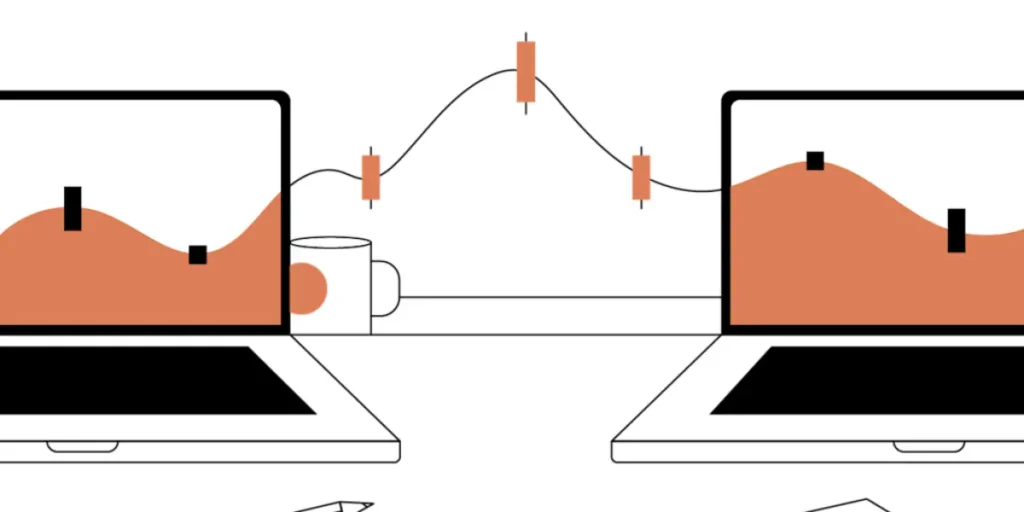
Automated market makers can process trillions in trades without relying on centralised intermediaries. Rather than matching buyers with sellers through order books, these protocols use mathematical formulae and liquidity pools to enable direct, permissionless trading of digital assets on the blockchain.
For beginners wondering what is automated market maker technology, the concept is straightforward: automated market maker AMM platforms provide continuous liquidity and accessibility, making it easier to trade a wide range of cryptocurrencies. Consequently, understanding automated market maker crypto mechanisms has become essential for anyone entering decentralised finance. This step-by-step guide breaks down how AMM automated market maker systems work, walks readers through making their first trade, and covers everything beginners need to know before getting started.
Related Article: Fintech Explained: How Technology Is Reshaping Money, Banking, and Payments
What Is an Automated Market Maker (AMM)?
Automated Market Maker Crypto Basics
An automated market maker is a decentralised exchange protocol that uses algorithmic mechanisms to facilitate trading of digital assets. Rather than relying on order books, AMMs employ self-executing computer programmes called smart contracts that automatically clear transactions between participants. These systems represent a fundamental departure from traditional market making, drawing origins from prediction markets and market scoring rules.
Smart contracts hold reserves of different tokens in what’s known as a liquidity pool. When traders want to exchange one cryptocurrency for another, they interact directly with these pools. The AMM uses mathematical formulae to update prices based on token quantities in the pool, enabling trades to execute at any time without requiring another buyer or seller.
How AMMs Differ from Traditional Exchanges
Traditional exchanges rely on a central limit order book model where buyers and sellers post competing offers. Trades only happen when prices match. In contrast, AMMs skip this matching process entirely. Being that there’s no order book or counterparty needed, AMMs function as peer-to-contract exchanges rather than peer-to-peer platforms.
Traditional exchanges depend on liquidity from their own reserves or individual market makers. AMMs instead source liquidity from multiple users who pool their tokens together. This pooled approach circumvents the high on-chain costs and latency issues that affect decentralised implementations of order book systems.
Key Components of an AMM
AMM designs include several core components. The price discovery component implements logic to determine token prices algorithmically. The parameter component stores values like trading fees, token reserve amounts, and weights. Token settlement components handle the actual exchange of assets.
Liquidity providers deposit tokens to receive LP tokens representing proportionate ownership of a pool. These LP tokens track each provider’s claim on the pool and enable them to withdraw their share of accumulated fees. Smart contracts serve as custodians, holding liquidity reserves whilst executing trades directly against these reserves.
How Do AMMs Work?
Understanding Liquidity Pools
Liquidity pools replace traditional order books with programmable reserves of digital assets. These pools are smart contracts holding balances of two tokens. When someone makes a trade, they interact directly with the pool rather than another person. Users deposit equal values of both tokens to become liquidity providers, earning a share of trading fees in return. The more liquidity in the pool, the easier it is to make large trades with minimal price impact.
The Role of Smart Contracts
Smart contracts are self-executing programmes deployed to public blockchains like Ethereum. These contracts power trading logic without requiring centralised operators. They determine conditions under which market participants provide liquidity and how compensation is distributed. Code governs a liquidity pool, unlike traditional accounts managed by human administrators. The smart contract pulls tokens into the pool and sends back the correct amount based on current pricing.
How Prices Are Determined Automatically
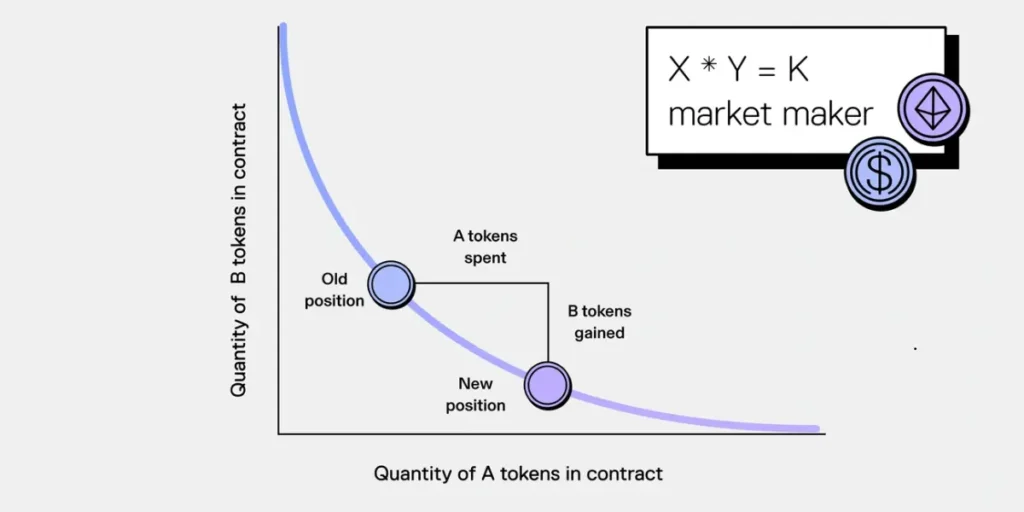
AMMs use algorithmic pricing rules based on token quantities in the pool. Prices adjust automatically as the ratio between tokens changes. If someone buys ETH from a USDC/ETH pool, the supply of ETH decreases and its price increases accordingly. Arbitrageurs monitor pool prices against external markets, executing trades to close price gaps.
The Constant Product Formula: x * y = k
The constant product formula powers AMM pricing: x * y = k. Here, x and y represent quantities of each token in the pool, whilst k is a fixed value that must remain constant after each trade. Every swap shifts the token ratio, changing the price whilst maintaining k.
Step-by-Step: Making Your First AMM Trade
Connecting Your Crypto Wallet
Download a self-custody wallet of your choice. Fund it with the native token of the blockchain (ETH for Ethereum, BNB for BNB Chain) to cover gas fees. Navigate to a DEX such as Uniswap, Curve, or PancakeSwap, ensuring the URL is official. Click ‘Connect Wallet’ on the interface and approve the connection. WalletConnect creates an encrypted link between mobile wallets and web-based platforms by scanning a QR code.
Choosing Your Token Pair
Select the token to sell (input) and the token to receive (output). The DEX displays the estimated output amount, price impact, and fees based on current pool ratios. For example, swapping USDC for ETH shows the real-time market rate calculated by the constant product formula.
Understanding the Quote and Slippage
Most DEXs let users set slippage tolerance between 0.5% and 1% for stable assets, or 1% to 3% for volatile tokens. This maximum acceptable price deviation protects against unfavourable execution. If slippage exceeds the threshold, the transaction fails rather than executing at a worse price. Markets move quickly, and the final execution price can shift from the initial quote, especially when liquidity is thin.
Confirming Your Swap
Review the output amount, price impact, and gas fee before clicking ‘Swap’. Confirm the transaction in the wallet. The smart contract pulls the input token, adds it to the pool, removes the output token, and sends it to the user.
What You Need to Know as a Beginner
Price Slippage and Market Movement
Market volatility causes rapid price swings between order placement and execution. Low liquidity amplifies this effect, particularly with lesser-known altcoins. Traders can set slippage tolerance on DEXs to specify maximum acceptable price deviation, typically 0.1% to 0.5% for stable assets or 1% to 3% for volatile tokens. Transactions exceeding this threshold fail rather than executing unfavourably.
Providing Liquidity to Earn Fees
Liquidity providers earn portions of trading fees but face impermanent loss when token prices diverge from deposit values. Higher APY offerings signal greater risk. Blue-chip pairs like ETH/USDC offer lower returns yet maintain asset stability. Fees may not offset losses during extreme price movements.
Gas Fees and Network Costs
Gas fees compensate validators for processing blockchain transactions, priced in gwei. Costs fluctuate with network congestion. Timing transactions during off-peak hours reduces expenses. Ethereum fees historically ranged from cents to over $30.
Token Research and Due Diligence
Evaluate white papers, team credentials, and market capitalisation before trading. High trading volume indicates liquidity and stability. Watch for pump-and-dump patterns showing exaggerated highs followed by crashes. Verify claims and avoid unrealistic promises.
Conclusion – Automated Market Maker
Right now, you have everything needed to start using automated market makers and trade on decentralised exchanges. The concepts might seem complex at first, yet the mechanics are straightforward once you understand liquidity pools and the constant product formula. Start with small trades on established platforms like Uniswap or PancakeSwap. Monitor slippage, research tokens thoroughly, and watch gas fees closely. Your AMM journey begins with one simple swap.
What exactly is an automated market maker in cryptocurrency?
An automated market maker is a decentralised exchange protocol that uses mathematical algorithms and smart contracts to facilitate cryptocurrency trading. Instead of matching buyers with sellers through traditional order books, AMMs enable traders to swap tokens directly against liquidity pools. These pools contain reserves of different cryptocurrencies, and prices are calculated automatically based on the ratio of tokens in the pool using formulae like the constant product equation (x * y = k).
How do liquidity providers earn money from AMMs?
Liquidity providers earn a portion of the trading fees generated by the pool. When you deposit tokens into a liquidity pool, you receive LP tokens representing your share of ownership. Each time someone makes a trade using that pool, a small fee (typically 0.3% on platforms like Uniswap) is charged and distributed proportionally among all liquidity providers. However, providers should be aware of impermanent loss, which occurs when token prices diverge significantly from their deposit values.
What is slippage and how can I minimise it when trading?
Slippage is the difference between the expected price of a trade and the actual execution price. It occurs due to market volatility and low liquidity, especially with lesser-known tokens. To minimise slippage, you can set a slippage tolerance on DEX platforms (typically 0.5-1% for stable assets or 1-3% for volatile tokens), trade during periods of high liquidity, make smaller trades, and avoid trading during times of extreme market volatility.
Which AMM platforms are best for beginners to start with?
Uniswap is the most established platform with billions in liquidity across Ethereum and supports over 1,500 trading pairs. PancakeSwap offers lower fees and operates on BNB Chain, making it cost-effective for beginners. Curve specialises in stablecoin swaps with minimal slippage, whilst Balancer supports multi-token pools. Start with small trades on these established platforms to familiarise yourself with the process before committing larger amounts.
What are gas fees and how do they affect my AMM trades?
Gas fees are payments made to blockchain validators for processing your transactions, measured in gwei on networks like Ethereum. These fees fluctuate based on network congestion and can range from a few pence to over £30 during peak times. To reduce gas costs, consider timing your transactions during off-peak hours when network activity is lower, or use alternative blockchains with lower fees like BNB Chain or Polygon.