Quantum computing could solve some problems in minutes or hours that conventional machines would need millennia to complete. That possibility is driving an industry estimated to reach USD 1.3 trillion by 2035. This guide answers the essential questions: what is quantum computing, how does quantum computing work, and what can quantum computing do? It explains how qubits use superposition and entanglement, why quantum processors require extreme cooling, and how gates and measurement produce results. It also examines molecular simulation, optimisation, cryptography, error correction and the technology’s noisy state in 2026, showing both its promise and its limits.
What Is Quantum Computing? Bits, Qubits and Their Differences
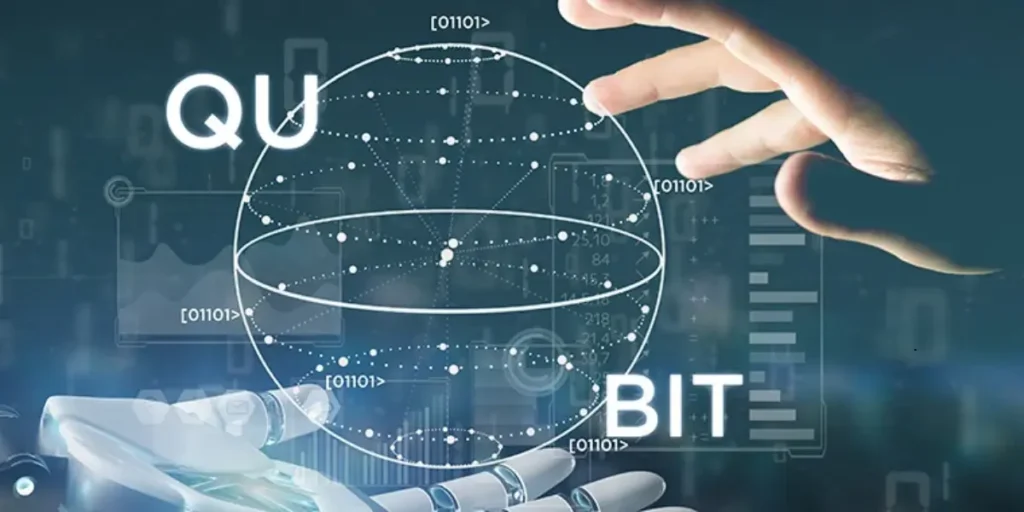
A computer takes information, applies operations to it and produces a result. Quantum computing follows this same broad pattern, but it processes quantum information rather than information represented only by ordinary electrical states. The difference begins with the units used to encode data: classical computers use bits, while quantum computers use quantum bits, or qubits.
How Bits and Qubits Store Information
A classical bit has one of two mutually exclusive values: 0 or 1. Its physical form can be an electrical state, a voltage above or below a threshold, a magnetic direction or another two-state system. For instance, a transistor or capacitor can represent one value when switched on and the other when switched off. The word bit comes from “binary digit”, because classical computation uses base-two numbers.
A system containing (N) classical bits has (2^N) possible arrangements, although it occupies one arrangement at a time. A 64-bit system therefore has approximately (2^{64}), or (10^{19}), possible binary states. Logic operations change these states according to the instructions in a programme, and the computer presents a string of 0s and 1s as its output.
A qubit is also a two-state system, but quantum mechanics permits a wider range of states before measurement. Its basis states are written as (|0\rangle) and (|1\rangle), while a general qubit state is expressed as:
[ |\psi\rangle = \alpha|0\rangle + \beta|1\rangle ]
Here, (\alpha) and (\beta) are complex probability amplitudes, and their squared magnitudes satisfy (|\alpha|^2 + |\beta|^2 = 1). This condition ensures that the total probability of all possible measurement results equals one.
This combination is called superposition. It does not mean that a qubit stores an unlimited amount of ordinary information, nor that measurement reveals every value contained in the state. Instead, the amplitudes determine the likelihood of obtaining 0 or 1 when the qubit is measured. Measurement produces one classical result and changes the quantum state into the corresponding basis state.
With (N) qubits, the quantum state can contain amplitudes for (2^N) basis states. Consequently, quantum operations can shape relationships between many possible computational states before measurement. That capability is useful only when an algorithm arranges the amplitudes so that useful results become more likely.
Why Quantum Computers Will Not Replace Classical Computers
Quantum processors are not faster versions of ordinary processors for every task. A classical machine remains well suited to activities such as adding numbers, running office software, browsing the internet and processing routine data. Individual quantum operations can also be slower and harder to perform than classical operations.
The advantage appears only in particular algorithms and problem types. Some calculations grow so rapidly with system size that classical machines require impractical amounts of time. Quantum methods may reduce the number of operations for selected problems, although the final answer still has to be measured and interpreted as classical data.
A quantum computer therefore needs classical systems for input preparation, control, memory, error handling and output processing. In other words, what is quantum computing is not a replacement for conventional computing, but a specialised processing method that works alongside it. The question of how does quantum computing work begins with qubits, yet its practical value depends on choosing problems for which their quantum properties produce a measurable advantage. That boundary also shapes what quantum computing can do in research and industry.
How Does Quantum Computing Work?

Quantum computation follows a sequence of state preparation, operations and readout. The operator does not inspect every possibility stored in a register. The operator prepares, couples, manipulates and reads qubits in that order. That sequence determines how does quantum computing work in practise, producing a useful output from each run.
Superposition: Combining Quantum States
A single qubit can occupy (|0\rangle), (|1\rangle), or a quantum state formed from both basis states. The coefficients are probability amplitudes, not ordinary probabilities: their magnitudes and relative phases determine what later measurements can show. During computation, an operation changes these amplitudes.
Since alternatives remain coherent, their contributions can combine. This is superposition, and it gives quantum circuits a space of possible states to manipulate before readout. Measurement returns one result, so the circuit must arrange amplitudes rather than merely create many possibilities. The state therefore represents possible outcomes mathematically, not a readable list of every answer.
Entanglement: Linking Qubit States
Entanglement joins qubits into a shared quantum state that cannot be described by treating each qubit independently. A pair may produce random individual outcomes, yet the outcomes remain correlated when measured in the same basis. The correlation belongs to the system as a whole, not to a hidden instruction held separately by each qubit.
If one member is measured, the state assigned to the joint system changes, and the other result follows the established correlation. Distance does not remove this quantum relationship. However, the random result cannot be selected by the operator, so entanglement cannot transmit a message faster than light. In a processor, it supplies relationships between qubits that individual operations cannot represent.
Quantum Gates and Interference: Shaping Outcome Probabilities
Quantum gates are controlled operations that change qubit states without first converting them into classical bits. Electromagnetic signals or lasers can create entanglement and implement operations, depending on the hardware. A gate may alter one qubit, or act on several qubits so that their amplitudes and correlations evolve together. A circuit arranges these gates in a defined order. Addition, multiplication and more complicated computations can be represented by suitable sequences of operations.
The useful effect comes from interference. Amplitudes behave as signed, complex quantities, so paths leading to the same basis state can reinforce one another or cancel one another. A well-designed algorithm increases the probability of desired outcomes and suppresses unhelpful ones. This differs from trying every solution and reading all answers simultaneously. Although many computational states participate in the evolving superposition, final measurement extracts only limited classical information. The algorithm therefore uses gate sequences and interference to make that limited output useful.
Measurement: Turning Quantum States into Classical Results
Measurement converts quantum information into a classical result. Before it occurs, a qubit may have amplitudes for both basis outcomes. In the computational basis, the detector records either 0 or 1, with probabilities set by those amplitudes. The act is not a passive readout: it changes the state and removes the earlier superposition. Repeating an identically prepared circuit produces a distribution of results, rather than guaranteeing the same bit string each time.
A processor may measure all qubits at the end, or measure selected qubits during the calculation. Mid-circuit measurement can guide later operations, while partial measurement can inspect ancillary qubits used to identify errors without measuring every data qubit. The resulting 0s and 1s pass to classical hardware for storage, interpretation and further processing.
What Is Inside a Quantum Computer?
Once the circuit has been designed, performance depends on the system that carries each qubit and the equipment surrounding it. A quantum processor combines a quantum data plane, control and readout hardware, and classical computing resources.
Superconducting Circuits, Trapped Ions and Other Qubit Types
Different platforms encode quantum information in different physical systems. Superconducting circuits use capacitors and Josephson junctions, formed by two superconductors separated by an insulator. At cryogenic temperatures, electrons form Cooper pairs and tunnel across the barrier. Microwave photons control the resulting circuit, allowing it to hold, change and read a qubit. Processor chips using this approach operate near 10 millikelvins in leading systems.
Trapped ions represent another route: ions are held and manipulated in an electromagnetic trap. Other platforms use photons, electrons, atoms or spins. No single design suits every task; platforms make different trade-offs in control, connectivity, measurement and scaling. The physical qubit arrangement therefore determines how a circuit can be assembled and operated.
Cooling, Isolation and Qubit Control
Thermal motion and stray signals disturb fragile quantum states, so the processor sits inside a cryostat. Superconducting chips commonly work around 20 to 100 millikelvins, while ion-trap systems can operate at about 10 kelvins. Pulse-tube coolers reach roughly 4 kelvins, while dilution refrigerators use helium-3 and helium-4 to reach 100 or 10 millikelvins.
The cryostat also uses radiation shields, philtres, thermal anchors and low-conductivity cryogenic cables. These parts remove heat, block noise and limit vibration. Control signals can be extremely weak, at -100 dBm or less, so room-temperature electronics attenuate them before they reach the qubits. Readout signals travel back through amplification and filtering.
For larger machines, cryo-CMOS or other custom circuits can move control and readout closer to the quantum chip. This reduces wiring and latency, but power dissipation remains constrained by the refrigerator.
How Classical Computers Work with Quantum Processors
A classical computer prepares pulse sequences, supplies timing, stores programmes and processes measurement results. The quantum processor performs the selected circuit, while classical electronics translate instructions into microwave pulses, laser controls or other signals, then convert detector output into bits.
This division explains how does quantum computing work in a real installation. A user submits a circuit; control hardware runs it repeatedly; classical software collects the resulting distribution. Mid-circuit measurements can trigger conditional gates through a real-time classical link. In one arrangement, two separate 127-qubit QPUs operated as one through such a connection, although feed-forward introduced latency of about 0.5 microseconds. Cloud access lets researchers use remote systems without owning the full cryogenic installation.
What Can Quantum Computing Do?

Quantum processors become useful when their circuits match a problem’s structure. The strongest candidates are not general office tasks but calculations involving quantum matter, difficult combinatorial choices or specialised mathematical routines. These applications remain problem-specific, and classical systems manage data and verification.
Molecular Simulation for Drug and Materials Research
Molecules are quantum objects, so electron correlation, polarisation and protonation or spin effects can challenge fixed-charge classical models. Quantum simulation encodes molecular Hamiltonians in qubits and estimates energies, spectra or binding properties. Near-term variational methods such as VQE work with classical optimisation and small active spaces; classical pipelines still handle geometry, large-scale search and ranking. This makes quantum computing a targeted evaluator for candidates, materials and catalysts, rather than a replacement for chemistry software.
Quantum Optimisation for Finance, Logistics and Energy
Finance, logistics and energy produce QUBO or Ising models for choices such as portfolios, routes, schedules, facility locations and grid decisions. QAOA alternates cost and mixer operations, while a classical optimiser tunes circuit parameters. Quantum annealing also searches low-energy states, and hybrid workflows repair constraints and refine candidates classically. Such methods can explore rugged search spaces, but hardware limits instance size and does not establish a universal speed advantage. In one benchmark, hybrid supply-chain methods cut operational costs by 12–18% and converged 20–35% faster. This is evidence from synthetic benchmarks, not a universal result.
Quantum Machine Learning: Potential Uses and Open Questions
QML maps data into quantum states, then measures kernels or parameterised circuits for classification, regression, clustering and generative modelling. Potential uses include materials science, energy forecasting, healthcare, bioinformatics, transport and finance. Hybrid variational models encode classical inputs, measure outputs and train parameters through classical feedback. Yet state preparation can dominate runtime, especially when data loading costs scale with input size. Noise, barren plateaus, scalability and weak benchmarking also complicate comparisons. QML therefore remains nascent: claims of advantage depend on the dataset, architecture, training regime and a classical baseline.
Shor’s Algorithm and the Risk to Public-Key Encryption
Shor’s algorithm attacks integer factorisation and discrete logarithms, the mathematical foundations of RSA, ECC and Diffie-Hellman. A sufficiently fault-tolerant quantum computer could therefore decrypt intercepted data, forge signatures and compromise key exchange. Current processors cannot break keys, and no demonstration has established that capability. However, public-key migration takes time, while harvested encrypted data may be stored for later decryption. Post-quantum cryptography replaces vulnerable mathematical assumptions with quantum-resistant schemes.
Where Quantum Computing Stands in 2026
By 2026, quantum computing remains limited by noise: environmental interactions and imperfect gates disturb coherent states, while decoherence destroys information. Superconducting processors may require cooling near 20 millikelvin, and cosmic radiation can trigger decoherence within milliseconds.
Noise and Decoherence in Today’s Quantum Processors
A physical qubit is a hardware element; a logical qubit encodes information across several physical qubits so error correction can detect and repair faults. The threshold theorem supports this approach only when error rates stay below a workable limit. Fault-tolerant quantum computing remains out of reach, and estimates suggest about three million physical qubits to factor a 2,048-bit integer in five months on a fully corrected trapped-ion system.
Physical Qubits, Logical Qubits and Error Correction
Quantum utility means reliable results beyond brute-force classical simulation, not proven practical speed-up. Practical quantum advantage requires beating the available classical alternative on a useful problem.
Quantum Utility Versus Practical Quantum Advantage
Gate fidelity measures operation accuracy; circuit depth counts sequential layers before errors dominate. CLOPS, circuit layer operations per second, combines quantum execution with near-time classical processing. Qubit count alone misleads: one survey recorded 56 commercially available QPUs from 24 manufacturers.
Comparing Gate Fidelity, Circuit Depth and CLOPS
Cloud services let researchers write circuits with Qiskit, test simulators, then submit small jobs to superconducting, trapped-ion or neutral-atom hardware. Repeated shots expose noise and support benchmarking.
Conclusion – Quantum Computing
Quantum computing is basically a specialised approach that works alongside classical computing rather than replacing it. Qubits use superposition, entanglement and interference to shape probabilities, while gates and measurement turn quantum states into useful classical results. The technology depends on demanding hardware, including extreme cooling, precise control and effective error correction. Its strongest possibilities include molecular simulation, optimisation, machine learning and cryptography, yet practical benefits remain problem-specific. Nevertheless, today’s noisy processors provide valuable opportunities for research and experimentation through cloud services. Given these points, quantum computing is neither magic nor a universal solution, but a developing tool whose long-term importance will depend on achieving reliable, measurable quantum advantage.
You May Also Be Interested In: Fintech Explained: How Technology Is Reshaping Money, Banking, and Payments
How is a qubit different from a normal computer bit?
A normal bit holds either 0 or 1. A qubit can exist in a superposition combining both states, but measuring it produces just one result: 0 or 1.
How does a quantum computer produce useful answers?
Quantum gates change qubit states and create relationships between them. Algorithms use interference to make useful outcomes more likely, then measurement converts the results into ordinary bits.
Will quantum computers replace ordinary computers?
No. Quantum computers are specialised tools for certain problems, not faster machines for every task. They rely on classical computers for control, data preparation and interpreting results.
What could quantum computing be used for?
Promising uses include simulating molecules for drug and materials research, exploring complex optimisation problems and testing quantum machine learning. Benefits depend on the problem, and practical speed advantages are not guaranteed.