
In 2023 alone, the ATO flagged over 100,000 crypto investors for non-compliance. With the Australian Taxation Office treating crypto as property rather than currency, accurate reporting has become especially critical. Therefore, automated crypto tax reporting solutions in Australia are becoming essential for investors seeking hassle-free compliance. Manual tracking across exchanges, calculating fair market value, and maintaining records for five years creates unnecessary stress. This guide explores how Australian crypto tax software simplifies crypto tax reporting, ensuring investors meet ATO requirements without the administrative burden.
Related Article: The Ultimate Crypto Tax Guide
Understanding ATO Crypto Tax Requirements in Australia
What the ATO Expects from Crypto Holders
The ATO applies standard tax rules to crypto assets without any special exemptions. For tax purposes, crypto assets are classified as property rather than money or foreign currency. This classification means investors and traders face the same obligations as holders of other investment assets. The tax treatment depends on how individuals acquire, hold, and dispose of their crypto holdings.
Investors who acquire crypto assets to build wealth over time face different tax implications than traders operating in a businesslike manner. Investors treat their holdings as CGT assets, whilst traders account for crypto as trading stock or ordinary income. This distinction affects eligibility for tax discounts and the ability to claim business expenses.
Capital Gains Tax vs Income Tax Classification
Most crypto investors hold their assets as investments, making them subject to capital gains tax. When disposal occurs, investors may realise either a capital gain or a capital loss. Holding crypto for at least 12 months qualifies for the CGT discount, reducing capital gains by 50%. This discount applies only to investors, not to traders.
Capital gains arise when disposal proceeds exceed the cost base. Conversely, capital losses occur when the cost base exceeds the proceeds. These losses can either offset capital gains in the same year or be carried forward indefinitely to future tax years. However, net capital losses cannot reduce other forms of income.
Certain crypto activities generate ordinary income rather than capital gains. Staking rewards, mining proceeds, and airdrops are taxed as assessable income at the time of receipt. The value in Australian dollars at the moment of receipt determines the taxable amount. Traders running crypto businesses also face income tax on all transactions, forfeiting the 50% CGT discount regardless of holding period.
Taxable Events You Must Report
A CGT event occurs when crypto assets are disposed of through various actions. Selling crypto for Australian or foreign currency creates a taxable event. Trading, exchanging, or swapping one crypto asset for another also triggers CGT obligations. Many investors overlook that crypto-to-crypto swaps are taxable disposals.
Gifting crypto to another person constitutes a disposal event. Using crypto to purchase goods or services likewise creates a CGT event. Even donating crypto to deductible gift recipients triggers tax consequences. The ATO monitors these transactions through data-matching programmes with designated service providers.
Record-Keeping Obligations
Investors must maintain detailed records for each crypto asset and every transaction. Required documentation includes receipts for purchases, transfers, and disposals, along with the transaction date. Records must show the transaction purpose and the other party’s details, even if only their crypto address is provided.
Exchange records, digital wallet details, and private keys must be retained. The value of crypto assets in Australian dollars at each transaction point must be documented. Since January 2020, the ATO has used Reserve Bank of Australia exchange rates for conversions. Costs for agents, accountants, legal services, and tax management software also need to be recorded.
These records must be kept for five years from the later of when they were they were prepared, when the the transactions are completed, or when the CGT event occurred. Records should be in English or translatable into English, in either electronic or paper format. Exporting transaction history at least every 3 months helps protect against account access loss. Before closing any exchange account, investors should export their complete transaction history.
Related Article: How to Set Up a Crypto Wallet in 2026: A Step-by-Step Guide for Beginners
Why Manual Crypto Tax Reporting Is Challenging

Manual crypto tax compliance presents substantial obstacles for Australian investors. The decentralised nature of cryptocurrencies, coupled with the multitude of wallets and exchanges available, makes record-keeping a daunting task. Managing 12,000 trades would prove impossible without automated assistance. Another investor noted spending painful days sorting through hundreds of crypto transactions manually.
Tracking Transactions Across Multiple Exchanges
Most investors trade across multiple platforms and with multiple assets of the same kind, making cost basis tracking confusing. Each wallet and exchange logs transactions independently. Without reconciling these records, the combined data may show duplicates or gaps, complicating tax reporting. Transfers between wallets must be treated as transfers rather than disposals to avoid triggering CGT incorrectly.
An accounting method dictates the order in which the cost basis is utilised when disposing of crypto. The ATO permits FIFO (First In, First Out), HIFO (Highest In, First Out), and LIFO (Last In, First Out) methods for investors, whilst traders can only use FIFO. Applying these methods consistently across multiple platforms requires meticulous tracking of acquisition dates and values.
Calculating Fair Market Value in AUD
Capital gains and losses must be calculated using the Australian dollar value of the cryptocurrency at the time of trade. For additional income from crypto, investors need to calculate the fair market value at the point of receipt in AUD. This valuation must occur for each transaction, requiring access to reliable exchange rate data at specific timestamps.
When exchanging one crypto asset for another, investors dispose of one CGT asset and acquire another. Because property is received instead of money, the market value of the crypto asset in Australian dollars must be determined. If the value of received crypto cannot be determined, the market value of the disposed crypto must be used instead. Each method requires accurate AUD conversions at the time of each transaction.
Managing Crypto-to-Crypto Swaps
Trading between different cryptocurrencies constitutes a disposal of one cryptocurrency for another, subject to taxation. One swap creates two records: a disposal of the first crypto and an acquisition of the second. Each disposal generates a possible capital gain or loss calculation, whilst each acquisition establishes a new cost base.
Transaction fees on blockchain networks create additional complexity. Gas fees, typically paid in crypto, are considered disposals with their own capital gain or loss calculations. Consequently, a single transaction can generate multiple taxable events requiring separate valuations and record entries.
Time-Consuming Record Maintenance
Active traders face particular challenges. Each trade is considered a separate CGT event, requiring gains or losses to be recorded and reported. This means tracking every trade’s details, including the cryptocurrency’s value at the time of the trade. Records must capture timestamps, values, and fees for all transactions.
Tax season migraines from crypto were common before automated solutions. The volume of calculations, combined with the need for precision across every transaction, makes manual compliance exceptionally time-intensive for portfolios with regular trading activity.
How Automated Crypto Tax Software Works
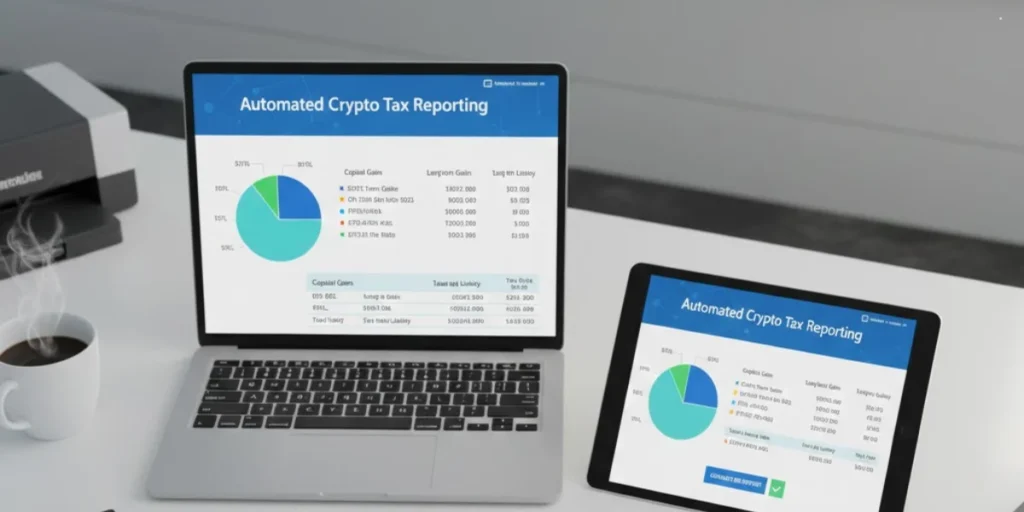
Automated crypto tax reporting solutions in Australia eliminate manual calculation burdens through systematic data integration and processing. These platforms transform scattered transaction data into ATO-ready reports by connecting directly to crypto holdings across multiple sources.
Connecting Your Exchanges and Wallets
Australian crypto tax software establishes connections through two primary methods. API connections enable automatic synchronisation with exchanges, custodians, and wallet providers. Platforms support local exchanges such as Coinspot and Swyftx, as well as 900+ international platforms. For data sources without API capabilities, CSV file uploads provide an alternative connection method.
The connection process requires users to specify where their crypto assets are held. This includes centralised exchanges, custodial services, individual blockchain addresses, and various wallet types. Once connected, the software accesses complete transaction histories across all linked sources, consolidating activity into a unified interface.
Automatic Transaction Import and Categorisation
After establishing connections, the crypto tax Australia software imports every transaction across all sources. Rules engines automatically categorise similar transactions, processing thousands of entries simultaneously. The software distinguishes between trades, transfers, staking rewards, and DeFi swaps without manual intervention.
Advanced categorisation extends to specialised transactions including NFT mints, liquidity pool deposits, and cross-chain bridges. Internal transfers between wallets receive particular attention. The platform detects wallet-to-wallet movements and collapses these entries in real time, preventing double-counting of assets. This ensures only external transactions affecting tax liability appear in final calculations.
Real-Time AUD Valuation Calculations
Historical price engines within Australian crypto tax software instantly determine fair market values in Australian dollars at specific transaction times. When exchange rates are quoted in AUD, the software uses rates from reputable digital currency exchanges or websites. For rates quoted in foreign currency, the platform converts amounts using the same-day foreign exchange rates.
Cost basis calculations occur automatically using selected accounting methods. Software supports FIFO, LIFO, and WAC methodologies. The system tracks gains and losses across all transactions and marks everything at fair market value. Discrepancies between data sources trigger flags for user review before month-end reconciliation.
Generating ATO-Compliant Tax Reports
Once transactions are categorised and valued, automated crypto tax reporting platforms generate comprehensive reports. These reports include all short-term and long-term disposals, capital gains, and income from mining, staking, airdrops, and forks. Independent verification by Big Four Australian accounting firms confirms the accuracy of the FIFO calculation and ATO compliance.
Users download completed reports with a single click after previewing calculated gains and losses. Reports can be filed directly through myGov or shared securely with accountants. The software provides detailed audit trails documenting every transaction, meeting ATO record-keeping requirements whilst streamlining the lodgement process.
Choosing the Right Australian Crypto Tax Software
Selecting appropriate Australian crypto tax software requires evaluation across several critical dimensions. The market offers numerous platforms, each designed for different investor profiles and transaction volumes.
Key Features to Look For
Automation is the primary feature that distinguishes quality platforms. The best tools import trades in bulk from exchanges and wallets, eliminating manual entry. Real-time reporting provides instant updates on tax liabilities throughout the financial year. Equally important, user-friendly interfaces ensure accessibility without requiring accounting expertise. Affordability matters, particularly for individual investors who should not face high tax compliance costs. Flexibility extends value further when calculators handle shares and other assets within the same dashboard.
Integration capability determines software effectiveness. Platforms that support extensive exchange and wallet connections make it easy to import transaction data via API keys or CSV files. The number of supported platforms varies significantly, with some software offering over 3,500 integrations , including exchanges, wallets, and DeFi protocols. Customer service quality is essential during tax season, when confusion even arises for experienced users.
Popular Crypto Tax Australia Software Options
Koinly integrates with over 800 platforms and exchanges, 100+ wallets, and more than 170 blockchains. The platform generates tax reports in as little as 20 minutes. Koinly’s FIFO calculations and tax reports have been independently verified by a Big Four Australian accounting firm. The software handles DeFi transactions, staking, lending, and NFT activities.
Crypto Tax Calculator, an Australian-made solution, supports over 1,000 exchanges, wallets, and blockchains. The platform serves as an official global tax partner of Coinbase and MetaMask. It handles exchange trading through to complex on-chain activity.
Summ offers Australian-made software with more than 3,500 integrations, including 160+ exchanges, 510+ wallets, and 2,300+ DeFi protocols. The platform supports NFTs and marketplaces such as OpenSea and LooksRare.
Comparing Pricing and Support
Pricing structures vary based on transaction volume and portfolio size. Syla’s Budget plan costs AUD 90.21 for up to 10,000 transactions, covering all financial years. Other platforms charge between AUD 382.25 and AUD 535.15 for similar transaction volumes. CoinTracking offers a free plan for up to 200 transactions, though manual CSV import is required.
Integration with the Australian Tax Systems
ATO-compliant software generates reports for myTax returns or tax agents. Platforms calculate capital gains and and losses and apply the 50% CGT discount for assets held for more than 12 months. Accountant access features allow easy sharing of tax reports and data exports to popular filing software.
Step-by-Step Guide to Setting Up Automated Crypto Tax Reporting

Setting up automated crypto tax reporting in Australia follows a systematic process that transforms scattered transaction data into ATO-ready documentation.
1. Select Your Crypto Tax Software
Choose a platform based on transaction volume, exchange integrations, and pricing. Free plans allow testing before committing to paid subscriptions. Most platforms require no credit card for initial sign-up.
2. Connect All Your Exchange Accounts
Link exchanges and wallets through API keys or CSV file uploads. Platforms support over 500 exchanges, blockchains, and wallets. API connections enable automatic syncing, whilst CSV uploads work for platforms without API support. Ensure API keys have no IP restrictions, as most software does not support restricted keys.
3. Import Historical Transaction Data
Once connected, the software imports complete transaction histories across all linked sources. Platforms support unlimited exchanges, wallets, and blockchains at no additional cost. Export your transaction history at least every three months to protect against account access loss.
4. Review and Categorise Transactions
View transactions across all platforms and make necessary edits and classifications. The software identifies taxable events, including capital gains and income.
5. Generate Your Tax Report
Download comprehensive crypto tax reports containing everything needed for ATO lodgement. Reports include capital gains, losses, and income from staking and mining.
6. Lodge with the ATO
Submit capital gains information through myTax online or paper forms. Alternatively, provide the report to a tax agent for professional lodgement.
Conclusion – Automated Crypto Tax Reporting
Crypto tax compliance in Australia doesn’t need to be overwhelming. With the ATO monitoring over 100,000 investors, accurate reporting has become non-negotiable. Manual tracking across multiple exchanges, calculating fair market values, and maintaining five years of records creates unnecessary complexity.
Automated crypto tax software eliminates these headaches. By connecting exchanges and wallets, automatically categorising transactions, and generating ATO-compliant reports, these platforms handle the heavy lifting. Most importantly, investors can focus on their portfolios rather than spreadsheets.
The setup process is straightforward. Choose software that fits your transaction volume, connect your accounts, and let automation handle the rest. With this in mind, compliance becomes manageable, and tax season becomes streamlined.
Is it mandatory to report cryptocurrency transactions to the ATO?
Yes, you must report crypto transactions to the ATO. Cryptocurrency is treated as property under capital gains tax rules. When you sell or trade crypto for another currency, it triggers a disposal event. If you make a capital gain, you need to report it on your tax return. Other capital gains within the same fiscal year may be offset by capital losses.
Do I need to report small crypto transactions under AUD 1,000?
Yes, you must report all taxable cryptocurrency transactions regardless of the amount. This includes income, gains, or losses from any crypto activity during the financial year. The ATO requires disclosure of all crypto transactions, whether large or small, to ensure complete tax compliance.
Can the ATO track my cryptocurrency transactions?
Yes, the ATO can monitor cryptocurrency transactions. Since 2019, the ATO has operated a data-matching programme that collects information from crypto exchanges and service providers. This enables them to track crypto activity and identify taxpayers who may be under-declaring income. Noncompliance might lead to substantial penalties and interest charges.
What types of crypto activities are considered taxable events?
Several crypto activities trigger taxable events, including selling crypto for Australian or foreign currency, trading one cryptocurrency for another, using crypto to purchase goods or services, and gifting crypto to another person. Additionally, staking rewards, mining proceeds, and airdrops are taxed as assessable income at the time of receipt.