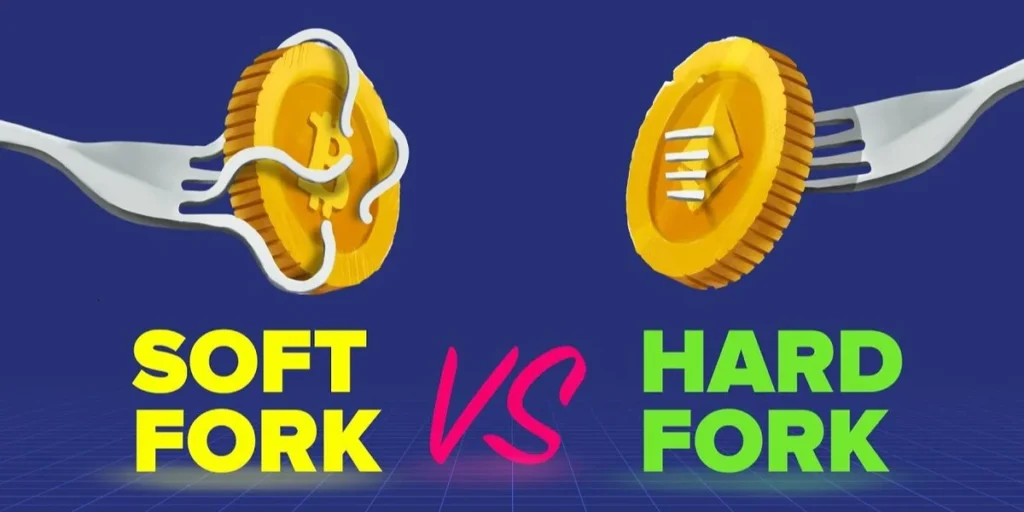
Understanding hard fork vs soft forks is essential for anyone navigating blockchain technology and cryptocurrency networks. Blockchain networks occasionally require updates to introduce new features, fix security vulnerabilities or address community disagreements. These updates come in two forms: soft forks, which are backward-compatible and allow older nodes to continue validating transactions, and hard forks, which require all nodes to upgrade and can split the blockchain permanently. For instance, Bitcoin Cash emerged from a hard fork of the original Bitcoin blockchain. This guide breaks down the key differences between soft fork vs hard fork, covering backward compatibility, consensus requirements, security implications and more to help readers understand how these protocol changes shape cryptocurrency networks.
What Is a Blockchain Fork?

A blockchain fork occurs when a deviation in the consensus mechanism or protocol rules results in a divergence in the blockchain’s chain of blocks. This happens whenever a community makes changes to the blockchain’s protocol or basic set of rules. Different parties need to use common rules to maintain the history of the blockchain, yet when parties are not in agreement, alternative chains may emerge.
Why Blockchains Need Updates
Blockchains require updates for multiple reasons. Adding functionality stands as a primary driver, as networks evolve to meet user demands and technological advancements. Security risks demand immediate attention through protocol changes. Community disagreements about the cryptocurrency’s direction also necessitate modifications. The decentralised nature of public blockchains means participants must agree on the shared state of the blockchain. When nodes cannot reach unanimous consensus regarding the future state of the blockchain, forks become inevitable.
How Protocol Changes Are Implemented
Most major blockchains use formal proposal frameworks to coordinate upgrades. Bitcoin implements Bitcoin Improvement Proposals (BIPs), whilst Ethereum uses Ethereum Improvement Proposals (EIPs). These proposals describe the upgrade, explain its purpose and outline compatibility considerations. They guide public review and coordination before any change becomes active. Independent development teams handle changes and improvements to the network, similar to how internet protocol changes allow web browsing to improve over time.
Related Article: Bitcoin vs. Ethereum For Beginners: Why Every 2026 Portfolio Needs Both
The Role of Network Consensus
Consensus mechanisms represent the complete stack of ideas, protocols and incentives that enable a distributed set of nodes to agree on the state of a blockchain. Reaching consensus means a general agreement has been achieved. For Ethereum, at least 66% of the nodes on the network must agree on the global state of the network. Unanimous consensus amongst network nodes results in a single blockchain containing verified data that the network asserts as correct.
Types of Forks: An Overview
Forks classify into accidental and intentional categories. Accidental forks happen when two or more miners find a block at nearly the same time, creating temporary chain splits that resolve when subsequent blocks make one chain longer. Intentional forks modify blockchain rules and split further into soft forks and hard forks. Hard forks create non-backward-compatible changes, potentially splitting the network into two separate blockchains. Soft forks introduce backward-compatible changes where non-upgraded nodes continue operating under new rules.
Hard Fork Explained

What Is a Hard Fork?
A hard fork represents a protocol upgrade that lacks backward compatibility. The changes introduce new rules so significant that old nodes reject blocks produced under the updated protocol as invalid. This fundamental incompatibility distinguishes hard forks from their softer counterparts in blockchain evolution.
How Hard Forks Create New Blockchains
When a hard fork activates without universal adoption, the blockchain permanently splits into two separate networks. Each network operates independently with its own transaction history and native cryptocurrency. Both chains share identical history up to the split point, then diverge completely afterwards. Nodes running old software continue validating the original chain, whilst upgraded nodes follow the new protocol.
Backward Compatibility Issues
The mechanism behind hard forks resembles a language grammar change that renders old speech unintelligible. For instance, if a protocol increases block size from 1MB to 2MB, nodes running old software reject blocks exceeding 1MB. Correspondingly, upgraded nodes accept these larger blocks, forcing the network split. Old nodes become incompatible and cannot participate in the new chain.
Planned vs Contentious Hard Forks
Planned hard forks appear on project roadmaps with community consensus for migration. Monero’s bi-annual proof-of-work changes exemplify planned upgrades. Contentious hard forks emerge from fundamental disagreements amongst developers, miners and users. The 2016 Ethereum split created Ethereum and Ethereum Classic after the DAO hack. In 2017, Bitcoin Cash emerged from Bitcoin through disagreement over block size limits and transaction capacity.
Hash Rate Distribution After a Hard Fork
Hash rate measurements shift dramatically post-fork when mining algorithms change. Nerva’s Hard Fork 13 demonstrated this, with expected hash rate dropping around 90%, from 400-800 kH/s to approximately 50 kH/s. This drop reflected algorithm change rather than security loss, as each hash performed substantially more work under the new protocol.
Soft Fork Explained
What Is a Soft Fork?
A soft fork represents a backward-compatible protocol upgrade that restricts the validation rules. The change makes previously valid transactions or blocks invalid under stricter criteria, yet old nodes continue recognising blocks produced under the new protocol. This differs fundamentally from hard forks, which expand rules and break compatibility entirely.
How Soft Forks Maintain Compatibility
Soft forks tighten the ruleset so blocks valid under new conditions remain valid under old ones. Non-upgraded nodes accept new blocks because stricter rules form a subset of what they already permit. For example, reducing block size from 1MB to 0.5MB allows old nodes to validate smaller blocks within their original 1MB limit, whilst upgraded nodes reject any blocks exceeding the new threshold.
Why Old Nodes Still Validate New Blocks
The compatibility works unidirectionally. Upgraded nodes enforce stricter conditions, rejecting blocks that violate new rules, whilst older nodes see nothing they would reject and continue validating the chain. Old nodes cannot validate that new blocks follow updated rules, yet they accept them as valid under their existing ruleset. This mechanism allows networks to transition gradually without forcing instant upgrades.
Majority Validator Requirements
Successful soft fork deployment requires majority consensus from miners in Proof-of-Work systems or validators in Proof-of-Stake networks. Bitcoin soft forks typically use miner-signalling activation methods, with Taproot activating after 90% of miners signalled support. Minority adoption results in fork failure, as the network continues operating under old rules and orphans new blocks.
When Soft Forks Fail
BIP-110 demonstrated soft fork failure at block 961,632 on August 8, 2026, triggering a chain split. The activation threshold was set at 55% of blocks in a difficulty period, yet actual support reached only 2.53%. The minority chain produced two blocks in eight hours before stalling. Without replay protection, users faced unintended transaction transfers across both chains.
Hard Fork vs Soft Forks: Key Differences
Backward Compatibility Comparison
The primary difference between hard fork vs soft forks lies in backward compatibility. Hard forks loosen or change rules so old software cannot understand new blocks, whilst soft forks tighten rules within parameters the old software already accepts. This technical distinction dictates coordination requirements during upgrades.
Network Split Risks
Hard forks carry higher chain split risk, fracturing communities into competing networks. This fragments liquidity and developer resources. Soft forks minimise this risk by keeping all nodes on the same chain, provided the majority enforces the upgrade. Chain splits duplicate balances, granting holders equivalent amounts on both chains.
Consensus Requirements
Hard forks prove more democratic yet chaotic, allowing dissenting groups to create separate networks. Soft forks are coercive for minorities, as upgraded majorities control chain validity, forcing non-upgraded nodes to follow or face orphaned blocks.
Security Implications
Security profiles differ significantly. Hard forks can expose both chains to replay attacks, where transactions duplicate across networks. Splitting miners and validators reduces network security. Soft forks strengthen security through stricter rules without fragmenting the network.
Conclusion – Hard Fork vs Soft Forks
The hard fork vs soft forks debate comes down to backward compatibility and network coordination. Hard forks create permanent splits and require universal upgrades, whilst soft forks maintain compatibility through stricter rules. Each approach serves different purposes: hard forks enable radical changes despite higher split risks, whereas soft forks deliver gradual improvements with majority consensus. Understanding these differences helps participants navigate protocol changes, whether they’re Bitcoin Cash’s capacity expansion or SegWit’s backward-compatible enhancement. Both mechanisms remain essential tools for blockchain evolution.
You May Also Want to Check Out: The Bitcoin 4-Year Cycle Explained: A Strategic Guide for 2026
What is the difference between a soft fork vs hard fork?
A soft fork is a backward-compatible blockchain upgrade that tightens the validation rules, allowing older nodes to continue participating in the network even without updating their software. In contrast, a hard fork lacks backward compatibility and introduces changes so significant that old nodes cannot validate blocks produced under the new protocol, potentially splitting the blockchain into two separate networks.
Has Bitcoin ever experienced a hard fork?
Yes, Bitcoin has undergone hard forks. The first major hard fork occurred on 1 August 2017, resulting in the creation of Bitcoin Cash. This split happened at block 478,559 due to disagreements over block size limits, with Bitcoin Cash increasing capacity from 1MB to 8MB and eventually 32MB.
Can older nodes still function after a soft fork upgrade?
Yes, older nodes can continue to participate in the network after a soft fork, even without updating their software. This is because soft forks tighten the ruleset within parameters that old software already accepts, making new blocks valid under the old rules. However, old nodes cannot validate that new blocks follow the updated rules—they simply accept them as valid under their existing ruleset.