
Before the 1970s, secure communication required elaborate key-sharing rituals between parties. The public key vs private key system solved this fundamental challenge, allowing people to communicate securely without meeting beforehand. At its core, public private key encryption uses two mathematically related keys: a public key that anyone can access and a private key kept secret. This asymmetric approach means the private key cannot be guessed from the public key, consequently establishing a secure foundation for modern digital security. Today, private and public keys underpin everything from HTTPS web browsing to cryptocurrency wallets. This guide breaks down the key differences, explains how these crypto private key vs public key pairs work together, and explores their real-world applications.
What Are Public and Private Keys?
Public Key Basics
A public key serves as the openly distributed component in asymmetric encryption. Anyone can access this key to encrypt messages intended for a specific recipient or verify digital signatures. In the RSA cryptosystem, the public key consists of two values: the modulus (n) and the public exponent (e). This key can be shared through email attachments or uploaded to key chain servers for widespread distribution.
The encryption operation uses the public key by raising the message to the eth power modulo n. Once data is encrypted with a public key, only the corresponding private key can decrypt it.
Private Key Basics
In contrast, the private key remains confidential and never gets shared. This secret component consists of the modulus (n) and the private exponent (d). The private key decrypts messages encrypted with its paired public key and creates digital signatures.
Decryption works by exponentiating the ciphertext to the dth power modulo n. When a sender encrypts a message with their private key, they create a signature that anyone can verify using the sender’s public key, proving authenticity.
How Asymmetric Cryptography Works
Asymmetric cryptography uses two different keys rather than a single shared key. Each participant generates their own key pair without requiring pre-shared secrets. The public key encrypts data or verifies signatures, whilst the private key decrypts data and creates signatures.
This separation eliminates the key distribution problem that plagued earlier encryption methods. Security depends entirely on keeping the private key secret, as the public key can be distributed openly without compromising the system.
Key Pair Generation and Mathematical Relationship
RSA key generation begins by selecting two large random prime numbers, p and q. The modulus n is calculated as their product (n = pq). An odd public exponent e is chosen between 3 and n-1, ensuring it’s relatively prime to both p-1 and q-1. The private exponent d is then computed from e, p, and q.
The relationship between exponents e and d ensures encryption and decryption function as inverses. Crucially, deriving the private key from the public key is computationally infeasible. This one-way mathematical function forms the cornerstone of security, allowing public keys to circulate freely without exposing private keys.
Related Article: How to Use This Crypto Security Guide to Prevent Hacks, Scams and Wallet Drainers in 2026
Key Differences Between Public and Private Keys
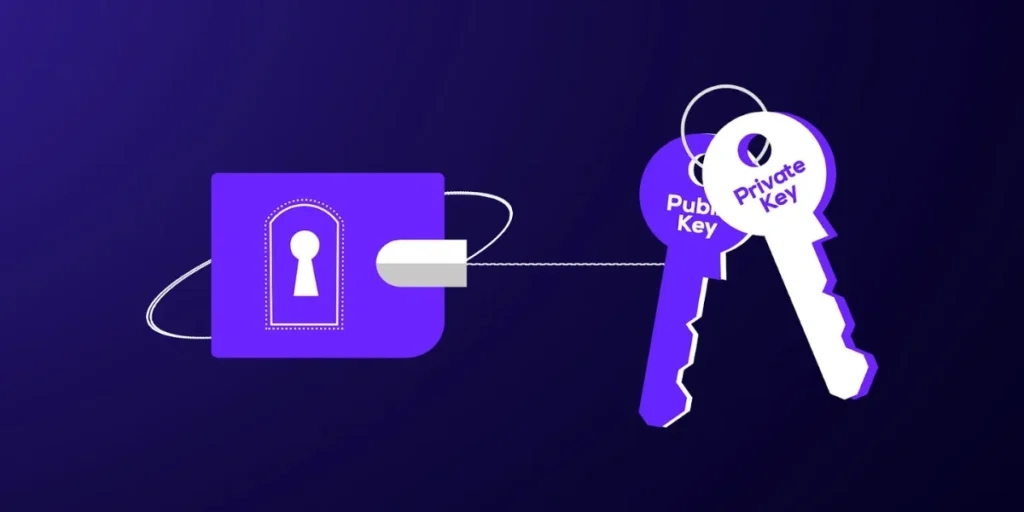
Distribution patterns distinguish the fundamental handling of private and public keys in asymmetric systems. Private keys demand strict confidentiality and never leave their owner’s control, whilst public keys circulate freely through digital certificates, key servers, and direct exchange without security risk. This separation allows secure communication initiation without pre-shared secrets.
Visibility and Sharing
Private keys require secure storage in encrypted files, Hardware Security Modules, or protected directories such as /etc/ssl/private/ on Linux systems. Public keys, conversely, embed themselves in certificates and distribute through channels like keys.openpgp.org without needing special protection. Anyone obtaining a private key gains full impersonation capabilities, making their secrecy the highest priority in cryptographic systems.
Encryption vs Decryption Roles
The keys perform opposite functions in public private key encryption. Recipients use public keys to encrypt messages that only the matching private key can decrypt. For digital signatures, the roles reverse: private keys create signatures, and corresponding public keys verify them. This complementary relationship ensures only intended recipients access encrypted data.
Security Requirements and Storage
Private key compromise creates severe consequences, exposing all encrypted content and signed documents to unauthorised access. Public key exposure carries minimal impact, requiring only certificate replacement. High-security environments store private keys in tamper-proof HSMs that perform cryptographic operations without exposing keys in plaintext.
Performance and Speed Comparison
Asymmetric operations consume significantly more computational resources than symmetric alternatives. RSA encryption processes only a few kilobytes per second in direct encryption mode. This performance gap appears in cloud pricing: AWS charges AUD 18.35 per 10,000 RSA operations versus AUD 0.05 for symmetric operations, a 400-fold difference.
Scalability in Large Networks
Both private and public keys scale linearly across networks. Each participant requires just one key pair regardless of network size, making asymmetric encryption practical for internet-scale applications without the key distribution challenges that plague symmetric systems.
How Public and Private Keys Work Together
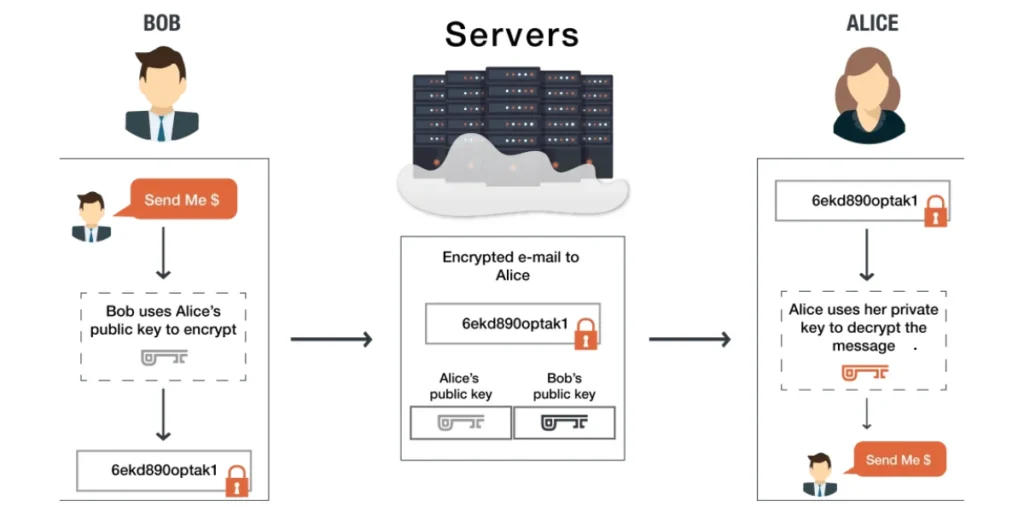
Public private key encryption achieves security through coordinated operations between mathematically linked keys. Each process leverages the complementary nature of the key pair to deliver specific security outcomes.
Secure Message Encryption Process
Anyone encrypting a message uses the recipient’s public key to transform plaintext into ciphertext. Only the recipient, possessing the corresponding private key, can decrypt and read the original message. A journalist might publish their public key on a website, allowing sources to send confidential information that only the journalist can decrypt using their private key. Even if attackers intercept encrypted emails during transmission or access compromised servers, the content remains unreadable without the private key.
Digital Signature Creation and Verification
Digital signatures begin by applying a hash function to the document, producing a fixed-length digest. The signer encrypts this hash value using their private key, creating the signature. Recipients decrypt the signature using the signer’s public key, then calculate a fresh hash of the received document. If both hash values match, the document is authentic and unaltered since signing. This process proves authenticity because only the private key holder could have created a valid signature.
Authentication and Identity Proof
SSH servers, cryptocurrency wallets, and enterprise applications use private key authentication rather than passwords. The possession of a private key corresponding to an authorised public key proves user identity. Conversely, workload authentication in Kubernetes relies on private keys to verify service identities through public-key-backed certificates.
Key Exchange Methods
Diffie-Hellman protocols enable secure key establishment over insecure channels. Each party generates a key pair and exchanges public keys, then combines their private key with the received public key to derive an identical shared secret. ECDHE variants provide forward secrecy by generating ephemeral keys for each session. Hybrid systems use asymmetric encryption to exchange symmetric keys, then switch to faster symmetric algorithms for bulk data encryption.
Real-World Applications and Use Cases

HTTPS and Web Security
Browsers rely on certificates to authenticate websites and establish encrypted connections. Every secure login page, payment portal, and admin console uses this model where the website’s public key enables encrypted sessions whilst the private key remains secured on the web server.
SSH Server Access
Public key authentication provides cryptographic strength that extremely long passwords cannot offer. Users generate key pairs, copy public keys to servers through ssh-copy-id utilities, and authenticate without passwords. This enables single sign-on and passwordless automation across enterprise networks globally.
Email Encryption
S/MIME and PGP both secure email through asymmetric cryptography. S/MIME uses X.509 certificates from centralised authorities, integrating natively into Outlook and Apple Mail. PGP operates on a decentralised web of trust model, requiring manual key exchange but offering complete independence from certificate authorities.
Digital Certificates and PKI
Certificate authorities issue digital certificates binding public keys to verified identities. These certificates support VPN access, Wi-Fi authentication, device identity, and internal applications where access decisions prioritise security over convenience.
Cryptocurrency Wallets
Private keys prove ownership of blockchain assets. When users initiate transactions, wallets use private keys to create digital signatures. Validators verify signatures against public keys, confirming legitimate fund ownership. Losing private keys means permanent loss of cryptocurrency access.
Code Signing and Software Distribution
Developers digitally sign software before distribution, allowing users to confirm code authenticity and detect tampering. Operating systems block unsigned drivers on 64-bit Windows, whilst app stores require signed submissions. Code signing certificates must be stored in Hardware Security Modules meeting FIPS 140-2 Level 2 standards.
Conclusion – Public Key vs Private Key
The public key vs private key system remains the foundation of digital security across countless applications. Public keys encrypt and verify, whilst private keys decrypt and sign, creating a complementary relationship that solved the pre-internet challenge of secure communication. Indeed, this asymmetric approach powers HTTPS websites, SSH authentication, cryptocurrency wallets, and code signing without requiring pre-shared secrets. Security depends entirely on private key confidentiality, as a matter of fact, since public keys can circulate freely without risk.
What distinguishes a public key from a private key?
A public key is openly shared and used to encrypt messages or verify digital signatures, whilst a private key remains confidential and is used to decrypt messages or create signatures. The public key can be distributed freely without security risk, but the private key must be kept secret as its compromise would allow unauthorised access to encrypted data and the ability to impersonate the key owner.
How can I verify that my public and private keys match?
You can verify key pair matching by encrypting data with the public key and attempting to decrypt it with the private key—successful decryption confirms they’re a matched pair. Alternatively, you can create a digital signature with the private key and verify it using the public key. Most cryptographic tools also provide commands to display key fingerprints or modulus values that should be identical for matching keys.
Is it possible for a public key to decrypt data encrypted by a private key?
Yes, when a private key encrypts data (creating a digital signature), the corresponding public key can decrypt it to verify authenticity. This reverse operation proves that the message originated from the private key holder. However, a public key cannot decrypt messages that were encrypted using itself—only the matching private key can perform that decryption.