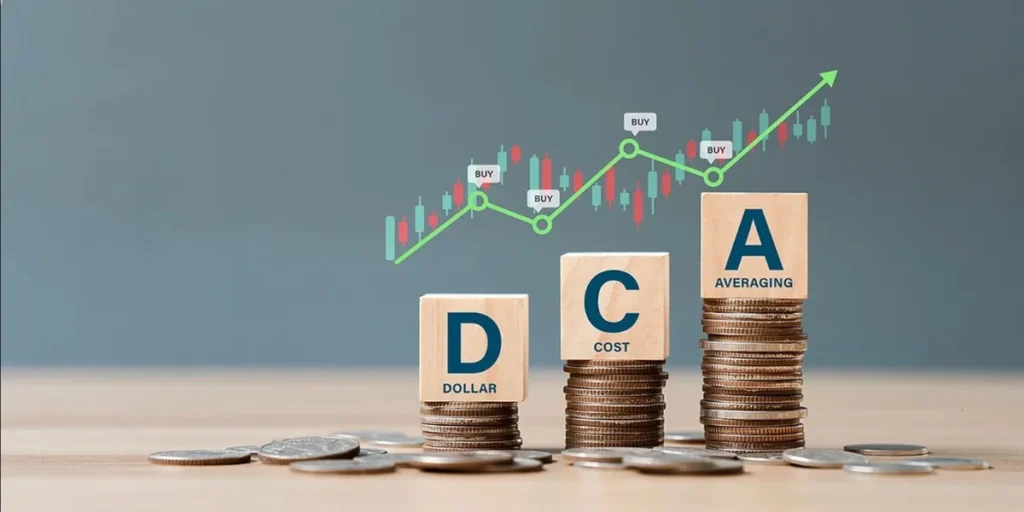
Even though it’s very difficult to time the cryptocurrency market precisely, many investors spend their nights searching for the ideal entry point. Dollar cost averaging offers a stress-free alternative that removes the guesswork from investing. Indeed, 51% of Australian investors now invest continuously and regularly, despite market volatility. By purchasing a set quantity of cryptocurrencies regularly, this technique can lower the average cost per share and reduce the overall impact of price volatility. If you are new to the market, our guide on what is dollar cost averaging explains everything you need to know and how to apply the DCA strategy successfully.
Dollar Cost Averaging in Crypto
DCA Definition and Core Concept
“Dollar cost averaging” is a strategy of investment in which you acquire a defined quantity of an asset on a regular basis. Rather than attempting to identify the optimal entry point, investors commit to buying cryptocurrency on a predetermined schedule, whether weekly, monthly or quarterly. The fixed amount remains constant, whilst the quantity of cryptocurrency acquired varies with market prices.
When prices fall, the fixed investment amount purchases more units of the cryptocurrency. Conversely, when prices rise, the same amount buys fewer units. This automatic adjustment creates an average purchase price across all transactions. For instance, an investor might allocate $150 towards Bitcoin every month, buying 0.003 BTC when the price is high and 0.006 BTC when the price drops.
The core principle centres on consistent accumulation rather than market prediction. By splitting investing capital into smaller increments and making several purchases at multiple different prices over an extended period, investors build their positions gradually. This disciplined approach removes the pressure of identifying market bottoms or tops, focusing instead on time in the market.
How DCA Differs from Lump Sum Investing
Lump-sum investing allocates all available capital to the market at once. In contrast, dollar cost averaging spreads that same capital across multiple purchases over time. The distinction carries significant implications for both returns and risk exposure.
Research shows that lump-sum investing generated slightly higher annualised returns than dollar-cost averaging in more than 56% of historical seven-year periods. For aggressive portfolios with high stock allocations, lump sum approaches yielded 0.42% higher returns than DCA over 12 months. The advantage stems from maximising time in the market and avoiding the opportunity cost of keeping funds uninvested.
However, in about one-third of cases—mostly during market downturns—DCA outperformed lump-sum investing. While lump sum investors suffered annualised losses of 13.84%, dollar cost averaging into an all-equity portfolio limited losses to 1.75% annually during the March 2000–October 2002 technology slump. This performance gap highlights DCA’s protective qualities during volatile periods.
The choice between strategies also involves practical considerations. Transaction costs multiply with frequent DCA purchases, whereas lump sum investing incurs fees only once. Yet many investors lack large capital sums to invest, making DCA the natural approach for those with recurring income streams.
Why DCA Works Well for Crypto Markets
Cryptocurrency markets exhibit extreme price volatility, which makes them particularly suited to dollar-cost averaging. Bitcoin has experienced price swings exceeding 10% in a single day multiple times. Such dramatic fluctuations create substantial timing risk for lump sum investors who might enter at local price peaks.
DCA addresses this volatility through several mechanisms. By investing on a schedule, the strategy automatically buys more cryptocurrency when prices are low and less when prices are high, which can reduce the average cost per unit over time. This reduces the risk of mistimed entries and spreads exposure across various price points.
Particularly valuable is DCA’s ability to enforce rules-based investing, removing emotion and short-term noise from decision-making. Survey data indicate that reducing the impact of market volatility was the top benefit of DCA strategies at 46.13%, followed by consistent investments at 23.95%. The approach builds emotional discipline by eliminating the need to react to daily price movements, allowing investors to maintain their strategy during both market euphoria and panic.
How Dollar Cost Averaging Works in Cryptocurrency

Setting Up Your Investment Schedule
Selecting the right purchase frequency is the foundation of any dollar-cost averaging strategy. Investors can choose daily, weekly, bi-weekly or monthly intervals based on their preferences and income patterns. The optimal approach aligns DCA purchases with regular income streams. Weekly income earners benefit from weekly DCA, whilst monthly salary recipients find monthly purchases more sustainable. This synchronisation ensures “fresh fiat” is available for each purchase without disrupting essential financial obligations.
Automation removes the burden of manual execution. Exchanges now offer recurring buy features that execute purchases automatically on predetermined schedules. Manual buying relies on willpower and becomes vulnerable when markets turn volatile or life becomes demanding. Automated systems ensure purchases happen consistently, allowing portfolios to grow on schedule without fail.
Calculating Your Investment Amount
Determining the investment amount requires careful assessment of personal financial circumstances. Investors must account for essential expenses, including bills, rent, groceries and savings, before allocating capital to cryptocurrency. Monthly costs dictate how much capital remains available for investing without compromising financial needs.
Starting with a comfortable amount proves more sustainable than overcommitting. Even £100 per month compounds over time when maintained consistently. The critical question becomes: “Can I maintain this amount during a recession?” Some investors consider limiting cryptocurrency exposure to no more than 10% of their savings in order to manage risk effectively. Consistency beats size, as the strategy depends on regular purchases rather than large amounts.
Choosing Which Cryptocurrencies to DCA Into
Asset selection requires thorough research, as DCA is a long-term investment strategy. Investors should examine the longevity of digital assets, as consistent accumulation over months or years requires demonstrated market staying power. Research into the cryptocurrency’s fundamentals provides insight into its long-term viability and growth potential.
Market metrics warrant evaluation before committing to a DCA plan. Trading volume, liquidity and historical price performance offer quantifiable indicators of market health. Similarly, monitoring online forums and reputable news sources allows investors to gauge sentiment and develop informed theses about an asset’s potential.
Benefits of DCA for Crypto Investors

Reducing the Impact of Volatility
Cryptocurrency markets exhibit extreme price fluctuations, distinguishing them from traditional assets. The annualized volatility is about 55%, which is almost four times higher than the S&P 500 Index. This volatility translates into potential drawdowns of up to 70% over 12-month periods. Dollar cost averaging addresses this turbulence by averaging prices systematically. The strategy automatically purchases more units when prices fall and fewer when prices rise, effectively smoothing out the average cost over time. This mechanism reduces the risk of mistimed entries that plague investors who deploy capital during price peaks.
Removing Emotional Decision-Making
Behavioural research reveals a significant psychological advantage for dollar cost averaging practitioners. A Fidelity study found that lump-sum investors are 37% more likely to panic-sell during major drawdowns than investors following systematic DCA schedules. In crypto markets where drawdowns of 50% or more occur regularly, this psychological resilience proves as valuable as any mathematical edge. The method eliminates typical emotional problems, such as uncertainty, doubt, and fear of missing out, which impair judgment. By committing to predetermined investments regardless of market conditions, investors avoid impulsive decisions driven by short-term fluctuations. This rules-based process eliminates the pressure to time the market or chase investment trends, allowing focus on long-term asset accumulation.
Building a Consistent Investment Habit
Dollar cost averaging promotes disciplined investing by removing the need for discipline entirely. The set-and-forget approach allows money to work without constant monitoring or decision-making. Correspondingly, this systematic method encourages regular investment that helps build wealth over time through commitment rather than market prediction. The strategy also provides flexibility based on personal financial circumstances. Investors building positions with patience through dollar-cost averaging can pause contributions to address emergencies without panic-selling. This adaptability supports long-term strategy maintenance through various life circumstances whilst preserving the core accumulation framework.
Lower Average Purchase Price Over Time
By making regular purchases even during bear markets, investors take advantage of price dips, leading to a lower overall cost for accumulated cryptocurrency than with one-time purchases. The average cost calculation divides the total amount spent by the quantity of crypto accumulated. When prices drop significantly, the fixed investment amount buys more units, reducing the cost basis. For instance, spreading purchases across different price points naturally lowers the average acquisition cost during substantial market corrections. This mathematical outcome arises automatically from the mechanics of fixed-amount investing across different price levels, requiring no active trading decisions or market timing.
Risks and Limitations of Crypto DCA
No investment strategy delivers perfect results in all market conditions. Dollar cost averaging presents several limitations that investors must weigh against its benefits before committing to this approach.
Missing Significant Price Dips
Markets tend to rise over extended periods, which puts DCA at a mathematical disadvantage compared to lump-sum investing. Consider an investor with £15,289.90 to deploy over a 10-year period in an asset that appreciates by 10% annually. Investing the full amount immediately would generate £24,368.16 in returns, whilst spreading the same capital as £1,528.99 annually would yield only £11,515.09. This substantial difference reflects the opportunity cost of holding uninvested cash whilst waiting for scheduled purchases.
DCA also underperforms when sharp price corrections recover quickly. Investors who buy aggressively during brief pullbacks and capture immediate rebounds may outperform steady DCA schedules in the short run, though this requires precise timing and emotional control that most struggle to maintain.
Transaction Fees on Multiple Purchases
Frequent purchases accumulate transaction costs, eroding returns over time. Centralised crypto exchanges charge fees on each trade, turning what seems like a minor cost into a substantial expense when multiplied across dozens or hundreds of purchases. An investor executing weekly DCA purchases might spend £7.64 to £15.29 monthly in transaction fees alone. For smaller investment amounts, these fees represent a significant percentage of capital deployed.
Platforms with lower fee structures or consolidated purchases help mitigate this impact. However, the core challenge remains: DCA inherently generates more transactions than lump-sum approaches, thereby incurring higher cumulative costs.
Market Downtrends and Continuous Losses
Extended bear markets make dollar cost averaging feel unrewarding. Investors continue buying as prices drift sideways or decline for months, leading to temporary unrealised losses on accumulated positions. If an asset trends downward with no signs of recovery, investors face the prospect of exiting at a loss unless they halt scheduled investments.
DCA cannot protect against fundamentally poor investment choices. Steady accumulation of declining assets simply compounds losses rather than averaging them out.
When DCA May Not Be the Best Strategy
Rising markets expose DCA’s primary weakness. Proponents assert that the strategy can deliver lower-than-expected returns because most recurring purchases occur during market rallies. Investors committed solely to single cryptocurrencies may miss profitable opportunities in other assets that cannot be captured through rigid DCA schedules. The passive nature of DCA also prevents investors from responding to market developments, new information or changing investment environments that might warrant strategy adjustments.
How to Start Dollar Cost Averaging Crypto Today

Select a Reliable Crypto Exchange
Platform selection determines both cost efficiency and ease of execution. Kraken supports recurring buys on over 200 cryptocurrencies, whilst Crypto.com offers weekly limits up to AUD 45,869.71 for basic users. Binance provides Auto-Invest features across 460+ coins with staking integration. Coinbase delivers institutional-level custody with seamless card-based recurring purchases. When evaluating platforms, prioritise low trading fees, robust security measures, including proof of reserves, and regulatory compliance.
Set Up Automated Recurring Purchases
After selecting a platform, navigate to the recurring buy feature. On Revolut, tap ‘Crypto’, select ‘Trade’, choose your token, tap ‘Buy’, then switch to ‘Recurring buy’ and set your purchase amount, start date and frequency. Crypto.com follows a similar process: select the cryptocurrency, choose ‘Recurring Buy’ from the dropdown, enter your amount, select the frequency and payment method, then confirm. The minimum purchase amount typically starts at AUD 30.58.
Determine Your Budget and Frequency
Financial experts suggest the 10% Savings Rule for crypto as part of diversified investment plans. Allocate no more than 10% of disposable monthly income after covering essential expenses. Weekly DCA captures smaller market dips without generating excessive transaction records for tax purposes. Monthly plans suit long-term holders seeking simplicity, whilst daily purchases work better for blue-chip assets like Bitcoin and Ethereum to smooth rapid price movements.
Track Your DCA Performance
Most platforms provide DCA calculators that simulate returns based on historical prices. Regularly review your portfolio allocation and equity curve to monitor performance. Access recurring buy screens to check active orders and filter by cryptocurrency.
Adjust Your Strategy When Needed
Platforms accommodate financial changes by allowing adjustments to deposit amounts and frequency without disrupting the overall strategy. Regularly review investments, perhaps quarterly or semi-annually, making adjustments based on evolving financial situations and market conditions. Avoid stopping DCA during crashes, as these present optimal buying opportunities.
Conclusion – What is Dollar Cost Averaging
Dollar cost averaging provides cryptocurrency investors with a disciplined, emotion-free approach to building wealth over time. This technique automatically reduces volatility and removes the strain of timing market entry by investing fixed sums at regular intervals. Certainly, DCA carries limitations, including transaction fees and opportunity costs during rising markets. However, the psychological advantages and consistent accumulation habits it fosters make the strategy particularly valuable for long-term crypto investors. As demonstrated throughout this guide, successful implementation requires selecting reliable platforms, determining sustainable budgets, and maintaining commitment through market cycles. The result is steady portfolio growth without the stress of attempting to predict unpredictable market movements.
You May Also Be Interested In: Investing Guide 2026: How Markets Are Shaping the Year Ahead
Is dollar cost averaging a suitable strategy for cryptocurrency beginners?
DCA is particularly well-suited for beginners, as it offers a simple, disciplined approach that doesn’t require extensive market knowledge or experience. The strategy removes the pressure of identifying optimal entry points and helps new investors build consistent investment habits without needing to constantly monitor market movements or time their purchases.
How does DCA help manage cryptocurrency price volatility?
DCA helps mitigate price volatility by spreading purchases over regular intervals at different price points. When prices fall, your fixed investment amount automatically buys more cryptocurrency units, and when prices rise, it buys fewer units. This mechanism smooths out your average purchase price over time and reduces the risk of investing a large sum at a market peak.
Does dollar cost averaging work well for long-term crypto investors?
Yes, DCA is an effective strategy for long-term investors who believe cryptocurrency will appreciate over extended periods. It eliminates the need to time the market perfectly, as you’ll naturally buy during both upward and downward price movements. This consistent approach allows you to accumulate assets steadily without requiring constant market analysis or active trading decisions.
What are the main advantages of using a DCA strategy in crypto markets?
The primary benefits include reducing emotional decision-making, building disciplined investment habits, and lowering your average purchase price over time. DCA removes the psychological pressure associated with market timing and helps investors avoid panic selling during downturns. The strategy’s automated nature ensures consistent accumulation regardless of short-term market fluctuations.
Are there any drawbacks to dollar cost averaging in cryptocurrency?
Yes, DCA has limitations, including higher cumulative transaction fees from multiple purchases and potential opportunity costs during rising markets. The strategy may underperform lump sum investing when markets trend upward consistently, and it cannot protect against poor investment choices in fundamentally weak assets. Additionally, extended bear markets can result in temporary unrealised losses on accumulated positions.