The decision between a market order vs limit order shapes every trade an investor executes, yet many traders struggle to choose the right approach. While market orders prioritize speed, limit orders prioritize price precision.
- Market Orders: Executed immediately at the best available price. They guarantee execution speed but offer no control over the final execution price.
- Limit Orders: Set a specific maximum purchase price or minimum selling price. They guarantee price precision but carry the risk that the order may never fill.
- Advanced Controls: Combining stop-loss and stop-limit orders provides traders with additional flexibility for managing risk and protecting capital in volatile conditions.
Related Article: Investing Guide 2026: How Markets Are Shaping the Year Ahead
What is a Market Order and How Does it Work?

A market order instructs a broker to buy or sell securities at the best available price in the current market. This order type represents the most straightforward transaction method, prioritizing execution speed over price control. When an investor places a market order, they accept whatever price the market offers at that moment, forfeiting the bid-ask spread in exchange for immediate execution.
Execution Speed and Immediacy
Market orders execute almost instantaneously during regular market hours. On liquid large-cap stocks, execution typically happens within a fraction of a second during normal trading conditions. This speed makes market orders reliable for getting trades filled, as they ensure the transaction happens regardless of minor price movements.
The immediacy comes with a trade-off:
- Price Control: Market orders are filled at a price dictated by the market, giving traders no control over the final execution price.
- Order Sizing: Small market orders in liquid markets usually execute almost instantly, whereas large orders may require time slicing or algorithmic execution to avoid excessive market impact.
Price Fluctuations and Slippage
Slippage occurs when the execution price differs from the quoted price at order placement.
For example, if a trader places a market order for 100 shares of Apple when bid-ask prices are AUD 280.57 / AUD 280.62, they might anticipate paying AUD 280.62 per share. However, if the spread shifts to AUD 280.63 / AUD 280.68 just before execution, they will pay AUD 280.68 per share—an extra AUD 6.12 for the total position.
Trading Hours and Market Order Timing
- Regular Trading Hours: 9:30 a.m. to 4:00 p.m. ET
- Pre-Market Trading: 7:00 a.m. to 9:30 a.m. ET
- After-Hours Trading: 4:00 p.m. to 8:00 p.m. ET
Market orders placed outside regular hours execute at the next market open, which could open significantly higher or lower than the prior close. Extended-hours trading features lower liquidity and higher volatility, making price execution less predictable.
What is a Limit Order and How Does it Work?
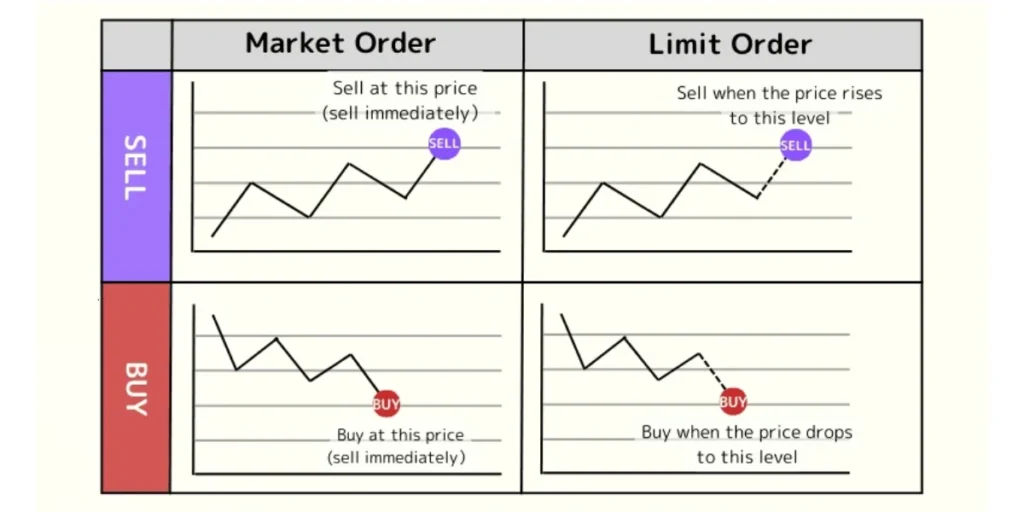
A limit order instructs brokers to buy or sell securities only at a specified price or better. This order type gives traders precise price control but sacrifices execution certainty.
- Buy Limit Orders: Execute at the limit price or lower.
- Sell Limit Orders: Fill at the limit price or higher.
Setting Your Price Points
When placing a limit order, traders establish the maximum purchase price or minimum sale price they are willing to accept:
- Buying: A trader wanting to buy XYZ stock currently trading at AUD 25.99 might set a buy limit order at AUD 22.17, purchasing shares only if the price falls to that level or below.
- Selling: A trader holding shares might place a sell limit order at AUD 30.58, selling only when the price reaches or exceeds that threshold.
Limit Order Execution Scenarios
Limit orders join a queue at their specified price level, filling based on price-time priority:
- Price Priority: Orders at better prices fill first.
- Time Priority: Among orders at identical prices, those submitted earliest execute first.
When Limit Orders Don’t Fill
Several factors can prevent a limit order from executing:
- Unreached Target: The market price may never touch the specified level.
- Low Volume: Insufficient trading volume at the limit price can leave orders unfilled or partially filled.
- Queue Exhaustion: In illiquid stocks, available shares disappear quickly as earlier queued orders consume them.
- Price Volatility: Rapid price movements may pass the limit briefly, but move away before the order reaches the front of the queue.
Good-Til-Cancelled (GTC) Limit Orders
GTC orders remain active until executed or manually canceled. Despite their name, most brokers set GTC orders to automatically expire after 30 to 90 days to prevent forgotten orders from suddenly filling during unexpected market swings.
Market Order vs Limit Order: Key Differences

| Feature | Market Order | Limit Order |
| Execution Speed | Immediate (prioritizes speed) | Delayed / Conditional (prioritizes price) |
| Price Certainty | Variable (subject to slippage) | Guaranteed (executes at limit price or better) |
| Execution Certainty | High (guaranteed execution if volume exists) | Low (no fill if market does not reach target) |
| Order Complexity | Simple (specify share quantity only) | Moderate (specify target price and expiration) |
| Best For | Liquid, high-volume stocks; urgent exits | Illiquid stocks; volatile markets; precise entry points |
Best Use Cases for Each Order Type
- Use Market Orders When: Trading liquid, high-volume stocks with tight bid-ask spreads; executing urgent exits; placing small position sizes where price variations are negligible; or when guaranteed execution outweighs price concerns.
- Use Limit Orders When: Trading illiquid or small-cap stocks; operating during volatile market conditions; targeting specific entry/exit prices; or scaling into or out of positions without moving the market.
Understanding Stop Orders and Advanced Order Types
Beyond basic order types, stop orders and their variations provide traders with sophisticated risk management and entry strategies.
What is a Stop Order?
A stop order remains inactive until a specified price threshold is reached, at which point it converts into a market order:
- Buy Stop Order: Placed above the current market price (e.g., set at AUD 30.58). Once triggered, it purchases shares at the next available market price (e.g., AUD 30.66).
- Sell Stop Order: Placed below the current market price (e.g., set at AUD 30.58). Once triggered, it sells shares at the next available market price (e.g., AUD 30.55).
Stop-Loss Orders for Risk Management
Stop-loss orders automatically sell securities when prices decline to a predetermined level, limiting investor losses.
- Example: A trader buys 100 shares of XYZ Company at AUD 152.90 and sets a stop-loss at AUD 137.61. If the stock falls below this threshold, the order triggers and executes at the next available price (e.g., AUD 137.53), protecting against further losses.
Stop-Limit Orders Explained
Stop-limit orders combine stop triggers with limit order execution, requiring two distinct price points:
- Stop Price: The threshold that activates the order.
- Limit Price: The specific price parameters required for execution.
This structure offers precise price control upon triggering, but introduces the risk of non-execution if prices gap past the limit price before the order can fill.
Partial Fills and Order Execution
A partial fill occurs when only a portion of the total order quantity executes at the target price. For instance, a limit order for 1,000 shares at AUD 81.04 might only fill 200 shares if available volume is exhausted. Market orders almost always execute fully, whereas limit orders remain subject to partial fills based on available liquidity.
Conclusion – Market Order vs Limit Order
The choice between a market order and a limit order comes down to trading priorities. Market orders suit traders who value execution certainty and deal primarily in liquid assets. Conversely, limit orders appeal to investors who prioritize strict price control over guaranteed fills. In practice, experienced traders combine both order types strategically—using market orders for urgent position changes and limit orders for planned entries and risk management.
What’s the fundamental difference between a market order and a limit order?
A market order executes immediately at the best available current price, guaranteeing execution but not the exact fill price. A limit order allows you to specify a maximum purchase price or minimum sell price, guaranteeing price precision but offering no guarantee of execution.
Which order type should I use for long-term investing?
For long-term strategies like dollar-cost averaging into index funds, market orders are typically more practical, as minor intraday price differences won’t significantly impact multi-year returns. However, limit orders are beneficial during highly volatile market conditions or when trading less liquid assets.
Can I use limit orders to get a better price than the current quote?
Yes. You can place a limit order inside the bid-ask spread to capture better pricing. For example, if the ask price is £305.80 and the bid price is £290.51, placing a buy limit order at £298.15 allows you to secure a better fill if a seller meets your price.
Why might my limit order fail to fill?
A limit order may remain unfilled if:
The market price never reaches your limit threshold.
Trading volume at your specified price is insufficient.
Earlier orders ahead of yours in the price-time queue consume all available volume before your order is reached.
Should I avoid placing market orders when the market is closed?
Yes. Orders placed while markets are closed execute at the next market open, exposing trades to overnight gaps where prices may open significantly higher or lower than the previous day’s close.