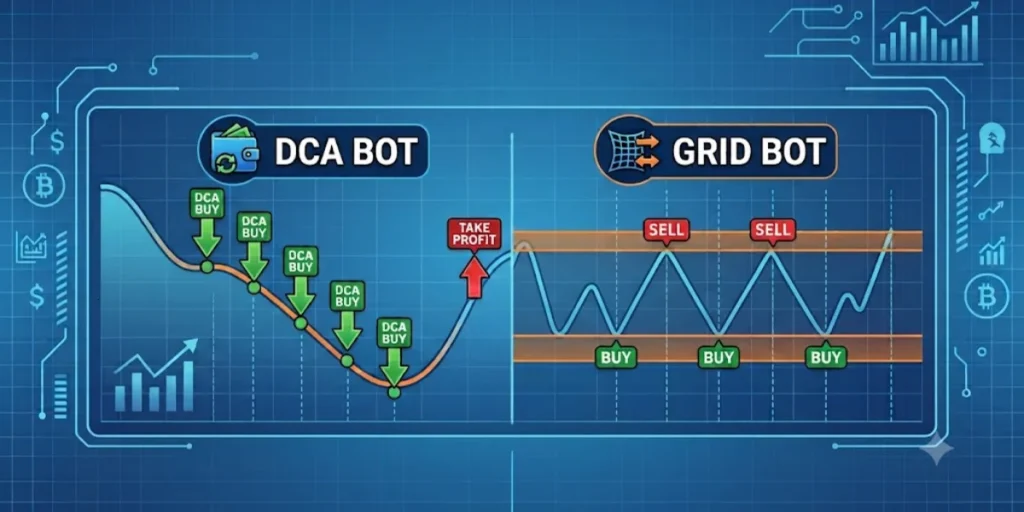
The DCA bot vs Grid bot debate has become increasingly relevant, as these strategies rank amongst the most popular CEX trading strategies today. DCA bots intelligently invest fixed amounts at regular intervals, providing traders with a reliable method to steadily build their portfolio and minimise the impact of market volatility. By comparison, Grid bots execute multiple buy and sell orders within a specified price range, leveraging market volatility to capture short-term profits. Whilst Grid bots excel in sideways markets, DCA bots are ideal for accumulation during downtrends. This article examines the key differences between these automated trading approaches, helping traders determine which strategy aligns with their risk tolerance, market outlook, and investment goals.
What Is a DCA Bot and How Does It Work?

Dollar-Cost Averaging Strategy Explained
DCA stands for Dollar-Cost Averaging, a trading strategy where incremental buy or sell orders are placed over time to average the entry price. This approach helps reduce the impact of volatility on positions by spreading investments across multiple price points rather than entering the market with full capital at once. The strategy involves investing a fixed amount of money into specific assets at regular intervals, regardless of the asset’s price.
The fundamental principle behind DCA lies in purchasing more shares when prices are low and fewer shares when prices are high. By buying at different prices over time, traders achieve a more stable average cost per share. This systematic approach removes the pressure of timing the market perfectly, as investors make consistent purchases whether markets rise or fall. In essence, DCA transforms the challenge of market timing into a disciplined, rule-based investment method.
DCA Bot Order Execution Process
A DCA bot automates the dollar-cost averaging strategy by executing recurring orders based on predefined parameters. The execution process begins with a base order that initiates the position. If the price moves against the trade, the bot places averaging orders (also called safety orders) to improve the average entry price. The bot then closes the trade when the target profit level is reached.
The technical workflow operates as follows: the bot initiates the first order based on configured strategy parameters, waits for the specified interval before executing the next order, and repeats this process until all configured orders have been executed. Throughout this cycle, the executor monitors each order’s execution and manages adjustments or cancellations according to market conditions and strategy requirements. DCA bots function on both spot and perpetual exchanges, scheduling orders at regular intervals to manage positions over time.
When to Use DCA Bots in Crypto Trading
DCA bots prove effective in sideways or slightly trending markets where consistent accumulation benefits long-term positions. These automated tools suit long-term holders of coins, investors who don’t focus on short-term price fluctuations, and those who can’t monitor the market constantly. The strategy particularly appeals to traders seeking to avoid emotional decision-making and panic-driven actions during volatile periods.
Bybit allows traders to create DCA bots with portfolios of up to five coins simultaneously. The 24/7 automated execution ensures traders never miss buying opportunities during market dips. DCA bots help capture small profits consistently through disciplined order placement, making them suitable for investors seeking systematic, emotion-free trading approaches.
What Is a Grid Bot and How Does It Work?
Grid Trading Strategy Explained
A grid trading bot automates the process of buying and selling cryptocurrencies within a predefined price range. This strategy divides a price range into evenly spaced levels, creating a grid structure where buy orders are placed below each level and sell orders above it. The bot capitalises on price fluctuations rather than directional trends, making predictions about market direction unnecessary. When prices drop to a buy level, the bot purchases the asset; when prices rebound to the corresponding sell level, the bot sells for profit.
Grid trading generates returns from market volatility by completing multiple buy-sell cycles. Each completed cycle captures a small profit, which accumulates over time, particularly in volatile markets where prices move frequently between levels. The strategy performs best during sideways market movements, helping traders generate profits when prices lack significant directional momentum.
Grid Bot Order Placement Mechanism
The bot operates by placing a series of buy and sell orders across defined price ranges. When the price drops to a lower grid level, the bot executes a buy order; conversely, when the price rises to a higher grid level, the bot executes a sell order. This cycle repeats continuously as long as prices remain within the set range. Once a sell order executes, the bot automatically places a new buy order below, maintaining the operational cycle.
Neutral vs Long vs Short Grid Bot Modes
Grid bots offer three primary modes tailored to different market conditions. Neutral Grid trades both buy and sell orders within a predefined range without initial positions, making it ideal for sideways markets. The strategy places sell limit orders above market price and buy limit orders below.
Long Grid suits bullish market conditions where prices fluctuate upwards. The bot opens long positions at lower grid levels and closes them as prices rise. This mode starts by entering with a long position, closing it at high points, then opening new long positions when prices drop.
Short Grid targets bearish environments with downward price trends. The bot opens short positions at higher levels and closes them at lower prices, profiting from declining markets by selling high and buying low.
Related Article: Market Order vs Limit Order: Which is Right for Your Trading Strategy? [2026]
DCA Bot vs Grid Bot: Key Differences

Take-Profit Strategy Differences
The fundamental distinction between DCA and Grid bots lies in their take-profit approach. DCA bots use one TP target for the whole position, recalculating the profit price with every new buy order to ensure all accumulated orders reach the set profit parameter. In contrast, Grid bots place take-profits for every order separately, executing a new sell order at profit level whenever a buy order triggers. This structural difference shapes their profitability patterns: DCA delivers bigger profits less often, whilst Grid produces small consistent profits.
Market Conditions and Suitability
DCA bots excel in downtrends, accumulating tokens during price declines. Grid bots thrive in ranging sideways markets where price fluctuations occur within specific ranges, profiting from volatility without requiring clear directional trends.
Risk Profile and Trading Philosophy
DCA bots adopt a passive, long-term investment approach with lower risk profiles. They systematically accumulate assets regardless of market conditions, reducing volatility impact. Conversely, Grid bots employ active, short-term trading strategies, carrying higher risk due to exposure to short-term price fluctuations but offering potential for enhanced returns in volatile conditions.
Order Management and Execution
DCA bots implement straightforward order strategies, executing trades at fixed intervals. Grid bots deploy complex order placement mechanisms, positioning multiple buy and sell orders at predetermined price levels within the grid structure.
Which Bot Is Better: DCA Bot vs Grid Bot for Your Portfolio?

Choosing DCA Bots for Trending Markets
DCA bots demonstrate maximum effectiveness in bear markets and recovery periods. Research shows that during the 2022–2024 crash, DCA investors making AUD 764.50 monthly contributions achieved 188.5% returns (AUD 27521.82 → AUD 79398.93), significantly outperforming lump-sum investors, with a max drawdown of just 45% versus 77% for those trying to time the market. Over extended periods, Bitcoin DCA with AUD 305.80/month delivered AUD 182408.53 in profits, whilst Ethereum yielded AUD 148617.85. The Sharpe ratio for Bitcoin DCA ranges between 1.45–1.85 over 5 years, nearly double that of the S&P 500 (0.85).
Choosing Grid Bots for Sideways Markets
Grid trading demonstrates maximum efficiency in sideways markets and during high volatility periods. Pairs such as BTC/USDT, ETH/USDT, and SOL/USDT with daily volumes of AUD 21.41B+ and volatility of 12–25% provide the most favourable conditions. Range-bound behaviour proves ideal for grid structures because repeated crossings create opportunities for paired orders.
Risk Tolerance and Trading Experience Factors
DCA functions as a psychological stabiliser, with studies showing 40% stress reduction among DCA bot users compared to active traders. Grid trading requires higher engagement and resilience to frequent P&L swings, demanding daily monitoring and parameter adjustments.
Combining Both Strategies with Combo Bots
Combo bots merge DCA and grid strategies, entering gradually like a DCA bot whilst layering a Minigrid on top of each order to harvest small swings. This hybrid approach combines passive income generation of grid bots with risk reduction benefits of DCA strategy.
Conclusion – DCA Bot vs Grid Bot
Both DCA and Grid bots offer distinct advantages for cryptocurrency traders seeking automated solutions. DCA bots provide systematic accumulation with reduced volatility impact, particularly effective during bear markets and recovery periods. Grid bots capitalise on price fluctuations within ranging markets, generating consistent small profits through volatility. The optimal choice ultimately depends on market conditions, risk tolerance, and investment objectives. Traders seeking balanced approaches may find combo bots particularly valuable, as they merge the risk mitigation of DCA with the profit-harvesting capabilities of grid strategies.
What is the most effective strategy for automated crypto trading bots?
The most effective strategy depends on market conditions and your investment goals. DCA bots work best in bear markets and recovery periods, systematically accumulating assets whilst reducing volatility impact. Grid bots excel in sideways or ranging markets, capturing small profits from price fluctuations. For balanced approaches, combo bots merge both strategies to provide risk mitigation alongside profit-harvesting capabilities.
How does a grid bot strategy work in crypto trading?
Grid bots execute multiple buy and sell orders across a predefined price range, creating a grid structure with evenly spaced levels. When prices drop to a buy level, the bot purchases the asset; when prices rise to the corresponding sell level, it sells for profit. This strategy capitalises on market volatility by completing numerous buy-sell cycles, generating consistent small profits particularly effective in sideways or choppy markets.
When should I use a DCA bot instead of a grid bot?
DCA bots are ideal for trending markets, especially during downtrends and recovery periods. They’re suited for long-term holders who want to accumulate assets systematically without timing the market. Choose DCA bots if you prefer lower risk, can’t monitor markets constantly, or want to avoid emotional decision-making during volatile periods. They deliver larger profits less frequently compared to grid bots’ small consistent returns.
What are the main differences between DCA and grid bot take-profit strategies?
DCA bots use one take-profit target for the entire position, recalculating the profit price with every new buy order to ensure all accumulated orders reach the set profit parameter. Grid bots place separate take-profits for every individual order, executing a new sell order at profit level whenever a buy order triggers. This means DCA delivers bigger profits less often, whilst grid bots produce small consistent profits.
Can I combine DCA and grid bot strategies together?
Yes, combo bots merge both DCA and grid strategies into a hybrid approach. They enter positions gradually like a DCA bot whilst layering a mini-grid on top of each order to harvest small price swings. This combination provides the passive income generation of grid bots alongside the risk reduction benefits of DCA strategy, offering a balanced solution for traders seeking both stability and profit opportunities.