
Understanding what is a crypto seed phrase is fundamental for anyone holding cryptocurrency. A seed phrase is a sequence of 12 to 24 random words that stores the data required to access or recover cryptocurrency. Generated automatically by crypto wallets, this master key serves as the backup to all private keys in a seed wallet. Consequently, anyone with access to a seed phrase can restore the entire wallet and control all its funds. This guide explains what a crypto wallet seed phrase is, how it works, and the best practises for seed phrase storage.
What Is a Crypto Seed Phrase?
The 12-24 Word Master Key to Your Wallet
A seed phrase, also called a recovery phrase, backup seed, or mnemonic phrase, is a sequence of random words that contains the information needed to access or recover cryptocurrencies from blockchains or wallets. The phrase, typically 12 to 24 words, is generated by wallet software during account creation.
Each word comes from a fixed set of 2,048 simple words like ‘army,’ ‘energy,’ ‘fabric,’ ‘lucky,’ ‘opera,’ or ‘void.’ The standardised word list exists because long numeric strings are hard to remember or transcribe. Words are easier to write and verify than complex characters.
The order of the seed phrase results is crucial. The words must be entered in the correct sequence for the phrase to work. Anyone with the seed phrase can reconstruct wallet accounts and spend funds. Thus, keeping the seed phrase secure and private at all times is essential.
How Seed Phrases Connect to Your Private Keys
A seed phrase is the master key for all private keys in a wallet. It derives every private key linked to wallet addresses. When a wallet generates a seed phrase, the software uses it to create all the private keys needed to control crypto holdings.
The relationship works through a cryptographic derivation process. A seed phrase is derived from a long random number called entropy. From this single phrase, wallets can recreate all addresses and access funds across multiple cryptocurrencies. The beauty of this system lies in the fact that you need to remember or store only one thing: the seed phrase itself.
Private keys serve a different function. They sign transactions and allow users to send cryptocurrency. Seed phrases, by comparison, exist primarily for recovery purposes. In essence, whilst a private key resembles a password for individual transactions or accounts, the seed phrase regenerates all wallet private keys, providing a wider safety net.
Why Wallets Generate Seed Phrases Automatically
Most crypto wallets generate a seed phrase automatically upon setup. The procedure is mechanical, with limited options for customising seed phrase settings. This automatic generation follows the BIP39 standard, which outlines how crypto wallets generate a string of words to create a mnemonic sentence.
BIP39, short for Bitcoin Improvement Proposal 39, defines how random bits transform into a mnemonic phrase and then into a seed. This standardisation means users can often restore wallets across different apps, provided those apps support the same standard. The standard makes major wallets interoperable: switching wallets requires only entering the seed phrase into the new application, and cryptocurrency becomes available there.
Automatic generation ensures proper randomness and adherence to security protocols. Wallets create a unique seed phrase during setup, which then serves as the foundation for generating all subsequent private keys. This eliminates the need to record each private key separately. Should a device be lost, stolen, or malfunction, the seed phrase provides the safety net needed to restore full wallet access.
How Crypto Seed Phrases Work

The BIP39 Standard Explained
The mechanism driving automatic seed phrase generation relies on BIP39, a technical standard introduced in 2013 by Marek Palatinus and the SatoshiLabs team. BIP39 stands for Bitcoin Improvement Proposal 39 and defines the method for generating a mnemonic sentence to serve as the master key for a deterministic wallet. The proposal addressed a significant pain point: before BIP39, users had to back up a new file every time they generated a new address.
BIP39 established a standardised method that translates entropy into human-readable words. This standard has become widely adopted across the cryptocurrency industry, implemented by numerous wallet providers for Bitcoin, Ethereum, Litecoin, and other cryptocurrencies. The standardisation enables interoperability, allowing users to restore wallets across different platforms with ease.
From Random Numbers to Readable Words
The conversion process from random numbers to readable words follows a precise mathematical sequence. Wallets first generate a random sequence of bits called entropy, typically between 128 and 256 bits. For instance, a 128-bit entropy might be achieved by flipping a coin 128 times, resulting in a long string of zeros and ones.
Following entropy generation, the wallet calculates a checksum by taking the first portion of the entropy’s SHA-256 hash. The checksum length equals the entropy length divided by 32. For 128 bits of entropy, this produces a 4-bit checksum. This checksum appends to the entropy, creating a combined bit string. The checksum serves to detect errors: if a user mistypes a word during recovery, the wallet flags it as invalid.
The combined bits are then split into groups of 11 bits each. Each 11-bit group is converted to a decimal number between 0 and 2,047, corresponding to an index in the BIP39 word list. This specific word list contains 2,048 carefully chosen English words, selected because they do not share four of the same letters. Such precision makes it statistically impossible to access another account by entering incorrect information.
The mnemonic phrase then passes through a key-stretching function called PBKDF2 using HMAC-SHA512. This function processes the phrase through 2,048 rounds, producing a 512-bit binary seed. This binary seed actually generates the wallet’s keys.
How One Seed Phrase Generates Multiple Keys
Through the master seed, wallets can generate an infinite number of private keys. The master seed consists of 256 bits, represented by the 24-word recovery phrase. All private keys derive from these words using dedicated cryptographic principles.
BIP32 introduced hierarchical deterministic wallets, organising keys like a tree structure. This one-way process starts with the master seed and ends at wallet addresses. Since each private key can be derived as needed, there is no need to store it. A particular seed phrase will always produce the same master key, which in turn produces the same child keys, according to the deterministic property.
Furthermore, BIP44 introduced a standard for derivation paths, enabling a single seed phrase to hold Bitcoin, Ethereum, and thousands of other assets simultaneously. Different blockchains use specific derivation paths to generate unique addresses whilst remaining linked to the same seed phrase. Each time a user creates a new account, the wallet generates a new address with a different number in the series, all from the same master key.
Related Article: Investing Guide 2026: How Markets Are Shaping the Year Ahead
Seed Phrase vs Private Key: Understanding the Difference

What a Private Key Does
A private key, which verifies the cryptographic ownership of a single blockchain address, is a randomly generated string of letters and numbers. It serves as the key to a particular cryptocurrency asset vault. When users send cryptocurrency, the private key signs the transaction, authorising the movement of funds from that address. Each private key controls only one account or address on a blockchain network.
The format of a private key appears as an alphanumeric string, such as: e9873d79c6d87dc0fb6a5778633389dfa4a8fd8e0fbdc3c1dfd6e2d3db2a6b39. This long sequence makes private keys difficult to remember or transcribe without errors. Wallets generate and manage private keys automatically, though advanced users can export and securely store them if needed.
Different from a password, a private key cannot be reset or recovered through customer support. Losing it means losing access to the corresponding funds forever. If someone else obtains a private key, they can directly move assets from the associated address without any additional verification.
What a Seed Phrase Does
A seed phrase serves as the master backup for an entire crypto wallet. This sequence of 12 to 24 words can deterministically recreate every private key a wallet will use. If a device is lost or hardware fails, users can restore all assets, accounts, and transaction histories by entering the seed phrase into compatible wallet software.
The seed phrase does not sign transactions directly. Rather, it regenerates all the underlying private keys needed to control assets. This distinction matters because a seed phrase represents the top-level key that unlocks everything in a seed wallet. The emergence of hierarchical deterministic wallets means most modern wallets use a single seed phrase to manage potentially thousands of private keys.
Why You Need Both, But Handle Them Differently
The relationship between Seed Phrase vs Private Key reveals their distinct roles. Correspondingly, losing a private key means losing access to one address, whilst a seed phrase loss compromises all assets in a wallet. This makes protecting a seed phrase more crucial than protecting individual private keys, given its broader access.
Anyone with a seed phrase gains full control over an entire crypto portfolio. By the same token, the process works one way: a seed phrase can generate private keys, but the reverse proves impossible. Backing up only private keys may result in losing access to other wallet addresses, whereas a seed phrase ensures full wallet recovery. Both remain vital for controlling wallets, yet their security practises differ markedly.
When You Need Your Seed Phrase
Restoring a Lost or Broken Wallet
Hardware failures, device theft, and file corruption can make it impossible to access a crypto wallet using normal means. A seed phrase is the only way to recover funds in these scenarios. Users can reinstall wallet software on any compatible device and regain access to assets by entering the seed phrase.
The restoration process works identically across most wallet platforms. After downloading the wallet application, users select the recovery or import option during setup rather than creating a new wallet. The software prompts for the seed phrase, which must be entered in the exact correct sequence. Once verified, the wallet regenerates all private keys and displays the complete balance and transaction history.
Both hot wallets and cold wallets support seed phrase recovery. Hardware wallet users experiencing device failure can purchase a replacement unit, complete the recovery setup, and restore access using their original seed phrase. The same principle applies regardless of whether the original wallet was stored online or offline.
Switching to a New Wallet or Device
Migration between devices or between different wallet applications requires the seed phrase to transfer access. Users moving from one smartphone to another, upgrading hardware wallets, or switching between wallet providers can restore their holdings without transferring funds on the blockchain.
The process involves installing the new wallet software and selecting the import or restore function. After entering the seed phrase, the new application regenerates the same addresses and keys, granting immediate access to all assets. The cryptocurrency itself never moves, being that it remains stored on the blockchain, whilst the wallet simply provides a new interface for interaction.
Related Article: Choosing the Best Crypto Hardware Wallets: What Security Testing Reveals About Popular Devices
Losing Your Seed Phrase
Seed phrase loss results in permanent loss of access to the wallet and all funds within it. Self-custodial wallet providers cannot recover lost seed phrases, reset them, or reverse transactions. The non-custodial architecture ensures no server or database stores seed phrases, making provider-assisted recovery impossible.
Recovery becomes impossible even with partial information. The entire phrase in correct order is required. One missing or misplaced word renders recovery unachievable. Without the seed phrase, accessing funds becomes nearly impossible. By the same token, device loss combined with seed phrase loss creates an irreversible situation in which cryptocurrency becomes permanently inaccessible.
How to Store Your Seed Phrase Safely
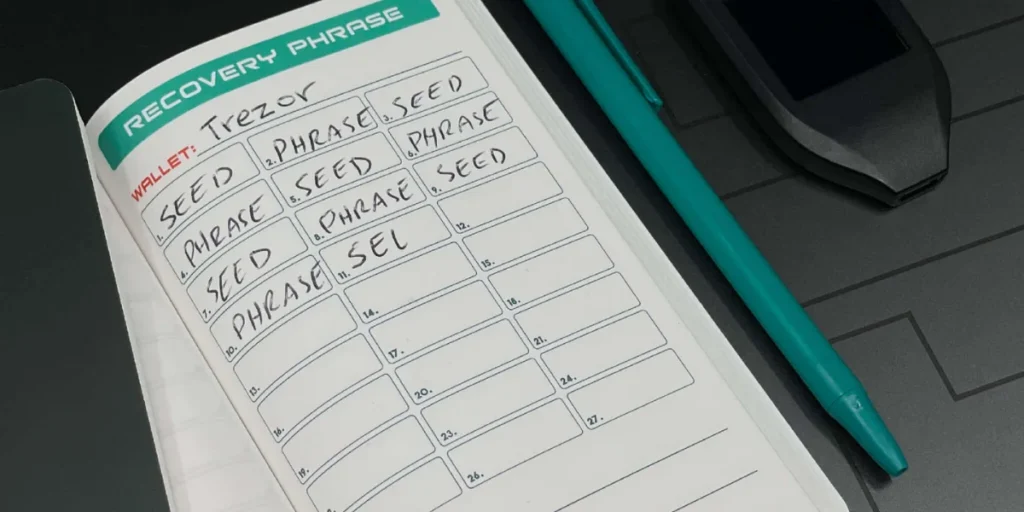
Write It Down on Paper or Metal
Keeping seed phrases offline stands as the industry-wide best practise. Writing words on paper represents the most straightforward method, requiring only a pen and paper. Make sure everything is spelled correctly and in the right order before storing it in a safe place like a bank deposit box or fireproof safe. Despite their simplicity, paper backups are nevertheless susceptible to deterioration, fire, and water.
Alternatively, metal backup plates provide superior durability. These stainless steel or titanium plates withstand fire up to 1510°C, water, and corrosion. Metal storage involves stamping or engraving words onto plates. Products range from letter tile systems to simple plates for direct engraving.
Use a Safe, Lockbox, or Safe Deposit Box
Store physical backups in fireproof safes at home or bank safe deposit boxes. Create at least two copies and place them in separate geographic locations. This redundancy protects against theft, fire, or loss at a single location.
Never Store It on Digital Devices
Digital storage introduces enormous risk. Never save seed phrases as screenshots, photos, cloud documents, email drafts, password managers, or notes apps. These methods expose phrases to malware, hacking, cloud breaches, and device theft.
Split Storage for Extra Security
Splitting seed phrases across multiple locations enhances security. Methods include dividing words into groups stored separately or using Shamir’s Secret Sharing, which creates multiple shares requiring a threshold (2-of-3 or 3-of-5) for recovery.
What Not to Do With Your Seed Phrase
Never photograph, print, or screenshot seed phrases. Avoid sharing with anyone, including family members or support staff. Never store in day-to-day notebooks, desks, or whilst travelling.
Conclusion – What is a Crypto Seed Phrase
Seed phrases represent the absolute foundation of cryptocurrency security and ownership. These 12-24-word sequences function as master keys, generating all private keys in a wallet according to the BIP39 standard. As a result, protecting them becomes paramount for anyone holding digital assets. Physical storage methods, particularly paper or metal backups stored in secure locations, offer the safest approach. Digital storage methods must be avoided without a doubt, given their vulnerability to hacking and device theft. The consequences of seed phrase loss remain severe: permanent, irreversible loss of all wallet funds. Understanding and implementing proper seed phrase security practises separates successful cryptocurrency holders from those who risk losing their entire portfolio.
Scammers will often pretend to be ‘Support’ agents and ask for your words. Our guide on common crypto scams in Australia shows you the red flags so you never accidentally hand over your Master Key.
Should I use a 12-word or 24-word seed phrase?
A 12-word seed phrase provides 128 bits of security, whilst a 24-word phrase offers 256 bits of security. Both are extremely secure and practically impossible to guess through brute force. Most modern wallets automatically generate a length, and both are sufficient for protecting your assets. The choice often depends on your wallet’s default settings, as the security difference is negligible in practice.
Can one seed phrase really recover wallets for multiple cryptocurrencies?
Yes, a single seed phrase can generate wallet addresses for multiple cryptocurrencies, including Bitcoin, Ethereum, and many others. This works through standardised derivation paths that use the same seed phrase but apply different cryptographic algorithms for each blockchain. When you restore your wallet using the seed phrase, compatible wallet software automatically regenerates all your addresses across different cryptocurrencies.
What should I do in the event of seed phrase loss?
Unfortunately, losing your seed phrase results in permanent and irreversible loss of access to your wallet and all funds within it. Wallet providers cannot recover, reset, or retrieve lost seed phrases because they don’t store them anywhere. This is why creating multiple physical backups and storing them in separate secure locations is essential when you first receive your seed phrase.
Is it safe to store my seed phrase digitally on my phone or computer?
No, you should never store your seed phrase results digitally. Saving it as screenshots, photos, cloud documents, password managers, or notes apps exposes it to significant risks, including malware, hacking, cloud breaches, and device theft. The safest method is to write it down on paper or engrave it on metal, then store the physical backups in secure locations, such as fireproof safes or bank deposit boxes.