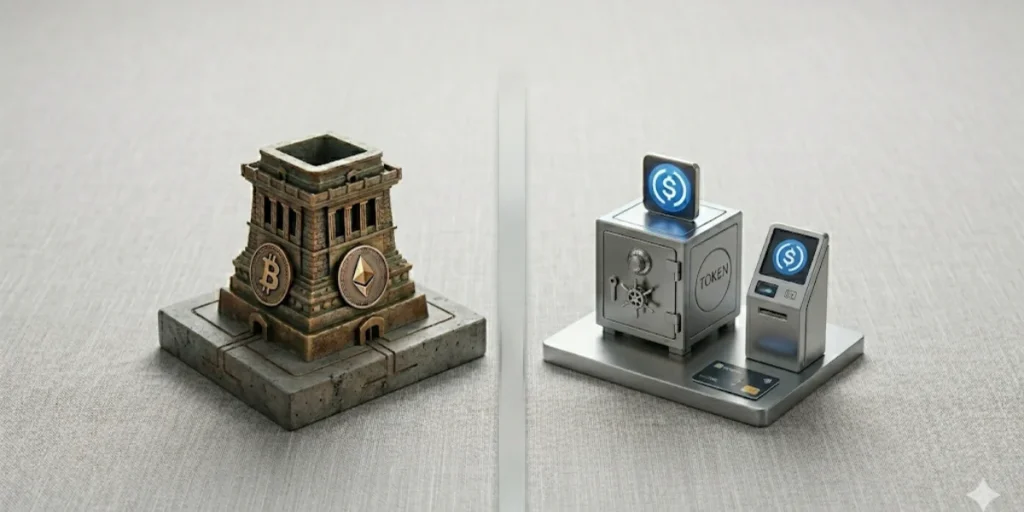
The crypto sector has over 20,000 assets, yet most people still struggle to distinguish between a token and coin. This mix-up happens frequently, with investors thinking they’re buying crypto coins but ending up holding tokens instead. The core difference is straightforward: a coin is native to its Layer-1 blockchain, whereas tokens are created on top of existing chains. Understanding crypto coin vs token distinctions is particularly important, as it affects transaction fees, use cases, and value sources. This guide breaks down cryptocurrency coin vs token differences to help readers identify what they’re actually dealing with.
What Are Crypto Coins?
Definition and Core Characteristics
Crypto coins represent the native assets of blockchain protocols, existing directly on the base layer rather than being built on top of existing networks. The primary medium of exchange for all transactions and smart contracts carried out on their respective blockchains is these digital currencies. Bitcoin operates on the Bitcoin blockchain, whilst ether runs on the Ethereum blockchain, each bearing names that reflect their underlying networks.
Blockchain users deploy cryptocurrencies for various purposes. Some treat them as peer-to-peer payment systems for transferring value electronically without intermediaries. Others view them as stores of value, free from the same controls that govern government-backed currencies. Unlike traditional banking systems that require central authorities, cryptocurrencies operate on decentralised networks secured by blockchain technology.
The defining characteristic of crypto coins is their native status. Individual coin ownership records are stored in digital ledgers secured through consensus mechanisms that control creation, verify transfers, and protect transaction records. Blockchains maintain integrity through cryptography, which verifies and secures data using complex mathematical algorithms. Each transaction forms part of a new block added to the chain, creating a permanent record accessible on public networks.
While Bitcoin is the most famous example of a ‘coin,’ many Australians prefer not to hold it directly. You can compare Bitcoin ETFs vs. buying Bitcoin to see which entry method fits your style.
How Crypto Coins Are Created
New coins enter circulation through validator rewards from blockchain consensus mechanisms. Proof-of-work and proof-of-stake are the two most common methods. The proof-of-work process requires network users to mine coins by solving complex mathematical problems that generate new units. Miners compete to solve these codes, with the system becoming increasingly complex as more computing power joins the network.
Bitcoin miners receive rewards for verifying transactions, with a new block compiled approximately every ten minutes. The proof-of-stake mechanism offers an alternative where users lock up coins through staking to receive rewards. Ethereum switched to proof-of-stake in September 2022, adding staking duties to ether’s existing functions.
Most cryptocurrencies are designed to gradually decrease output, putting limits on total supply. Bitcoin’s supply increases at a predetermined rate and is capped at 21 million units. This controlled issuance differs from that of traditional currencies, in which central banks can adjust supply based on policy decisions.
Popular Examples: Bitcoin, Ethereum, and BNB
Bitcoin launched in January 2009 as the first cryptocurrency, created by pseudonymous developer Satoshi Nakamoto. The system was designed to electronically mimic cash transactions whilst enabling peer-to-peer payments without central parties. Bitcoin undergoes a halving approximately every 4 years and uses proof-of-work consensus.
Ethereum, created in 2013 by Vitalik Buterin, is currently the second-largest cryptocurrency by market capitalization. The platform allows third-party applications to be built on its infrastructure, with ether used to validate transactions and create new blocks. Ethereum has an unlimited total supply, but burns a portion of it after each transaction to prevent inflation.
BNB was developed in 2017 by software entrepreneur Changpeng Zhao and serves as the Binance exchange’s native utility token. BNB trades on the BSC and opBNB networks, regularly sitting in the top five crypto assets by market capitalisation. The token uses an auto-burn mechanism to continuously reduce its total supply to 100,000,000 BNB. BNB Chain operates using a hybrid Proof of Stake Authority consensus, requiring users to stake at least 10,000 BNB for validator selection.
Native Blockchain Ownership
Native tokens are cryptocurrencies created directly on blockchains, used to power transactions and operations within those networks. Originally, the term referred only to a blockchain’s primary token, but it now includes any token built on that chain. These assets are integral to their blockchain networks because they exist on and are directly tied to specific blockchains.
Supply and issuance rules for native coins are governed by the blockchain’s core protocol. When blockchains are developed, they generally address specific issues. Bitcoin’s blockchain and native token were created as a payment system, with rewards incentivising network security. Without native tokens, blockchain networks couldn’t process transactions, maintain security, or function at scale.
What Are Crypto Tokens?
Definition and How Tokens Work
Crypto tokens are digital assets built and deployed on top of Layer-1 blockchains rather than operating on their own networks. Whereas coins function as native currencies, tokens run on existing blockchain infrastructure and serve unique purposes within specific platforms or ecosystems. Developers create tokens using smart contracts, which are self-executing programmes that define token rules, supply limits, and transfer mechanisms. These contracts automate token operations, from minting to transferring between wallets, removing the need for intermediaries.
Tokens are minted all at once, with the maximum supply created in a single batch. Developers can then distribute these tokens through various methods, including initial coin offerings, initial exchange offerings, and airdrops. The programmability of tokens allows them to represent virtually anything, from reputation points on online platforms to financial assets like company shares. Smart contracts ensure that when tokens are sent, the contract verifies balances, updates records, and executes transfers automatically.
Token Standards: ERC-20, BEP-20, and Beyond
Token standards establish the rules and protocols that dictate how tokens function on a blockchain. The ERC-20 standard, proposed by Fabian Vogelsteller in November 2015, became the most widely used specification for creating fungible tokens on Ethereum. This standard implements an API for tokens within smart contracts, requiring six mandatory functions: totalSupply, balanceOf, transfer, approve, transferFrom, and allowance. These functions enable tokens to track total supply, manage balances, and handle transfers between addresses.
BEP-20 serves as the token standard for the BSC ecosystem, following a blueprint that dictates how tokens can be transferred, burned, and minted. BEP-20 and ERC-20 are practically identical in both specification and implementation due to BSC’s EVM compatibility. Additional standards address different use cases. ERC-721 creates non-fungible tokens with unique identifiers for digital art and collectibles. ERC-1155 enables more efficient trades by allowing fungible and non-fungible tokens within a single contract, supporting batch transfers that reduce transaction costs.
Types of Crypto Tokens
Utility tokens provide access to products, services, or features within specific blockchain ecosystems. They function as digital keys rather than representing ownership stakes. Security tokens represent investment contracts or ownership stakes in real-world assets, companies, or revenue streams. These tokens, which are governed by securities laws, frequently grant holders the power to vote, earnings, and asset appreciation.
Governance tokens give holders power to participate in decision-making processes within decentralised platforms. Token holders can propose, debate, and vote on protocol changes, resource allocation, and new features. Non-fungible tokens represent unique, indivisible digital assets with distinct characteristics and ownership records. Each NFT has unique properties, making it well-suited to represent one-of-a-kind items such as digital artwork or gaming assets.
Popular Token Examples: USDT, UNI, and LINK
Tether is an Ethereum token pegged to the US dollar and functions as a stablecoin. USDT’s issuer claims the token is backed by bank reserves and loans that match or exceed the token’s circulating supply. Uniswap’s UNI is an Ethereum token that powers an automated liquidity provider designed to facilitate easy exchange of ERC-20 tokens. Rather than using order books, tokens are exchanged through liquidity pools defined by smart contracts. Chainlink’s LINK token compensates node operators for providing reliable real-world data to smart contracts, solving the oracle problem by enabling blockchain applications to interact with external systems.
Related Article: What Are Stablecoins and Are They Safe to Hold?
Crypto Coin vs Token: The Key Differences
Distinguishing between these asset classes requires examining five fundamental differences that affect how users interact with coin vs token types.
Blockchain Ownership: Native vs Built-On
The most crucial difference lies in blockchain architecture. Coins are the main form of payment for such networks and run on separate, independent blockchains. Tokens lack independent networks and instead leverage infrastructure from pre-existing blockchains through smart contracts. Bitcoin runs solely on the Bitcoin blockchain, whereas thousands of tokens operate on Ethereum’s network without owning the underlying infrastructure. This architectural distinction determines every other difference between the two asset types.
Creation Methods: Mining vs Smart Contracts
New coins enter circulation through blockchain consensus mechanisms requiring significant computational resources or capital. Proof-of-work coins are mined by solving complex mathematical problems, whilst proof-of-stake coins reward validators who lock up existing tokens. Tokens follow a different path. Developers mint the entire token supply at once using smart contracts that define specifications. This process requires neither mining hardware nor staking capital, making token creation considerably faster and less resource-intensive than establishing new blockchains.
Transaction Fees: Self-Paid vs Host-Dependent
Users pay all blockchain transaction fees in native coins rather than tokens. To send tokens, holders must possess enough native coins to cover gas fees. A wallet containing only tokens, but no native coins, cannot execute transfers because validators refuse to process transactions without native coin payments. Custodial wallets run by exchanges may temporarily cover fees and deduct costs in tokens with added markup, but non-custodial wallets require users to hold native coins themselves. This dependency often strands users holding tokens they cannot move.
Primary Functions and Use Cases
Coins function primarily as digital money, a store of value, and a network fuel for powering blockchain operations. They serve three main purposes: a medium of exchange, a store of value, and, sometimes, as a unit of account. Tokens extend far beyond currency functions. They grant platform access, enable governance voting, represent real-world assets, and power decentralised applications. Whereas coins focus on monetary utility, tokens address diverse needs from stablecoin pegs to NFT ownership verification.
Value Sources and Market Behaviour
Coins derive value from utility, scarcity, and demand within native networks. Bitcoin gains value from its capped supply and role as a digital alternative to traditional currencies. Network effects increase the coin’s value as more users and transactions join the blockchain. Token value operates differently, tied to specific project success, utility within applications, and tokenomics designed by developers. This creates distinct market behaviour patterns between cryptocurrency coin vs token assets.
Related Article: What Are Tokens? Your Practical Guide to Digital Assets
How Coins and Tokens Are Used in 2026
Adoption patterns have shifted considerably, with crypto coins and tokens serving distinct but complementary roles in established financial infrastructure.
Coins as Digital Money and Network Fuel
Native blockchain currencies continue powering decentralised networks through validator rewards and transaction processing. Users deploy coins for peer-to-peer transfers, particularly in regions experiencing monetary instability where access to stable currencies remains limited. Coins maintain networks by compensating validators who secure blockchains and process transactions. Bitcoin’s role as a digital alternative to fiat currencies strengthens as institutional investors increasingly allocate capital through ETF wrappers, model portfolios, and directed mandates rather than self-directed investments.
Tokens for Governance and Utility
Governance tokens confer voting rights on protocol changes, fee structures, and treasury allocations within decentralised autonomous organisations. Holders propose improvements and vote on implementations, with smart contracts automatically executing approved changes. Utility tokens grant access to specific platform features and services, functioning as digital keys rather than currencies. DeFi protocols require native tokens for accessing lending, staking, and yield farming opportunities, whilst platform tokens power ecosystems by rewarding users and enabling interactions.
Stablecoins and Asset-Backed Tokens
Stablecoin supply expanded from AUD 314.97 billion to over AUD 458.70 billion in 2025, accelerated by regulatory clarity from the GENIUS Act passed in July 2025. Corporations recognise advantages for treasury operations, with settlement time reductions creating significant savings for companies processing billions in transactions. Major financial institutions, including JPMorgan, Société Générale, and US bank consortia, now issue regulated tokens for remittances, B2B payments, and cross-border settlement. Tokenisation of real-world assets enables fractional ownership of bonds, real estate, and carbon credits, reshaping capital markets through programmable securities that settle atomically via smart contracts.
NFTs and Digital Collectibles
NFTs transitioned from speculative collectibles to functional infrastructure for verification, certification, and access control. Projects surviving beyond initial mints answer practical questions about post-purchase utility. Applications include verifiable certificates for artwork provenance, fraud-resistant event tickets with automated perks, and membership tokens granting exclusive access to communities and content.
How to Identify a Coin vs Token
Verification methods separate crypto coins from tokens through four practical approaches that reveal asset architecture.
Check the Blockchain Platform
Native crypto assets belong to specific blockchains, whilst tokens are developed on blockchains and depend on those networks for operations. Multiple blockchains can support tokens, whereas coins remain exclusive to their networks. Checking which blockchain an asset operates on immediately reveals its classification. Bitcoin running on the Bitcoin blockchain signals a coin, whereas an asset running on Ethereum through a smart contract indicates a token.
Use Blockchain Explorers
Blockchain explorers function as search engines that let users view transactions, wallet balances, smart contracts, and block histories. Etherscan allows users to read the Ethereum blockchain, whilst Solscan serves the Solana network. Different chains require specific explorers: Bitcoin uses Blockchain.com, Ripple uses XRPScan, and Polygon uses Polygonscan. Users can search by transaction hash, block number, or wallet address to find relevant information. For tokens, pasting the smart contract address into the explorer reveals token decimals, contract data, and other specifications in the profile summary.
Review Project Documentation
Official project materials explicitly state whether assets function as native coins or tokens built on existing infrastructure.
Conclusion – Token and Coin
The distinction between coins and tokens is fairly straightforward once the architecture is understood. Coins operate on their own blockchains, whilst tokens are built on existing networks through smart contracts. This difference affects everything from transaction fees to value sources.
As a result, checking the blockchain platform reveals the classification instantly. On its native chain, Bitcoin signals a coin, whereas assets running on Ethereum indicate tokens. Blockchain explorers provide verification by displaying contract addresses and network details. Altogether, understanding the differences between cryptocurrency coins and tokens helps investors identify what they’re purchasing and anticipate how these assets function within their respective ecosystems.
Whether you are buying a coin or a token, the security rules remain the same. Always ensure you have a backup of your crypto seed phrase before moving assets off an exchange.
How can I tell if I’m buying a coin vs token?
Check which blockchain the asset operates on. If it runs on its own dedicated blockchain, it’s a coin. If it’s built on top of another blockchain like Ethereum or Binance Smart Chain, it’s a token. You can verify this by using blockchain explorers such as Etherscan for Ethereum-based assets or by reviewing the project’s official documentation.
Do I need the native coin to send tokens?
Yes, you must hold the native coin of the blockchain to pay transaction fees when sending tokens. For instance, to transfer ERC-20 tokens on Ethereum, you need ETH in your wallet to cover gas fees. Without the native coin, you cannot execute token transfers, even if you hold the tokens themselves.
Which is better to invest in: coins vs tokens?
Neither is inherently better—they serve different purposes. Coins typically function as digital currency and network fuel, whilst tokens often provide access to specific applications, governance rights, or represent real-world assets.
Can tokens become coins?
Yes, a token can become a coin if the project later launches its own blockchain. Several projects have started as tokens on existing blockchains and subsequently migrated to their own networks. When this happens, the asset transitions from being a token dependent on another blockchain to a coin with its own independent infrastructure.