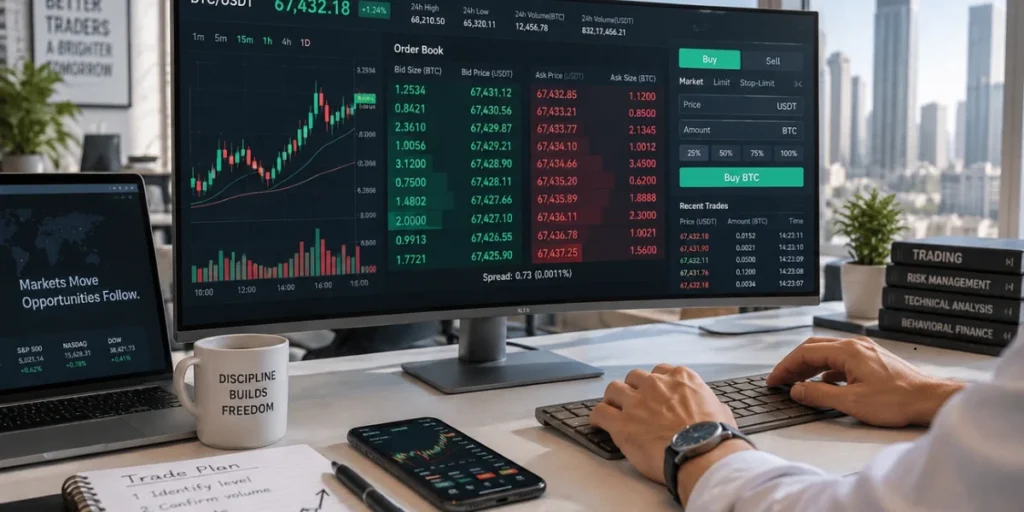
What is an order book, and why does almost every exchange rely on this electronic registry to facilitate trading? An order book serves as a dynamic record of buy orders, sell orders, and order history, organised by price level. This fundamental infrastructure is used across various assets, including stocks, bonds, currencies, and cryptocurrencies.
Understanding the order book meaning helps traders decode critical market signals. For instance, the difference between the highest bid and lowest ask reveals liquidity conditions, whilst clusters of orders can indicate potential support and resistance levels. This guide explores what is an order book in trading, how does an order book work, and how limit order book mechanics shape the bid-ask spread and overall market structure traders encounter daily.
What Is an Order Book in Trading
Order Book Meaning and Core Components
An order book lists the number of shares being bid on or offered at each price point, serving as a comprehensive registry that trading venues use to record market interest in specific securities or financial instruments. Beyond price information, these systems identify market participants behind transactions, although some choose to remain anonymous.
The structure comprises three distinct parts. Buy orders contain buyer information, including all bids and the amounts traders wish to purchase. Sell orders resemble buy orders but display all offers or asking prices where participants are willing to sell. Order histories show all transactions that have taken place in the past. The top of the book displays the highest bid and lowest ask prices, indicating the predominant market and price levels needed to get an order executed.
Buy Orders (Bids) and Sell Orders (Asks)
The bid side displays all purchase orders placed by traders and investors, indicating price levels at which buyers are willing to acquire assets along with the quantities they seek. Correspondingly, the ask side shows sell orders, outlining price levels at which sellers look to sell assets and the quantities available for sale.
Orders organise according to their respective price levels, with the highest bid price typically shown at the top of the bid side, whilst the lowest ask price appears at the top of the ask side. Each entry specifies the quantity of the asset the trader intends to transact, which can vary from a single unit to larger volumes depending on trader intention.
Real-Time Updates and Market Depth
Order books update in real time because they serve as important indicators of market depth, the amount of trades at any given moment. This continuous updating earns them the designation ‘continuous book’. Market depth data exists as an electronic list organised by price level, reflecting current activity.
The depth refers to the number of price levels available at a particular time in the book. Securities with strong market depth will usually have strong volume and be quite liquid, allowing traders to place large orders without significantly affecting the market price.
Electronic vs Manual Order Books
Since 1986, exchanges like the London Stock Exchange have used electronic order books to match buyers with sellers and facilitate trades, known as Central Limit Order Books. These orders can be both manual or electronic. The opposite of trading in an exchange’s order book is trading off-book, where the trade price is agreed directly between two parties. The reporting process for off-book trading is not as rigid as trading directly into an order book, with fewer time constraints.
How Does an Order Book Work

Limit Orders Adding Liquidity to the Book
Limit orders specify both a price and quantity at which a trader is willing to buy or sell. When a trader places a buy limit order below the current market price or a sell limit order above it, the order enters the order book and waits to be matched. These orders add liquidity to the market since they provide shares available for other participants.
By placing their orders in the open market, traders let other market participants know they have shares available for purchase. A buy limit order sets a maximum price to be paid, whilst a sell limit order establishes a minimum price to be received. Unlike market orders, execution isn’t assured, and any limit orders that aren’t executed immediately appear in the order book.
Market Orders Removing Liquidity
Market orders execute trades immediately at the best price currently available in the order book. A market buy order immediately matches with the lowest available sell orders, whilst a market sell order matches with the highest available buy orders. As these trades execute, they reduce the quantities available in the order book and may shift the best bid and ask prices. Using a market order removes liquidity from the market because the trader either buys at the ask or sells at the bid, taking shares off the current book.
Price Priority and Time Priority Rules
Electronic markets follow two key priority rules when matching orders: price priority and time priority. Better prices execute first, meaning the highest bid has priority among buy orders, whilst the lowest ask has priority among sell orders. If multiple orders are placed at the same price level, time priority applies. The order submitted earlier will be executed before later orders. Queue position represents real value, as earlier orders fill before later ones at the same price.
Order Matching and Execution Process
When a buy order matches at the same price with a sell order, then a trade is born. The matching engine checks for crossing prices, executes trades at the best available price, updates remaining quantities, and maintains price-time priority. The interaction between incoming limit orders and market orders continuously reshapes the order book and drives short-term price movements.
Decoding Bid-Ask Spreads in Order Books
Understanding the Bid-Ask Spread
The bid-ask spread represents the difference between the highest price a buyer will pay and the lowest price a seller will accept for an asset. Calculated as ask price minus bid price, this spread serves as the principal transaction cost of trading outside of commissions. In essence, traders view the bid-ask spread as an indicator of market liquidity, with high friction between supply and demand creating a wider spread.
Spread Width as a Liquidity Indicator
Narrower spreads often indicate an asset is easier and cheaper to trade. Currency markets demonstrate this principle, featuring some of the narrowest bid-ask spreads at one-hundredth of a percent. Correspondingly, less liquid assets such as small-cap stocks may have spreads equivalent to 1% to 2% of the asset’s lowest ask price. The measure can be calculated quickly with data widely available in real time.
Transaction Costs and Spread Impact
Every trade incurs the spread cost, collected by market makers through the natural flow of orders processed at bid and ask prices. Under competitive conditions, the bid-ask spread measures the cost of making transactions without delay.
Support and Resistance Levels from Order Clusters
Significant liquidity concentrations in the order book, often called ‘liquidity walls’, manifest as true support or resistance levels. High-volume clusters indicate price zones where significant exchange of ownership occurred.
Market Structure and Order Book Transparency

Dark Pools and Hidden Orders
Not all trading occurs on visible order books. Dark pools operate as private exchanges where institutional investors execute large trades without broadcasting intentions to the wider market. These alternative trading systems account for approximately 15% of US equity volume, allowing participants to avoid the market impact that transparent order placement creates. Since dark pool participants do not disclose their trading intention to the exchange before execution, there is no order book visible to the public.
Off-Book Trading vs Exchange Trading
Off-book trading executes away from an order book but is reported to an exchange under exchange rules. Between January 2023 and December 2024, off-book on-exchange market share nearly doubled from 13% to 23%. However, when examining only addressable, price-forming trades, the market share remained flat at 7% over the same period.
Market Depth and Volume Distribution
Market depth represents the volume of orders to buy or sell at various price levels. Traders use this data to determine optimal order sizes based on available liquidity, minimising slippage and market impact. The depth information updates in real time and proves critical for execution strategy selection.
Order Book Data for Institutional vs Retail Traders
Institutional participants access dark pools for large block trades, whilst retail investors typically lack direct access to these venues. Research shows that average order size decreases following periods of high retail attention, suggesting retail traders submit smaller orders compared to institutional counterparts.
Conclusion – Order Book
Order books remain the backbone of modern trading infrastructure, essentially providing transparency into market liquidity and price formation mechanisms. The bid-ask spread serves as a critical indicator of transaction costs and asset liquidity, whilst clusters of orders reveal potential support and resistance zones. As a result, traders who understand order book mechanics gain significant advantages in executing strategies efficiently. Market depth analysis, coupled with awareness of off-book trading venues, equips both institutional and retail participants with tools to navigate today’s complex market structure effectively.
You May Also Be Interested In: The Ultimate Crypto Tax Guide
What exactly is an order book and why is it important in trading?
An order book is an electronic registry that records all buy and sell orders for a specific security or financial instrument, organised by price level. It displays the number of shares being bid on or offered at each price point, helping traders understand market interest and liquidity. Order books are fundamental to modern trading as they provide real-time transparency into supply and demand, allowing traders to make informed decisions about when and at what price to execute their trades.
How do bid and ask prices work in an order book?
The bid represents the highest price a buyer is willing to pay for an asset, whilst the ask is the lowest price a seller is willing to accept. These prices appear at the top of the order book, with bids organised from highest to lowest and asks from lowest to highest. The difference between the highest bid and lowest ask is called the bid-ask spread, which serves as an indicator of market liquidity and represents the primary transaction cost of trading.
What’s the difference between limit orders and market orders in an order book?
Limit orders specify both a price and quantity, adding liquidity to the order book by waiting to be matched at the specified price or better. Market orders execute immediately at the best available price, removing liquidity from the book. Whilst market orders guarantee execution, limit orders offer price control but may not execute if the market doesn’t reach the specified price level.
What are dark pools and how do they differ from regular order books?
Dark pools are private exchanges where institutional investors execute large trades without displaying their orders on public order books. Unlike transparent exchange trading, dark pools allow participants to trade anonymously without revealing their intentions to the wider market, helping them avoid the price impact that large visible orders might create. Dark pools account for approximately 15% of US equity trading volume.