
Crypto staking Australia offers investors the opportunity to earn returns ranging from around 4% to 12% annually on major cryptocurrencies. Staking cryptocurrency involves locking up digital assets to help secure blockchain networks in exchange for rewards. Understanding the staking crypto meaning is essential: users participate in proof-of-stake systems where validators confirm transactions based on their staked holdings. This article explores how proof-of-stake consensus works, the various staking methods available, yield calculations, and critical risks including slashing penalties that can result in stake loss.
What Is Staking Crypto?
Staking Cryptocurrency Explained
Staking represents a process where cryptocurrency holders deposit their digital assets to activate validators and participate in blockchain consensus mechanisms. The practise enables users to lock up their coins within a network, creating a financial commitment that serves as proof of their genuine interest in the network’s operation. Instead of relying on computational power to validate transactions, crypto staking operates through proof-of-stake systems where participants pledge their capital as collateral.
The proof-of-stake consensus mechanism emerged as an alternative to energy-intensive mining operations. Users who stake their cryptocurrency become eligible for selection as validators, with the network randomly choosing participants based on their staked amounts and other factors. This deposited cryptocurrency remains locked on the blockchain for specified periods, during which owners cannot move or trade these assets. The lock-up ensures validators maintain their commitment to honest network participation.
When users stake their crypto, they receive potential rewards for supporting network operations. These rewards function similarly to earning returns on deposited assets, with participants receiving additional cryptocurrency over time. The network distributes these rewards to compensate stakers for their capital commitment and active participation in maintaining blockchain security and efficiency.
How Staking Supports Blockchain Networks
Proof-of-stake blockchains depend on staked capital to maintain security and process transactions. Validators who stake their assets provide the economic foundation that protects networks from malicious attacks. An attacker would need to control the majority of all staked cryptocurrency to threaten network integrity, making such attempts prohibitively expensive.
The staking mechanism creates strong deterrents against fraudulent behaviour through economic penalties. Networks can destroy portions of a validator’s staked assets if dishonest activity occurs, a process known as slashing. This financial risk aligns validator incentives with network health, ensuring participants act in the blockchain’s best interest. The threat of losing staked capital prevents double-spending attempts and other fraudulent transactions.
Moreover, crypto staking enables decentralised transaction validation without centralised intermediaries. Multiple validators continuously cross-check each other’s work, maintaining blockchain accuracy and efficiency. This distributed verification process ensures all transactions meet network rules before blocks get added to the chain. The system reduces energy consumption dramatically compared to proof-of-work mining, consuming approximately 99.9% less electricity whilst maintaining robust security.
Validators and Their Role in Staking
Validators serve as the operational backbone of proof-of-stake networks. These entities run specialised software on dedicated servers, maintaining complete copies of the blockchain and participating in consensus processes. On Ethereum, becoming a validator requires depositing 32 ETH into a smart contract. This deposit functions as a security bond, with the network using this stake to enforce honest participation.
Validators perform two critical functions. First, when selected by the network, they propose new blocks containing batched transactions and broadcast these blocks across the network. Second, when not proposing blocks, validators act as attestors who review and vote on blocks proposed by others. Time in proof-of-stake systems divides into slots and epochs, with one validator randomly selected as a block proposer in every slot.
Not everyone who stakes becomes a validator. Delegated staking allows users to participate without meeting full validator requirements or operating technical infrastructure. Delegators assign their staked cryptocurrency to existing validators, who then validate transactions on their behalf. Both validators and delegators earn rewards for successful participation, with the rewards distributed proportionally. This delegation model enables broader network participation whilst maintaining the security benefits of the staking mechanism.
Validators face accountability for their actions. Networks enforce penalty mechanisms where validators can lose portions of their stake through slashing if they act maliciously or fail to fulfil their responsibilities effectively. These penalties range from minor amounts for going offline to complete stake destruction for provable misbehaviour such as proposing multiple blocks in a single slot or submitting contradictory attestations.
How Proof-of-Stake Consensus Works
Proof-of-Stake vs Proof-of-Work
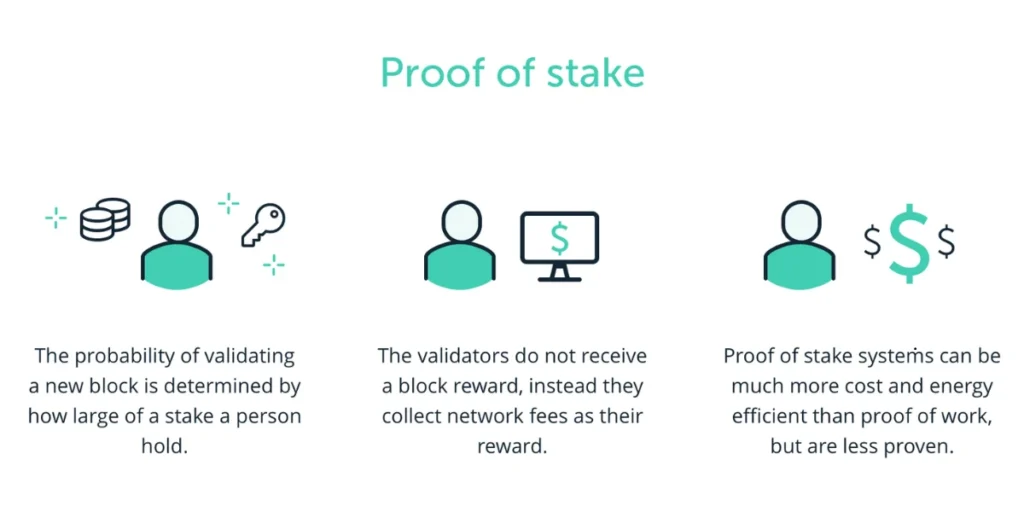
Proof-of-stake and proof-of-work employ fundamentally different security models. In proof-of-work systems, network security relies on computational effort, with miners competing to solve cryptographic puzzles by expending electricity and hardware resources. The cost of attacking such networks ties directly to energy consumption and access to specialised mining equipment. By contrast, proof-of-stake enforces security economically. Validators lock capital into the protocol, and the risk of losing this stake through slashing replaces the need for continuous computational work. Attacking a proof-of-stake network requires acquiring and risking a substantial portion of the token supply.
These differing security approaches create meaningful trade-offs. From an energy perspective, proof-of-stake demonstrates significantly greater efficiency because it does not rely on continuous hashing. Ethereum’s 2022 transition from proof-of-work to proof-of-stake reduced the network’s energy consumption by approximately 99.9%. Performance characteristics also differ substantially. Proof-of-stake networks typically achieve faster block times and stronger finality guarantees, enabling higher throughput. Bitcoin’s proof-of-work network takes roughly 10 minutes to create new blocks, whilst Ethereum’s proof-of-stake system produces blocks every 12 seconds.
Validator Selection Process
Proof-of-stake systems select validators through pseudo-random mechanisms weighted by stake size. Instead of competing through computational power, participants commit economic value by staking tokens. In Ethereum, one validator receives random selection as a block proposer in every slot, with time divided into 12-second slots and epochs containing 32 slots. The selection process uses RANDAO, a randomization mechanism that prevents predictability whilst incorporating stake amounts as weighting factors.
The amount staked influences selection probability, yet randomness ensures broader participation. Networks balance security, fairness, and decentralisation through these protocol-specific weighting rules. Ethereum requires validators to deposit 32 ETH into a smart contract, with depositors joining an activation queue that limits new validator entry rates. Once activated, validators receive new blocks from network peers and begin participating in consensus.
Block Creation and Transaction Validation
The validation process follows a structured sequence. Validators who receive selection as block proposers bundle transactions from their local mempool into execution payloads. The execution client processes these transactions locally to generate state changes, passing this information to the consensus client. The consensus client wraps the execution payload within a beacon block containing rewards, penalties, slashings, and attestations.
Other network nodes receive the new beacon block through the consensus layer gossip network. Their execution clients re-execute transactions locally to verify the proposed state change’s validity. Validator clients then attest that blocks appear valid and represent the logical next block in their chain view. A randomly chosen committee of validators votes on each block’s validity, with this division into committees keeping network load manageable.
Network Security Through Economic Incentives
Economic incentives create powerful security guarantees. Validators vote for checkpoint pairs that they consider valid, and when checkpoint pairs attract votes representing at least two-thirds of total staked ETH, the checkpoints upgrade to justified and finalised status. Once finalised, blocks cannot be reverted without a majority slashing event where attackers would forfeit at least one-third of the total staked supply. Correlation penalties scale with the number of validators being slashed simultaneously, ranging from minor amounts for individual validators to complete stake destruction during coordinated attacks. This economic model makes attacks prohibitively expensive whilst maintaining robust decentralisation.
Different Methods to Stake Crypto
Multiple approaches exist for participating in proof-of-stake networks, each offering distinct trade-offs between control, technical requirements, and capital commitment.
Solo Staking: Running Your Own Validator
Solo staking represents the most direct participation method, requiring users to operate their own validator infrastructure. Ethereum mandates a minimum deposit of 32 ETH to activate a validator. This approach demands dedicated hardware with substantial RAM, enterprise-grade storage, and reliable internet connectivity. Validators must maintain their nodes online approximately 24 hours daily to fulfil consensus responsibilities and earn full protocol rewards. Solo stakers retain complete control over their validator keys, receiving payments directly from the blockchain without intermediaries. The technical complexity requires understanding client software, security practises, and network operations, though simplified tools have emerged to reduce barriers.
Delegated Staking Through Validators
Delegated staking enables participation without operating validator infrastructure. Token holders assign their staking power to professional validators whilst retaining custody of their assets. The delegation occurs at the protocol level as a voting power assignment rather than a fund transfer. Validators typically charge commission fees ranging from 5% to 10% of earned rewards. Delegators share slashing risk with their chosen validator, meaning validator misbehaviour results in stake penalties for both parties. Networks implement varying unbonding periods, with Cosmos requiring 21 days and Solana taking 2 to 3 days before delegated tokens become liquid again.
Staking Pools and Combined Resources
Staking pools aggregate capital from multiple participants to meet minimum validator requirements. These pools lower entry barriers substantially, allowing users to contribute smaller amounts than solo staking demands. Pool operators manage the technical infrastructure and validator operations, charging fees typically around 5% of rewards. Participants receive proportional rewards based on their contribution to the total pool. Annual returns have fluctuated considerably, with rates historically ranging from 10% to 150% depending on network conditions and pool structure. Most pools implement lock-up periods aligned with their blockchain’s native requirements, though some offer flexible withdrawal options.
Exchange-Based Staking Services
Centralised exchanges provide custodial staking where platforms like Kraken, Binance, and Coinbase manage the entire process. Users deposit assets with the exchange, which handles validator operations and distributes rewards automatically. This method offers maximum convenience for beginners but requires trusting the exchange with asset custody. Platforms typically support both flexible and fixed-term options, with longer lock-ups generating higher yields.
Liquid Staking and Derivative Tokens
Liquid staking protocols issue derivative tokens representing staked positions, preserving capital mobility. Users deposit assets and receive liquid staking tokens (LSTs) that track the underlying stake’s value whilst accruing rewards. These derivatives function as transferable receipts usable across DeFi protocols for lending, collateral, or trading. Major providers like Lido charge approximately 10% commission on staking rewards. LSTs introduce smart contract risk and potential price deviations from underlying assets during market stress, yet they eliminate traditional lock-up constraints.
Related Article: Smart Contract Development: What Every Developer Gets Wrong About Security
Staking Yields and Reward Distribution

How Staking Rewards Are Calculated
Protocols calculate staking rewards through precise mathematical formulas that account for multiple contribution types. On Ethereum, validators receive a base reward that represents the foundation for all earnings. This base reward equals the validator’s effective balance multiplied by a factor, then divided by the product of base rewards per epoch and the square root of total active balance. The calculation means base rewards scale proportionally with a validator’s stake yet inversely with total network validators.
Validators earn rewards across five components: source votes for correct checkpoint attestations, target votes, head votes for accurate block identification, sync committee participation, and block proposal duties. These components carry different weightings that sum to 64, with target votes weighted at 26 and proposer rewards at 8. A validator performing all duties receives the full base reward, whilst those not proposing blocks earn seven-eighths of the base reward.
Annual Percentage Yield (APY) Ranges
Current staking yields vary substantially across proof-of-stake networks. Ethereum staking generates approximately 3.1% annually as of mid-2025, with the active validator set exceeding one million and more than 35 million ETH staked. Solana offers 5% to 7% annually, whilst the median reward rate across proof-of-stake assets stands at 7.32%. Individual networks show considerable range, with some assets delivering yields exceeding 15%.
Factors Affecting Your Staking Returns
Validator performance dominates outcome determination. Uptime and attestation timeliness directly influence earnings, with missed attestations reducing rewards and extended outages triggering inactivity penalties. The total amount staked network-wide dilutes individual returns as more validators share fixed issuance. Transaction fees and MEV create additional variable income tied to network activity levels.
Reward Payment Frequency and Compounding
Ethereum distributes rewards at each epoch conclusion, approximately every 6.4 minutes. Solana pays rewards every epoch spanning 2 to 3 days, with automatic compounding if tokens remain staked. In contrast, most major stakeable cryptocurrencies require manual compounding, where claiming and restaking incurs transaction fees that must be considered against potential gains.
Risks of Crypto Staking: Understanding Slashing

Staking introduces several financial and operational risks that participants must understand before committing capital.
What Is Slashing in Proof-of-Stake?
Slashing penalises validators for protocol violations by destroying portions of their staked assets. Three primary offences trigger slashing: proposing multiple blocks in a single slot, submitting contradictory attestations that surround previous votes, and double voting by attesting to two candidates for the same block. Networks enforce these rules automatically through cryptographic proof submitted by whistleblowers. Slashing occurrences remain relatively rare, with less than 0.04% of Ethereum validators experiencing penalties as of February 2024.
Validator Penalties and Stake Loss
Penalty severity escalates based on coordinated violations. Individual Ethereum validators face immediate losses of approximately 1 ETH, followed by ongoing penalties during a 36-day removal period. The correlation penalty applies on Day 18, scaling with the number of simultaneously slashed validators. Mass slashing events can destroy 100% of a validator’s stake. Delegators share proportional losses when their chosen validator faces slashing.
Lock-Up Periods and Liquidity Constraints
Unbonding periods prevent immediate asset access. Ethereum’s withdrawal queue delays exits during volatile conditions, whilst Cosmos requires 21 days and Polkadot 28 days. Assets earn no rewards during unbonding.
Market Volatility Impact on Staked Assets
Token price declines can exceed staking yields. A 40% price drop eliminates gains from 10% annual returns. Solana’s 2022 price collapse demonstrated how market conditions override high staking rates.
Platform and Smart Contract Risks
Smart contract vulnerabilities expose staked funds to exploits. A June 2025 liquid staking incident enabled unauthorised token minting worth approximately 27 million dollars. Exchange insolvency and operational failures create additional counterparty risks.
Conclusion – Crypto Staking Australia
Crypto staking represents a compelling yet complex opportunity for investors seeking passive cryptocurrency income. As shown above, proof-of-stake consensus mechanisms provide energy-efficient blockchain security through economic incentives rather than computational power. Participants can choose from solo staking, delegation, pools, or liquid staking depending on their technical expertise and capital availability. Yields ranging from 3% to 15% annually come with corresponding risks, particularly slashing penalties that can destroy staked capital. Token price volatility, lock-up periods, and smart contract vulnerabilities require careful consideration. Successful stakers balance potential rewards against operational demands and financial exposure, selecting participation methods aligned with their risk tolerance and investment objectives whilst maintaining awareness of network-specific requirements.
You May Also Be Interested In: How to Buy Meme Coins in Australia: A Step-by-Step Guide for Beginners
What exactly is crypto staking and how does it generate rewards?
Staking involves locking up your cryptocurrency to help secure and validate transactions on a blockchain network. In return for committing your assets and supporting the network’s operations, you receive staking rewards in the form of additional cryptocurrency. The process works through proof-of-stake systems, where your staked tokens give you the opportunity to participate in transaction validation, and the network compensates you for this contribution with yields typically ranging from 3% to 15% annually.
Is staking crypto considered a worthwhile investment strategy?
Crypto staking can be an attractive option for earning passive income on crypto holdings, particularly for long-term investors. However, it carries specific risks that must be weighed against potential returns. Whilst you can earn steady yields, your staked assets remain locked for certain periods, during which token price volatility can exceed your staking gains. Additionally, validator penalties, smart contract vulnerabilities, and liquidity constraints mean staking suits those who understand these risks and can tolerate temporary loss of access to their funds.