
Solana can process up to 710,000 transactions per second, whilst each transaction costs less than one cent. That’s faster and cheaper than virtually any other blockchain available today.
Yet, speed and low costs are just the beginning. Those exploring this Solana ecosystem guide will discover a thriving network of decentralised exchanges, DeFi platforms, NFT marketplaces, and Web3 gaming applications. Essentially, the Solana ecosystem explained encompasses everything from setting up Solana wallets to staking, trading, and staying secure. This Solana ecosystem guide walks beginners through the fundamentals, helping them navigate Solana’s key components and master essential activities with confidence.
Understanding Solana: The Foundation of the Solana Network
What is Solana and Why It Matters
Anatoly Yakovenko, a former Qualcomm engineer, founded Solana in 2017 and launched the network in March 2020. His vision centred on creating a decentralised network capable of matching the performance of a single node. The platform addresses fundamental problems that plagued earlier blockchains like Bitcoin and Ethereum: high transaction fees and slow processing speeds.
Solana operates as a global network of computers processing transactions in under a second. Over 1,000 validators worldwide maintain this distributed structure, preventing any single point of failure or control. More than AUD 7.19 trillion in stablecoins moved across Solana in the past year, demonstrating the network’s capacity to handle real-world financial activity at scale.
How Solana Works: Proof of History Explained
Proof of History represents Solana’s core innovation, though it functions differently than many assume. Proof of History is not a consensus mechanism. Instead, it operates as a cryptographic timekeeping mechanism that works before consensus occurs.
Traditional blockchains require nodes to communicate constantly to agree on the order of transactions. Yakovenko illustrated this inefficiency by referencing Hedera Hashgraph, where each message must travel to a supermajority of nodes, collect signatures, then propagate across the entire network. This process consumes significant computational power and creates bottlenecks.
Proof of History solves this by using an SHA-256 sequential hashing verifiable delay function. Each validator maintains its own clock by encoding the passage of time through this hashing process. The system creates a sequential chain where each hash derives from the previous one, taking a specific amount of time to compute. This forms a historical record that nodes use to verify the sequence and timing of events.
When new transactions arrive, they use the most recent hash. Validators can confirm that transactions occurred at specific time periods by verifying these cryptographic timestamps. Since consensus on time and sequence is removed from the process, Solana creates lengthy schedules of leaders who constantly rotate validating duties.
Solana vs Other Blockchains
Solana processes 2,000-4,000 transactions per second with 0.4-second block times. In contrast, Ethereum handles 15-30 TPS with 12-second blocks, whilst Bitcoin manages approximately 7 TPS with 10-minute block times.
Transaction fees reveal equally stark differences. Solana maintains costs at fractions of a cent per transaction, whereas Ethereum base layer fees fluctuate significantly and can spike during network congestion. Ethereum currently has over 1 million validators running on consumer-grade hardware, whilst Solana operates with approximately 1,500-2,000 validators requiring more powerful equipment. This represents a trade-off Solana accepts for higher performance.
Solana uses a monolithic architecture where all core functions execute within a single blockchain layer. The network employs Sealevel, a parallel execution engine running multiple smart contracts simultaneously, and Gulf Stream, a transaction forwarding protocol reducing confirmation times.
The SOL Token and Its Role
SOL serves as Solana’s native currency, performing multiple functions across the network. Users need SOL to pay transaction fees, with less than AUD 1.53 worth covering hundreds of transactions. Holders can stake their SOL by delegating it to validators, securing the network whilst earning rewards. Staking yields typically range from 4-8% annually.
Solana follows a predictable inflation schedule starting at 8% annually, decreasing by 15% each year until reaching a fixed 1.5% rate. The network burns a portion of each transaction fee, counteracting inflation and creating scarcity. Validators keep the remaining fees as compensation for processing transactions.
Essential Components of the Solana Ecosystem Overview
Solana Wallets: Your Gateway to Solana
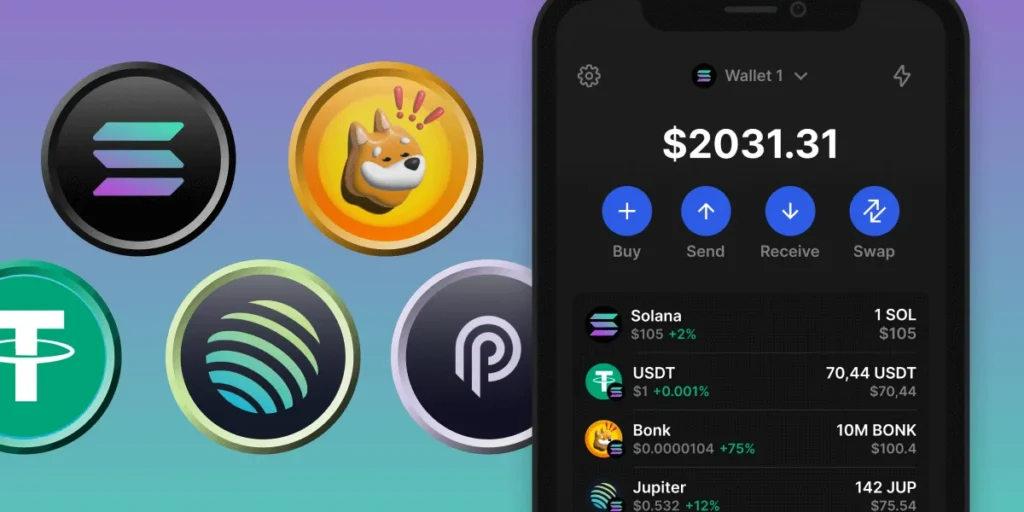
Non-custodial wallets give users full control over private keys whilst enabling interaction with the entire Solana network. These wallets store cryptographic keys that prove asset ownership, display token balances and NFT collections, sign transactions, and connect to decentralised applications.
Phantom serves as one of the most widely adopted options, with over 15 million users managing assets across Solana, Bitcoin, Ethereum, Base, and other blockchains. Solflare attracts over 4 million users through its Solana-native focus, offering integrated staking, swaps, and DeFi access without external tools. Backpack provides advanced tooling for developers, whilst Jupiter Wallet prioritises active traders seeking low-fee swaps.
Hardware wallets like Ledger and Trezor offer cold storage security by keeping private keys offline. Most experienced users combine both approaches: hardware wallets for long-term holdings and software wallets for frequent transactions.
Decentralised Exchanges (DEXs)
Solana’s DEX ecosystem processed AUD 1.18 billion in 24-hour volume, accounting for 11.4% dominance across all blockchains. These platforms enable token swaps directly from wallets through automated market makers rather than order books.
Orca leads with 27.2% market share by volume, processing BTC 2,694.27 in 24 hours. Manifest follows with 21.7% share, whilst Meteora captures 17.5%. Jupiter functions as a DEX aggregator, routing trades across multiple liquidity sources to secure optimal rates through intelligent algorithms.
Swaps costs less than one cent, making frequent trading economically viable. Concentrated liquidity pools allow liquidity providers to allocate capital within specific price ranges, generating higher fee revenue compared to traditional AMM designs.
DeFi Platforms and Protocols
Solana maintains approximately AUD 7.49 billion in total value locked across DeFi protocols. Lending platforms like Kamino, Marginfi, and Solend enable users to earn interest on deposits or borrow against collateral. Interest rates adjust automatically based on supply and demand within each pool.
Liquid staking protocols like Jito and Marinade allow users to stake SOL whilst maintaining liquidity through derivative tokens. JitoSOL combines traditional staking rewards with MEV benefits, whilst mSOL from Marinade can be traded and used across DeFi applications whilst continuously earning rewards.
NFT Marketplaces
Magic Eden established itself as the leading Solana NFT marketplace after launching in September 2021, becoming the number one platform within two months. The marketplace supports major token standards including Metaplex Core, Token 22, compressed NFTs, and inscriptions.
Tensor focuses specifically on traders, offering real-time data, candlestick charts, and AMM pools for NFTs. The platform rewards trading activity through NFT airdrops and mystery boxes. Exchange.art specialises in curated digital art rather than profile picture collections, creating a gallery-like experience for collectors.
Gaming and Web3 Applications
Solana’s 400-millisecond block time functions as a real-time database accessible globally. Transaction fees costing fractions of a cent enable NFT-based game items and USDC micropayments without economic friction.
Star Atlas offers a full-featured MMO space simulation where players earn through resource mining, crafting, trading, and combat. Genopets links fitness goals with crypto rewards through a virtual pet ecosystem. Game developers build using UnitySDK, UnrealSDK, or Godot whilst leveraging Solana’s high throughput for player-owned economies.
Setting Up Your First Solana Wallet
Choosing the Right Wallet for Your Needs
Browser extension wallets offer the most accessible entry point for beginners. They integrate directly into Chrome, Firefox, Brave, and Edge, providing secure everyday use without complex setup requirements. Security measures, protocol ecosystem compatibility, and multi-chain support form the three pillars of wallet selection.
Phantom delivers a user-friendly interface with biometric security options and supports assets across multiple blockchains. The wallet raised over AUD 229.35 million in funding and currently serves more than 15 million users. Solflare focuses exclusively on Solana, offering built-in staking and live chat support from Monday to Friday. Trust Wallet serves over 210 million users and includes features like encrypted cloud backup and a security scanner.
Hardware wallets like Ledger Nano S (AUD 120.79) and Keystone Pro 3 (AUD 227.82) store private keys offline, protecting holdings from online threats. Experienced users typically maintain both: hardware wallets for long-term storage and software wallets for daily transactions.
Step-by-Step Installation Guide
Visit the official website and verify the URL before downloading anything. Fake versions exist specifically to steal funds. Download the browser extension or mobile app from the official extension store.
Open the application and select “Create New Wallet”. Set a strong password that unlocks the wallet on your current device. This password differs from your seed phrase and cannot restore your wallet on other devices. Mobile apps offer biometric security through fingerprint or facial recognition, which should be enabled immediately.
The wallet generates a Secret Recovery Phrase consisting of 12 or 24 randomly generated words. This phrase represents the master key to all assets. Write each word on paper in the exact order shown, numbering them sequentially. The wallet requests confirmation by asking you to select words in order, verifying accurate transcription.
Securing Your Seed Phrase
Anyone possessing your seed phrase controls your wallet’s funds. Loss of this phrase means permanent loss of access, with no recovery option available. Wallet providers never request this information, and team members will never ask for it.
Never screenshot, photograph, or store the phrase digitally. Devices connected to the internet expose seed phrases to spyware, malware, and hacking attempts. Paper storage works temporarily but remains vulnerable to fire, water damage, and physical degradation. Metal backup solutions like Cryptosteel Capsule Solo resist fire and water, providing long-term durability.
Store backups in fireproof safes or bank safety deposit boxes. Consider splitting the phrase across multiple secure locations for geographical redundancy. Write the phrase manually using archival quality paper and smudge-resistant ink if paper storage is necessary.
Adding SOL to Your Wallet
Three methods fund a newly created wallet. Transfer SOL from a centralised exchange by copying your wallet address from the Receive button, navigating to the exchange’s withdrawal section, and selecting the Solana network. Always send a small test amount first to verify the address and network selection.
Built-in fiat on-ramps connect to MoonPay, Coinbase Pay, and similar providers. Purchase SOL using cards, Apple Pay, or Google Pay, with funds arriving within minutes. Availability depends on regional regulations. Alternatively, receive SOL from another self-custody wallet. Maintain at least 0.05 SOL to cover future transaction fees.
Getting Started with Solana Ecosystem Activities
How to Stake SOL for Rewards
Staking generates annual returns between 5-7%, with rewards distributed every epoch lasting approximately 2-3 days. Users delegate SOL to validators through their wallet’s staking section without transferring asset ownership. Newly delegated tokens activate at the beginning of the next epoch, sometimes requiring a warmup period if substantial stake volumes are activating simultaneously.
Validator selection influences reward outcomes. Uptime above 95%, commission rates between 5-10%, and historical performance records determine reliability. Supporting smaller validators strengthens network decentralisation whilst maintaining competitive returns. Correspondingly, liquid staking through protocols like Jito and Marinade provides derivative tokens (JitoSOL, mSOL) that maintain liquidity for DeFi activities whilst earning staking rewards.
Unstaking requires one full epoch cooldown, with Solana enforcing a network-wide limit preventing more than 25% of total active stake from deactivating in a single epoch. Rewards compound automatically into stake account balances without manual claiming.
Trading on Decentralised Exchanges
Jupiter aggregates liquidity across multiple Solana DEXs, analysing routes through Raydium, Orca, Meteora, and others to secure optimal pricing. The platform splits trades across different pools when necessary, consistently delivering better rates than individual exchanges. Solana eliminates token approval transactions required on Ethereum, enabling immediate swaps.
Connect a wallet to Jupiter or any Solana DEX, select token pairs, review rates and fees, then confirm. Transactions execute within seconds or fail immediately, removing pending transaction uncertainty.
Exploring NFTs on Solana
Magic Eden dominates Solana NFT trading, supporting Metaplex Core, Token 22, and compressed NFT standards. Tensor provides professional trading terminals with real-time charts and collection analytics. Minting costs approximately 0.003 SOL, whilst marketplace fees range from 2-3%.
Connect a Solana wallet containing sufficient SOL for purchases and fees. Browse collections using philtres for price, rarity, and recent listings. Fixed-price purchases execute instantly; auction formats require bid placement. Transactions settle on-chain in under 500 milliseconds.
Participating in DeFi Protocols
Begin with simple token swaps through DEX aggregators before progressing to lending protocols. Platforms like Marginfi and Solend offer interest on deposited assets, with rates adjusting based on supply and demand. Evaluate protocol safety by checking operational duration (minimum six months), audit reports, team transparency, and incident history.
Liquidity provision generates fees from trading activity but introduces impermanent loss risk when token price ratios shift. Start with stable pairs and amounts affordable to lose whilst learning protocol mechanics.
Staying Safe in the Solana Ecosystem Explained

Common Scams on the Solana Network
Phishing websites replicate legitimate platforms with altered URLs, capturing seed phrases when users connect wallets. Fake support agents initiate unsolicited messages claiming to resolve issues, requesting private keys or verification through external sites. Wallet drainers disguise themselves as airdrops or NFT mints, executing malicious transactions that grant permission to drain entire wallets.
Deepfake scams use AI-generated video and audio impersonating trusted figures to promote fraudulent platforms. Address poisoning creates wallet addresses with identical prefixes and suffixes to actual transaction histories, tricking users into sending funds to scammer-controlled wallets.
Best Security Practises
Store seed phrases on fireproof, waterproof steel plates rather than paper or digital formats. Enable hardware security keys like YubiKey for two-factor authentication instead of SMS-based codes vulnerable to SIM swapping. Maintain separate wallets for different purposes: hardware wallets for long-term holdings, software wallets for daily transactions, and burner wallets for testing new applications.
Verifying Projects and Platforms
Verified builds guarantee deployed programmes match public source code. Token verification through Jupiter, CoinGecko, or Solflare confirms legitimate projects versus impersonators. Check for audit reports, operational history exceeding six months, and transparent team information before depositing funds.
Managing Risk as a Beginner
Diversify holdings across multiple protocols and blockchains. Start with small amounts when testing new platforms. Never share seed phrases with anyone, regardless of claims.
Conclusion – Solana Ecosystem Guide
Right now, beginners have everything needed to start exploring Solana with confidence. The network’s speed, low costs, and diverse ecosystem create opportunities across DeFi, NFTs, gaming, and beyond. Security remains paramount, given that scams and phishing attempts target newcomers specifically. Keep seed phrases offline, verify projects thoroughly, and start with small amounts when testing new platforms. Take time to understand each component in the Solana network, stay vigilant about security, and your Solana journey will build solid foundations for long-term success.
You May Also Be Interested In: What Are Tokens? Your Practical Guide to Digital Assets
What makes Solana different from other blockchain networks?
Solana processes 2,000-4,000 transactions per second with 0.4-second block times, significantly faster than Ethereum’s 15-30 TPS and Bitcoin’s 7 TPS. Transaction fees remain under one cent, whilst the network uses Proof of History as a cryptographic timekeeping mechanism that allows validators to verify transaction sequences without constant communication, eliminating the bottlenecks that plague traditional blockchains.
How do I get started with a Solana wallet?
Choose a wallet that suits your needs. Download from the official website, create a new wallet with a strong password, and securely write down your 12 or 24-word seed phrase on paper. Never store this phrase digitally. Add SOL by transferring from an exchange, using built-in fiat on-ramps, or receiving from another wallet.
What can I do with SOL tokens in the Solana ecosystem?
SOL serves multiple purposes: paying transaction fees (less than one cent per transaction), staking to earn 5-7% annual rewards, trading on decentralised exchanges, purchasing NFTs, and participating in DeFi protocols. You can also use SOL for gaming applications and Web3 activities across the ecosystem, with most transactions settling in under one second.