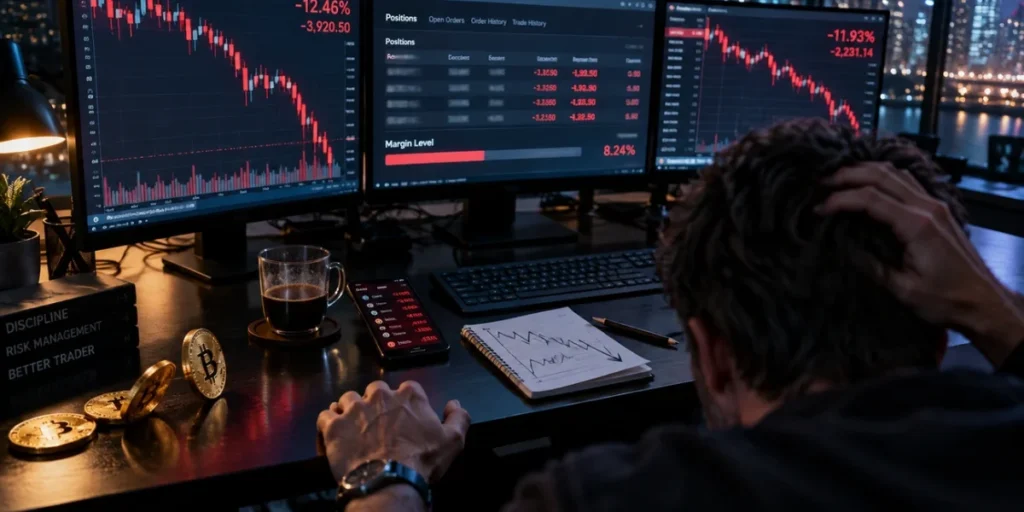
Forced position closures push prices far enough to trigger the next closure, and the next. Each liquidation is mechanical, an exchange closing a trader’s position because their margin dropped below the required maintenance level, but strung together, a few thousand of them can move a market more in minutes than days of ordinary trading would.
A crypto liquidation cascade is a chain reaction of forced automated asset sell-offs. It occurs when declining asset prices trigger liquidations, which further depress prices and cause subsequent liquidations across the market. The process relies on automated smart contracts that continuously monitor the health of every leveraged position. When collateral value drops and pushes the loan-to-value ratio above the protocol limit, the smart contract automatically initiates a liquidation.
Margin calls and liquidations represent two distinct stages in risk management. A margin call is a warning notification issued when a trader’s margin ratio approaches the liquidation threshold but has not yet reached it. This gives traders advance warning and time to deposit additional collateral or reduce position size. Liquidations, by contrast, are automatic enforcement actions that remove trader control entirely.
What Is a Crypto Liquidation?

Crypto liquidation is an auto-enforced close-out of a trader’s leveraged position when insufficient collateral remains to maintain the margin requirements. Unlike voluntary trade closures where traders retain some capital, liquidation is an automated risk management measure that typically results in the loss of the original deposit. This mechanism applies exclusively to leveraged trading. Holders of Bitcoin, Ethereum, or other cryptocurrencies on spot exchanges without borrowed funds face no liquidation risk.
Initial Margin vs. Maintenance Margin Thresholds
Initial margin represents the minimum collateral required to open a leveraged position. Maintenance margin, by contrast, sits at a lower threshold and defines the minimum balance needed to keep that position open. An exchange might require 10% initial margin to open a trade but trigger liquidation once equity falls to 5%. This gap between the two thresholds determines how much adverse price movement a position can absorb before automatic closure.
On major derivatives exchanges such as Bybit, Binance, and OKX, maintenance margin rates typically range from 0.4% to 2% for major cryptocurrencies. Traditional market regulators set minimum maintenance margin requirements at 25% of total market value for securities bought on margin, though crypto exchanges operate with tighter thresholds due to the asset class’s distinct characteristics.
Why Forced Exits Occur in Crypto Derivatives
Leverage amplifies both gains and losses by allowing traders to control positions larger than their deposited capital. When a market moves against a leveraged position, losses erode the margin balance. Once this balance drops below the maintenance threshold, the exchange’s liquidation engine activates. Volatility compounds this risk substantially. Crypto’s elevated volatility creates rapid price swings that can quickly push an account’s margin into negative territory. Exchanges liquidate positions to protect themselves from losses they cannot recover, closing trades automatically before the trader’s debt exceeds their collateral.
How Exchange Liquidation Engines Execute Trades

Liquidation engines monitor every open position continuously, sampling mark price against margin thresholds in real-time. When the mark price breaches the liquidation level, the engine executes a takeover protocol: the position transfers to the exchange’s automated system, which attempts to close it immediately through market orders.
Mark Price vs. Index Price: Preventing Whipsaw Triggers
Mark price represents a weighted average of prices across multiple exchanges, designed to prevent manipulation on a single venue. Bybit and other major platforms use this dual-price mechanism specifically because liquidation triggered by last traded price would expose traders to order book manipulation. The index price aggregates spot market values from multiple exchanges to establish broader market consensus. Mark price then incorporates both the index and short-term market dynamics, including a moving average of the basis between contract and index. This construction prevents temporary spikes from triggering unnecessary liquidations whilst maintaining fair valuation.
The Role of Automated Liquidator Bots and Market Orders
Once triggered, liquidation engines execute positions at the best available market price. Some exchanges employ partial liquidation, closing only enough of the position to restore margin above maintenance requirements. Others use full liquidation, closing the entire position for speed and finality. Phemex’s engine processes 300,000 transactions per second with sub-millisecond latency, slicing large orders into smaller pieces to reduce market impact.
Exchange Insurance Funds and Auto-Deleveraging (ADL)
When liquidation execution fails to cover losses before initial margin depletion, insurance funds absorb the shortfall. These reserves, funded by trading fees and liquidation penalties, prevent negative balances from spreading. Auto-deleveraging activates when insurance fund drawdowns exceed specified thresholds. Bybit triggers ADL when 8-hour drawdowns reach 30% of peak fund balance. The system then closes profitable opposing positions, ranked by leveraged return, to offset liquidation losses.
The Mechanics of a Liquidation Cascade

When leveraged positions cluster at similar price levels, the preconditions for systemic unwinding lock into place. A single price movement can initiate a self-reinforcing sequence where each forced closure generates market orders that push price into the next cluster’s threshold.
High Open Interest and Concentrated Leverage Traps
High open interest paired with elevated average leverage creates fragile market structure. Liquidation prices of numerous traders sit compressed near current market price, requiring minimal adverse movement to trigger sequential failures. Large liquidation waves consume substantial liquidity reserves. For this reason, high open interest at multi-month peaks combined with extreme funding rates signals elevated mean-reversion risk.
How Order Book Slippage Fuels Systemic Price Shifts
Forced liquidations generate massive simultaneous sell pressure that collapses order book depth. In reality, slippage during these events creates a feedback loop where forced selling generates additional slippage, which triggers further crypto market liquidations. Price movements from liquidated collateral demonstrate persistence, with 38.7% of the impact enduring medium-term. This lasting effect causes other loans using identical collateral to fall undercollateralised, perpetuating the cascade.
Managing Liquidation Risk Across Market Cycles
Distance to liquidation determines survival duration in adverse market conditions. The relationship between leverage and liquidation threshold is mathematically precise: 2x leverage liquidates at approximately 50% price drop, 10x at 10%, and 100x at just 1% movement. Maintenance margin rates on major exchanges range from 0.4% to 5% depending on position tier, which tightens the actual liquidation point beyond the textbook formula.
Calculating Distance to Liquidation and Position Sizing
For long positions using isolated margin, liquidation price equals entry price multiplied by (1 minus 1 divided by leverage plus maintenance margin rate). Conservative position sizing allocates 1-2% of total portfolio to any single trade, creating a buffer where liquidation sits well beyond the stop-loss trigger. Specifically, if a stop-loss sits 2% below entry, liquidation should rest at 5% or lower, limiting maximum leverage to approximately 20x.
Dynamic position sizing adjusts risk parameters as market character shifts. When ATR expands, position quantity must contract to maintain consistent risk exposure. Overleveraging magnifies both execution risk and emotional stress, particularly during volatility spikes that widen spreads and thin order book depth.
Macro Volatility and the Bitcoin 4-Year Cycle
Bitcoin’s traditional four-year halving cycle may be transitioning into a more mature phase. Market capitalisation growth from billions to over $3 trillion has coincided with declining volatility. The October 2025 peak registered as the calmest top on record, with only two of eleven classic warning indicators reaching prior-top levels. Institutional holders now control over 1.2 million BTC, whilst spot ETPs hold 1.3 million, representing 6.4% of circulating supply. This structural shift dampens the 80% drawdowns characteristic of earlier cycles.
Conclusion – Crypto Liquidation
Liquidation cascades represent systematic risk that demands respect and preparation. Understanding the mechanics behind forced closures, the distinction between initial and maintenance margins, and the automated systems that execute these trades provides traders with essential knowledge. By contrast, ignoring these mechanisms leaves positions vulnerable to sudden market shifts. Conservative position sizing, calculated distance to liquidation thresholds, and awareness of concentrated leverage clusters form the foundation of sustainable derivatives trading in volatile crypto markets.
What is the difference between a margin call and liquidation in crypto trading?
A margin call is a warning notification issued when your margin ratio approaches the liquidation threshold, giving you time to add more collateral or reduce your position size. Liquidation, however, is an automatic enforcement action that forcibly closes your position when your collateral falls below the maintenance margin requirement, removing all trader control.
How can I avoid getting liquidated when trading crypto futures?
To avoid liquidation, use conservative position sizing (allocating only 1-2% of your portfolio per trade), maintain a safe distance between your entry price and liquidation price by limiting leverage, set stop-losses before entering trades, and consider hedging your positions during volatile market conditions. Always ensure your liquidation price sits well beyond your stop-loss trigger.
What is a liquidation cascade and why is it dangerous?
A liquidation cascade is a chain reaction where declining prices trigger forced liquidations, which create additional selling pressure that pushes prices lower and triggers more liquidations. These cascades are particularly severe in crypto because liquidations are fully automated, markets operate 24/7, and many traders use high leverage with thin margins, allowing billions to be wiped out within hours.
How do exchanges determine when to liquidate a position?
Exchanges use automated liquidation engines that continuously monitor the mark price (a weighted average across multiple exchanges) against your maintenance margin threshold. When the mark price breaches your liquidation level, the system automatically takes over your position and closes it through market orders to prevent losses from exceeding your collateral.