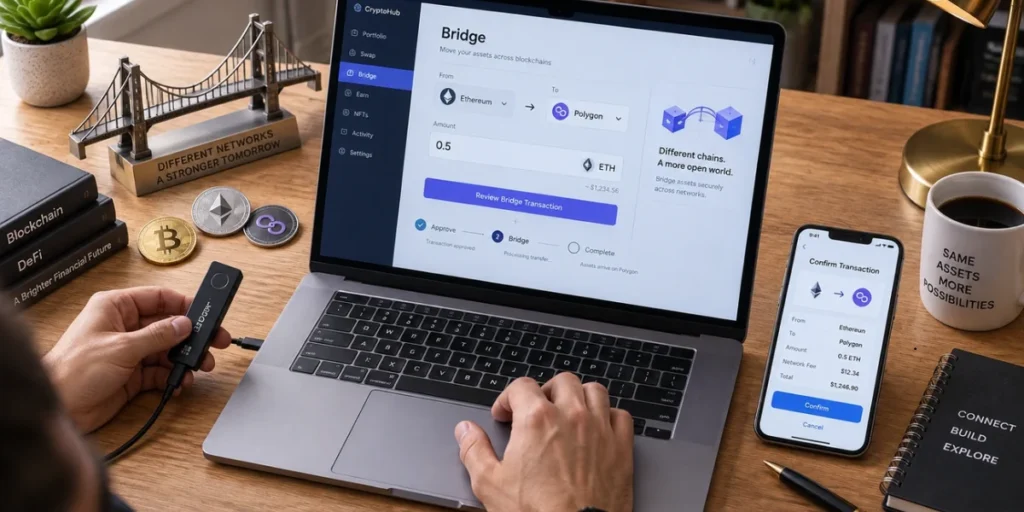
Understanding how do crypto bridges work is crucial for anyone navigating today’s multi-chain cryptocurrency landscape. Blockchains such as Ethereum, Solana, Arbitrum, and Polygon operate as isolated networks, each with unique advantages. Whilst one network might offer ultra-fast transactions and lower gas fees, another might host specific decentralised applications users want to access.
Crypto bridges solve this isolation problem. A crypto bridge (also known as a cross-chain bridge) is a protocol that enables communication and token transfer between otherwise isolated blockchains. Bridging in crypto refers to the process of transferring assets between different blockchain networks, enabling users to move assets from Ethereum to Solana, Base, Polygon, and more. This guide breaks down exactly how crypto bridges work and walks beginners through the complete bridging process.
Understanding How Crypto Bridges Work

The Basic Concept Behind Bridging
Crypto bridges don’t physically move assets between blockchains. Instead, they operate through smart contracts that lock assets on one network whilst creating equivalent representations on another. When transferring Bitcoin to Ethereum, the bridge locks the original BTC in a smart contract and issues wrapped Bitcoin (WBTC) on Ethereum in return. This wrapped token mirrors the value of the locked asset and functions as a native token on the destination blockchain.
Asset Locking on Source Chain
The bridging crypto process begins when a user sends tokens to a bridge contract on the source blockchain. These assets are held securely in custody, either by a smart contract, multi-signature wallet, or a combination of both. The locking mechanism effectively removes these tokens from circulation on the source chain. Bridge validators or relayers then observe this lock transaction and verify it has reached sufficient finality before proceeding. This verification step prevents double-spending if the source chain reorganises.
Token Minting on Destination Chain
Once the bridge contract registers the deposit on the source chain, it sends a secure message to its counterpart on the destination blockchain. Upon receiving this message, the destination chain contract executes a mint function that creates new tokens. These wrapped tokens represent a claim on the locked collateral and can be used seamlessly within the destination chain’s ecosystem. For instance, WBTC operates as an ERC-20 token on Ethereum, allowing holders to trade, swap, or use it in decentralised applications.
The Unwrapping Process
To retrieve original assets, users send wrapped tokens back to the bridge contract on the destination chain. The contract burns these tokens, removing them from circulation. After registering the burn, the destination chain sends a confirmation message to the source chain. The source chain bridge contract then unlocks the original assets and returns them to the user’s designated address. This burn-and-unlock mechanism maintains supply consistency across both networks.
Different Methods Bridges Use to Transfer Assets
Traditional Lock-and-Mint Systems
Three primary mechanisms facilitate cross-chain transfers in traditional bridge designs. Lock-and-mint involves locking assets on the source chain whilst minting wrapped versions on the destination chain. Burn-and-mint removes assets from the source chain entirely, then mints equivalent tokens on the destination chain. Atomic swaps exchange assets directly between parties on different chains without intermediaries.
Lock-and-mint bridges create wrapped tokens that expose decentralised finance protocols to smart contract risks, potentially leading to undercollateralised assets. Each bridge mints different wrapped versions of the same underlying asset, fragmenting liquidity across the ecosystem. Token issuers face reduced transparency when tracking their assets across multiple chains.
Liquidity Pool-Based Bridges
Liquidity pool-based bridges maintain token reserves on both source and destination blockchains. Users lock tokens in the source chain pool and unlock equivalent amounts from the destination chain pool. Liquidity providers receive incentives such as fee sharing to maintain pools on both sides, making this approach less capital-efficient than other methods. The amount transferable depends entirely on destination pool holdings, requiring constant rebalancing as funds flow directionally.
Message-Passing Protocols
Generalised message passing bridges transfer assets alongside arbitrary data and smart contract instructions across chains. The source chain encodes actions as cryptographically signed messages, which relayers carry to the destination chain. Light clients on the destination chain verify messages against source chain block headers using Merkle proofs before executing corresponding actions. Protocols like Axelar, LayerZero, and Wormhole implement variations of this architecture.
Intent-Based Bridge Technology
Intent-based bridges reverse traditional execution order. Users deposit assets into escrow contracts and submit signed intent messages specifying desired outcomes. Competing solvers immediately provide equivalent assets on the destination chain using their own capital, delivering transfers within seconds. The protocol verifies fulfilment asynchronously and releases escrowed assets to reimburse solvers only after confirmation.
Choosing the Right Type of Bridge

Centralised vs Decentralised Bridges
Bridge architecture falls along a spectrum between trusted and trustless models. Centralised bridges depend on validator sets or central operators who control transaction verification and asset custody. Users relinquish control of their assets during transfers, relying on the operator’s reputation and security protocols. Decentralised bridges eliminate intermediaries through smart contracts and algorithms, allowing users to maintain custody throughout the process. The security of trustless bridges mirrors that of underlying blockchains, whereas trusted bridges introduce additional risks including censorship and custodial vulnerabilities.
Speed and Cost Considerations
Transfer speed varies from under one minute to seven days depending on bridge type. Intent-based bridges like Across Protocol and Orbiter Finance complete transfers in one to three minutes. Native rollup bridges require seven-day withdrawal delays for maximum security, though deposits from Ethereum to Layer 2 networks settle within 10 to 15 minutes. Fee structures range from 0.01% for small transfers on Orbiter Finance to flat percentages around 0.06% on Stargate. For transfers exceeding AUD 15,289.90, native bridges or Stargate offer optimal cost efficiency.
Security Trade-offs
Architecture determines exploit risk more reliably than audit count or team reputation. Over AUD 3.06 billion has been lost to bridge exploits historically. Native rollup bridges inherit Ethereum’s security model without introducing additional trust assumptions. Third-party bridges carry smart contract risks despite extensive audits. Intent-based architectures present structurally lower risk than liquidity pools, which carry lower risk than lock-and-mint designs based on historical exploit patterns through mid-2026.
Supported Chains and Tokens
Most bridges handle EVM-compatible chains effectively. For non-EVM destinations including Solana, Aptos, Sui, and Cosmos chains, Wormhole supports over 20 networks. Chain coverage and token availability require verification before initiating transfers. Native bridges provide canonical token representations, whilst third-party bridges may create competing wrapped versions that fragment liquidity.
Complete Beginner’s Guide to Bridging Crypto
Preparing Your Wallet for Bridging
At first, users must ensure their wallet holds sufficient native tokens for gas fees on the source chain.
Related Article: How to Set Up a Crypto Wallet in 2026: A Step-by-Step Guide for Beginners
Step 1: Select Your Bridge Service
Bridge selection requires verifying support for both source and destination chains alongside the specific token being transferred. Native bridges (Arbitrum Bridge, Optimism Bridge, Base Bridge) charge zero protocol fees, whilst third-party options like Across Protocol, Stargate, and Orbiter Finance offer faster speeds with fees ranging from 0.01% to 0.25%.
Step 2: Connect Your Wallet
Users click “Connect Wallet” on the bridge interface, select their wallet provider from the options displayed, and approve the connection request. The wallet must be set to the correct source blockchain before proceeding.
Step 3: Choose Networks and Token
After selecting the source network, users specify the destination chain and token. Bridges display available assets based on wallet balances.
Step 4: Enter Transfer Amount
Users input the desired transfer quantity. Minimum thresholds apply on certain bridges, and transactions fail if amounts are lower than network fees.
Step 5: Check Fees and Estimated Time
Bridge interfaces display network transaction fees, protocol fees, and estimated completion times. Standard transfers complete within 10 to 20 minutes, whilst optimistic rollup withdrawals require up to 7 days.
Step 6: Approve and Execute Transaction
For ERC-20 tokens, users sign an approval transaction granting the bridge contract spending permission before executing the main transfer. Native assets skip this step. After confirming details, users sign the deposit transaction.
Step 7: Monitor Transfer Status
Transaction history within the bridge interface or wallet activity tab tracks transfer progress. Block explorers on both chains provide independent verification using transaction hashes.
Conclusion – How do Crypto Bridges Work
Crypto bridges have become essential infrastructure for navigating the multi-chain ecosystem. Understanding the different bridge types, their security models, and fee structures empowers users to make informed decisions when transferring assets between blockchains.
The bridging process itself remains straightforward: connect a wallet, select networks, review fees, and execute the transaction. With proper preparation and careful bridge selection, anyone can safely move assets across chains and access opportunities throughout the decentralised finance landscape.
You May Also Be Interested In: Fintech Explained: How Technology Is Reshaping Money, Banking, and Payments
What exactly happens to my cryptocurrency when I use a bridge?
Your original cryptocurrency doesn’t physically move between blockchains. Instead, it gets locked in a smart contract on the source blockchain, and an equivalent wrapped version is created (minted) on the destination blockchain. This wrapped token represents a claim on your locked assets and functions like a native token on the new network.
How long does it typically take to bridge crypto between different blockchains?
Transfer times vary significantly depending on the bridge type you use. Intent-based bridges can complete transfers in one to three minutes, whilst standard transfers typically take 10 to 20 minutes. However, native rollup bridges withdrawing from Layer 2 networks back to Ethereum can require up to seven days for maximum security.
Are crypto bridges safe to use, and what are the main risks?
Bridge security depends heavily on the architecture used. Native rollup bridges inherit Ethereum’s security model and are generally safest, whilst third-party bridges carry smart contract risks despite audits. Historically, over AUD 3.06 billion has been lost to bridge exploits. Intent-based architectures present lower risk than liquidity pool designs, which are safer than traditional lock-and-mint systems.
What fees should I expect when bridging cryptocurrency?
Bridge fees vary by platform and transfer amount. Protocol fees typically range from 0.01% to 0.25% of the transfer amount, with some bridges like Orbiter Finance charging as low as 0.01% and others like Stargate around 0.06%. Additionally, you’ll need to pay network gas fees on the source blockchain. Native bridges often charge zero protocol fees but may take longer to complete transfers.
Can I bridge any cryptocurrency to any blockchain network?
No, bridge compatibility is limited. Most bridges handle EVM-compatible chains effectively, but you must verify that your chosen bridge supports both your source and destination blockchains, as well as the specific token you want to transfer. For non-EVM networks like Solana, Aptos, or Cosmos chains, you’ll need specialised bridges such as Wormhole, which supports over 20 different networks.