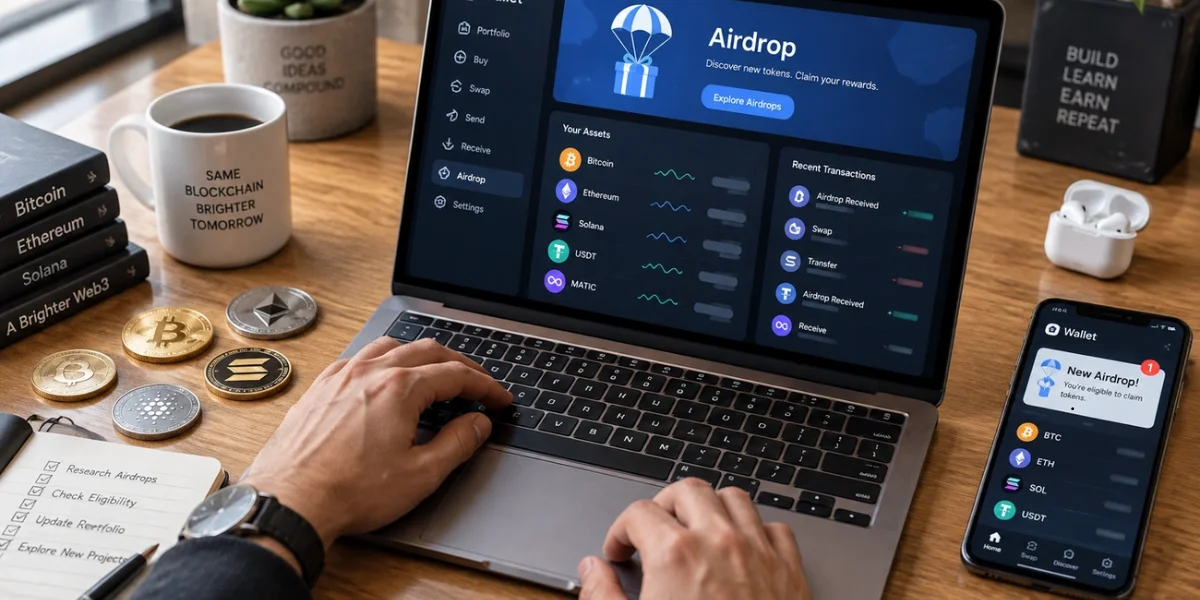
A crypto airdrop is a marketing strategy where blockchain projects distribute free tokens to wallet addresses, raising awareness and adoption of new projects. Since 2017, over 3,793 airdrops have been tracked, with notable examples like Uniswap distributing 400 UNI tokens to early users in 2020. Understanding how does airdrop work is essential for anyone seeking airdrop cryptocurrency opportunities. This guide explains eligibility requirements, the claiming process for free crypto airdrop events, tax implications of receiving tokens, and how to use airdrop checker tools whilst avoiding scams.
What Is a Crypto Airdrop and How Does Airdrop Work
Free Token Distribution Explained
Blockchain projects execute crypto airdrop events through unsolicited distribution of tokens or coins to numerous wallet addresses. Recipients receive these digital assets without prior request, distinguishing airdrops from traditional purchase mechanisms. The value delivered to individual recipients varies significantly, ranging from fractions of a cent to 6-figure sums, though distributions typically skew toward the lower end of the spectrum.
Projects send coins or tokens only to specific wallets based on predefined criteria tied to the blockchain network or existing holdings. The distribution occurs either automatically through smart contracts or requires manual claiming through dedicated portals. In view of technical execution, projects often use Treasury wallets to facilitate transfers and publicise transaction blocks to demonstrate fairness in the allocation process.
The term originates from military operations where supplies drop from aircraft to ground forces. In another case, the cryptocurrency context transformed this concept into digital token distribution, creating a novel economic mechanism for user acquisition and ownership decentralisation.
Strategic Purpose Behind Airdrops
Projects deploy airdrop cryptocurrency distributions to solve a fundamental question: who should hold the token? Selling entire supplies to investors concentrates ownership amongst small groups, whilst distributing portions to active users spreads control across broader communities.
Decentralisation forms a primary objective for many distributions. Governance tokens grant holders voting rights on protocol changes, treasury spending, and fee structures. Protocols whose tokens remain with founders and venture investors are decentralised in name only. Spreading tokens across thousands of independent wallets establishes credible claims that control is genuinely distributed.
Liquidity bootstrapping drives another strategic purpose. Exchanges, lending markets, and bridges remain useless when empty. Nobody trades where liquidity is absent, and nobody supplies liquidity without trading activity. Token rewards compensate early participants who absorb the unrewarding initial period.
Marketing represents a parallel motivation. Traditional startups spend cash on advertisements, conversely, token projects spend tokens instead. This preserves cash reserves, though analysis of the Uniswap distribution estimated that airdrops can cost several times more per acquired user than conventional sales and marketing spending.
Rewarding loyal community members generates passion and appreciation. Projects use free crypto airdrop events to spark enthusiasm amongst existing holders, potentially reducing sell pressure and maintaining price stability.
Blockchain Snapshot Mechanism
Snapshot-based distributions capture blockchain state at predetermined moments. Projects record wallet addresses and balances at specific block heights or timestamps, creating an immutable record of eligibility. The snapshot process captures user activity data, including transaction history, token holdings, and platform interactions.
Teams define criteria before execution, determining what counts toward qualification. Past transactions, volume traded, liquidity provided, assets bridged, NFT holdings, or earned points may all factor into eligibility. Criteria often remain secret until after snapshot completion to prevent gaming behaviour.
Activity occurring after the snapshot moment typically does not count toward distribution. Projects frequently announce snapshot dates only after they pass, preventing participants from manipulating eligibility through last-minute actions. According to the process, teams then apply Sybil filtering to remove addresses believed to belong to single individuals operating multiple wallets, regularly eliminating large portions of applicants.
Smart contracts execute the actual distribution once the project confirms eligibility. Distribution may occur instantaneously or in stages depending on project design. Some implementations require users to manually claim tokens within set timeframes through airdrop checker tools and claim portals, with unclaimed allocations potentially reallocated if windows expire.
Related Article: Smart Contract Development: What Every Developer Gets Wrong About Security
Eligibility Requirements for Crypto Airdrops

Qualification criteria differ dramatically across projects, with some requiring minimal engagement whilst others demand extensive participation across multiple dimensions. Projects establish rules that may include transaction thresholds, temporal requirements, and behavioural scoring models designed to identify genuine users rather than opportunistic farmers.
Wallet Activity and Transaction History
Transaction patterns form the foundation of most airdrop cryptocurrency eligibility frameworks. For instance, Arbitrum established minimum criteria requiring users to bridge funds into Arbitrum One, conduct transactions for at least two distinct months, complete more than four transactions or interact with more than four different smart contracts, conduct transactions exceeding AUD 15,289.90 in value, and bridge more than AUD 15,289.90 of assets into the network. Each fulfilled criterion awarded one point, with three points yielding 1,250 Arbitrum tokens worth approximately AUD 2,446.38, whilst 12 or more points delivered 10,250 tokens valued at approximately AUD 20,641.37.
In like manner, ZKsync required interaction with at least 10 non-token smart contracts over 30 days, use of paymasters for at least five transactions, trading at least 10 different assets on partnered decentralised exchanges, depositing assets to provide liquidity on partnered DeFi protocols, holding at least one Libertas Omnibus NFT, remaining active for at least three months on ZKsync Lite, and donating to Gitcoin. The maximum allocation reached 100,000 ZKsync tokens worth approximately AUD 32,108.79.
Consistency matters more than volume in many distributions. Projects measure active days, total transaction count, and variety of actions such as swapping combined with liquidity provision and staking. Bridging assets alone frequently proves insufficient, as protocols reward wallets that bridge and subsequently swap, stake, or otherwise utilise the transferred assets.
Token Holdings and Minimum Balances
Holding specific tokens in compatible wallets automatically qualifies participants for certain distributions. Projects often specify minimum token balances required during snapshot periods. Some airdrops reward holders proportionally based on quantities held, whilst others apply threshold systems where meeting minimum requirements triggers fixed allocations.
Wallet type significantly affects eligibility. Most projects require self-custodial wallets where users control private keys, as compatible wallets must support the specific blockchain network hosting airdrop tokens. Consequently, exchange wallets typically disqualify users since individuals lack direct control over these addresses. CEX-routed transactions likely fail to qualify when projects require self-custody activity via MetaMask, Trust Wallet, or similar non-custodial wallets.
Platform Engagement and Governance Participation
Behavioural scoring models increasingly evaluate frequency of interaction, duration of engagement, cross-protocol activity, and community participation. Active forum participants who contribute feedback in structured discussions and assist new members may receive preferential weighting compared to silent liquidity providers. Discord participation, governance forum activity, community contribution, and educational outreach signal alignment beyond transactional extraction.
Many airdrops require engagement with projects on social media platforms including Twitter, Facebook, or LinkedIn through following official accounts, retweeting, liking, commenting, or sharing posts.
Geographic and KYC Restrictions
KYC verification procedures increasingly accompany distributions to ensure regulatory compliance and prevent fraudulent activities. Users typically provide identification documents, proof of address, and other relevant information. Some airdrops exclude users from certain countries due to regulatory restrictions.
Nevertheless, Sybil filtering algorithms detect addresses linked to coordinated farming behaviour, regularly disqualifying wallets that satisfy stated rules. Geographic exclusions embedded in distribution terms, dust-threshold rules that eliminate wallets below minimum activity floors, and incompatible contract wallets further restrict eligibility.
Step-by-Step Airdrop Claiming Process

Claiming airdrop cryptocurrency requires methodical execution across five distinct stages, each presenting security considerations that determine whether participants receive tokens or lose existing holdings.
Setting Up a Compatible Self-Custodial Wallet
Self-custodial wallets form the mandatory foundation for crypto airdrop participation. Wallet configuration demands strong security practises including two-factor authentication where available. Seed phrases and private keys must never be shared, as legitimate projects never request these credentials.
Creating separate wallets for different activities compartmentalises risk and organises airdrop participation. A dedicated claim wallet funded with just enough for gas fees contains damage if something goes wrong, whereas main wallets holding actual holdings should never touch claim sites.
Monitoring Airdrop Announcements
Tracking upcoming distributions occurs through dedicated platforms and community resources. Following project social media accounts delivers official announcements, especially when notifications are enabled for actively used projects.
URL discovery must occur through official sources rather than search results or unsolicited messages. Finding announcement links directly from verified Twitter accounts or official websites eliminates the majority of wallet drainer attacks. Typing URLs manually into browsers rather than clicking forwarded links prevents redirection to malicious domains.
Connecting Your Wallet to Claim Pages
Legitimate projects allow pasting public wallet addresses to check eligibility without wallet connection. Sites requesting wallet connection merely to verify qualification present red flags.
Verifying domain authenticity character by character against official announcements prevents phishing attacks. Bookmarking official URLs after initial verification streamlines future claims whilst maintaining security.
Verifying Smart Contract Permissions
Transaction approval requests require scrutiny before confirmation. Hardware wallet device screens display actual contract addresses, approval scopes, and destinations independent of browser displays. Checking whether approval amounts are limited to airdrop tokens or request unlimited spend determines legitimacy.
Contract addresses must match official project announcements. Within 24 hours of claim sessions, visiting Revoke.cash to audit active approvals and revoke unnecessary permissions closes potential attack vectors.
Managing Gas Fees During Claims
Airdrops operate on pull models where users call functions to claim allocations, paying gas themselves for transfers. Sufficient native tokens must exist in wallets to cover transaction costs, which vary with network congestion. Reviewing transaction details including recipient addresses, token contracts, and gas fees before signing prevents costly errors.
Tax Implications of Receiving Airdrop Cryptocurrency

Receiving tokens through crypto airdrop distributions creates immediate tax obligations in most jurisdictions, with consequences that persist through eventual disposal. Tax authorities classify airdrops differently based on circumstances of receipt, requiring participants to understand when liabilities arise and how to calculate them accurately.
When Airdrops Become Taxable Income
Airdrops are typically not taxable until recipients gain control over tokens. Control manifests when individuals can trade, sell, or transfer assets freely. If the airdrop follows a locked or vesting schedule, taxation does not occur until tokens become accessible and tradeable.
The Australian Tax Office treats most airdrops as ordinary income at fair market value when received. For instance, receiving 300 tokens valued at AUD 3.50 each requires reporting AUD 1,050 as income regardless of whether the distribution was solicited. In the United States, crypto airdrops are considered income as part of Federal income tax returns, recognised at fair market value when received.
Nevertheless, initial allocation airdrops receive different treatment. These distributions occur during project launches where tokens have not traded prior to the airdrop. The receipt is not taxable as income, with cost basis set at zero if received for free or the amount paid to acquire them. Capital gains tax still applies when these tokens are sold or disposed of.
Fair Market Value Assessment
Market value determination uses pricing from major digital currency exchanges or other reliable sources at the precise moment of receipt. This figure establishes both taxable income for ordinary airdrops and cost basis for future capital gains calculations. Tokens without determinable market value at receipt, such as newly minted coins lacking trading history, carry nil valuations for income tax purposes.
Reporting Requirements by Jurisdiction
Reporting varies significantly across locations. Australian residents include airdrop market value in annual income tax returns under ‘Other Income’. United Kingdom residents face income tax only if they performed actions to earn airdrops, otherwise receipt incurs no immediate tax. Canadian taxpayers receiving genuinely unsolicited airdrops may classify them as non-taxable windfalls with nil cost basis, deferring tax until disposal. German tax authorities consider airdrops received without rendering services as tax-free inflows.
Capital Gains on Token Sales
Subsequent disposal of airdropped tokens triggers capital gains tax. The cost basis equals fair market value at receipt for tokens taxed as income, or zero for untaxed initial allocations. Holding tokens for more than 12 months may qualify for a 50% CGT discount in Australia.
Record-Keeping Best Practises
Tax compliance demands detailed records including market value of transactions, dates of acquisitions and disposals, and wallet addresses used. The ATO requires maintaining records for at least five years to support tax positions. Recording FMV of all received tokens on receipt dates, including amounts in annual returns, and maintaining transaction details for future CGT calculations fulfils compliance obligations.
Safety Measures and Avoiding Airdrop Scams
Scammers exploit free crypto airdrop popularity through sophisticated schemes designed to drain wallets or steal credentials, making defensive knowledge essential before claiming any distribution.
Identifying Legitimate Free Crypto Airdrop Opportunities
Genuine airdrops originate from established projects with official announcements via verified social media and project websites. Legitimate distributions never request private keys or seed phrases, require reasonable participation such as holding specific tokens or using protocols, display transparent tokenomics and smart contract details, and provide time-bound, clearly explained processes. A legitimate crypto airdrop never seeks capital investment, operating purely for promotional purposes.
Red flags include requests for advance payments to receive tokens, unsolicited direct messages offering airdrops, mandatory token purchases before claiming, and extreme urgency creating artificial time pressure. Projects lacking online presence, minimal followers, or absent official websites signal potential fraud.
Related Article: Public Key vs Private Key: What’s the Difference and How They Work Together [2026]
Never Share Seed Phrases or Private Keys
Seed phrases grant complete and irrevocable wallet control. Anyone obtaining this information can import wallets on their devices and transfer every asset without requiring phones, passwords, or biometric authentication. No legitimate project, support team, or airdrop ever requires seed phrases for verification. Sharing these credentials results in immediate, irreversible fund loss.
Using Airdrop Checker Tools and Verified Platforms
AirdropAlert has tracked legitimate opportunities since 2017, helping users claim hundreds of millions in value whilst avoiding scams. Read-only checkers function without wallet connections, requiring only public address input to scan eligibility across multiple networks. These platforms verify airdrops before listing, providing basic curation.
Recognising Phishing and Drainer Sites
Drainer contracts authorise theft through malicious transaction signatures, not through brute-force attacks. Scammers create fake claim sites cloning legitimate portal designs but redirecting approvals to drain wallets. Phishing campaigns surrounded the Arbitrum airdrop with 273 fraudulent sites in March 2023. Dusting scams send micro amounts to track transactions and link wallets to identities before stealing funds. Verifying domains against official sources and checking registration dates closes primary attack vectors.
Conclusion – Crypto Airdrop
Crypto airdrops represent powerful distribution mechanisms that reward early adopters and bootstrap protocol adoption. Recipients must understand eligibility criteria spanning transaction history, token holdings, and platform engagement to maximise opportunities. The claiming process demands methodical execution through self-custodial wallets whilst maintaining strict security protocols. Tax obligations arise immediately upon receipt in most jurisdictions, requiring accurate fair market value assessments and meticulous record-keeping. As a matter of fact, scammers exploit airdrop popularity through sophisticated phishing schemes and drainer contracts. Success requires participants to verify sources through official channels, never share seed phrases, and utilise airdrop checker tools. Armed with this knowledge, users can safely navigate distributions whilst avoiding costly mistakes that compromise wallet security.
You May Also Be Interested In: How to Buy Meme Coins in Australia: A Step-by-Step Guide for Beginners
What exactly is a crypto airdrop and why do projects distribute free tokens?
A crypto airdrop is when blockchain projects distribute free tokens to wallet addresses as a marketing strategy. Projects use airdrops to decentralise token ownership, reward early users, bootstrap liquidity on new platforms, and spread awareness. Rather than concentrating tokens amongst investors, airdrops distribute them across thousands of independent wallets, establishing genuine decentralisation and creating passionate community members.
Do I need to pay tax when I receive airdropped cryptocurrency?
In most jurisdictions, airdrops become taxable as ordinary income at their fair market value when you gain control over the tokens. For example, in Australia, receiving 300 tokens valued at AUD 3.50 each requires reporting AUD 1,050 as income. However, initial allocation airdrops from project launches may not be taxable until you sell them. When you eventually dispose of airdropped tokens, capital gains tax applies based on the difference between your cost basis and sale price.
What are the typical eligibility requirements to qualify for an airdrop?
Eligibility criteria vary significantly across projects but commonly include wallet activity such as completing a minimum number of transactions over several months, holding specific tokens in self-custodial wallets, interacting with smart contracts, bridging assets between networks, and providing liquidity. Some projects also consider governance participation, social media engagement, and community contributions. Exchange wallets typically disqualify users since you must control your private keys.
How can I safely claim an airdrop without getting scammed?
Always verify claim sites through official project announcements on verified social media accounts rather than clicking unsolicited links. Use read-only airdrop checker tools that only require your public wallet address to verify eligibility before connecting your wallet. Never share your seed phrase or private keys, as legitimate projects never request these. Check smart contract permissions carefully before approving transactions, and consider using a separate wallet funded with just enough for gas fees to limit potential losses.